
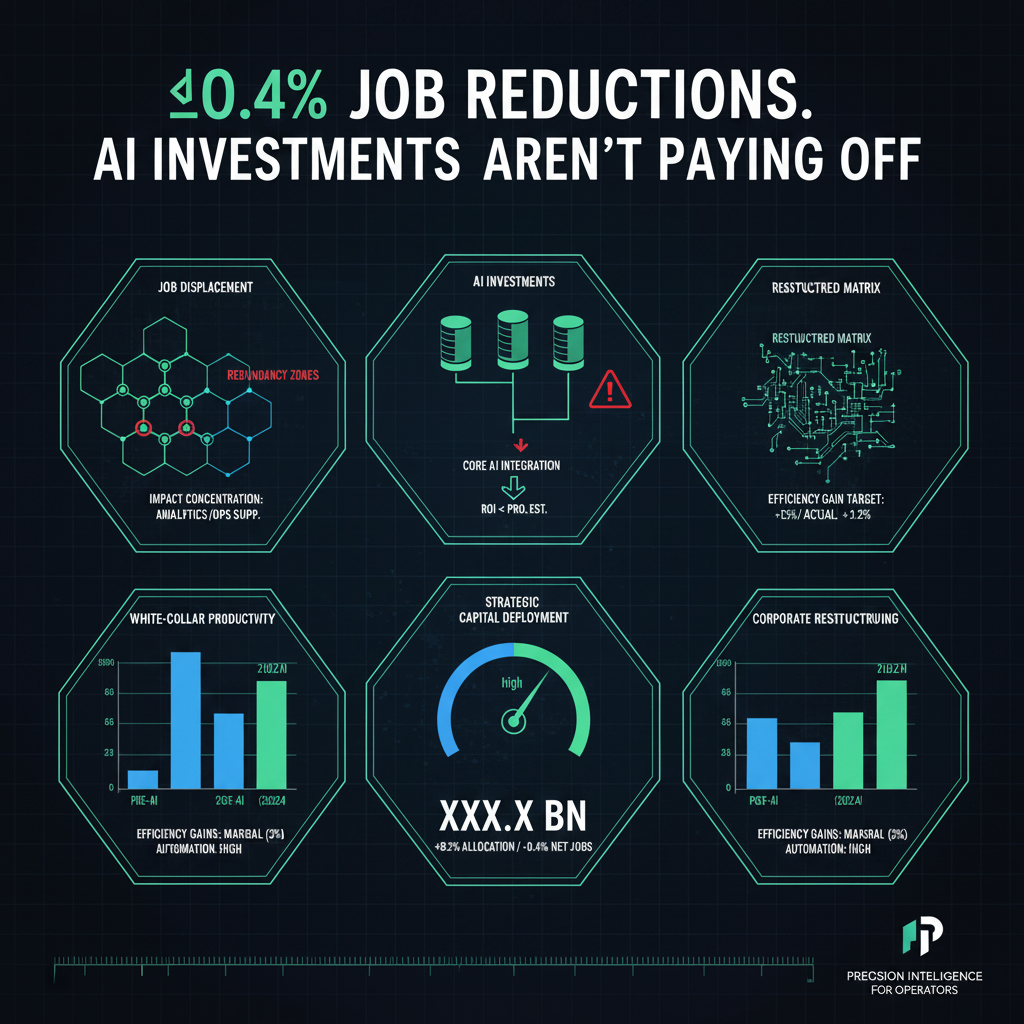
The AI job-apocalypse narrative is dead; companies are actively reducing headcount to fund AI investments, not because of them.
📊 11 episodes across 10 podcasts
⏱ 387 minutes of intelligence analyzed
🎙 Featuring: Zach Warren (Legal Insights and Strategy Lead, Thomson Reuters Institute), David Simon (Partner and Adjunct Faculty Member at University of Wisconsin Law School, Foley & Lardner), Brandon Germer (VP Analyst, Gartner), Karen Stokes Lockhart (Host, Gartner), Mark Smucker (CEO and Chair, The J.M. Smucker Company), Eric Zimmerman (Game Designer and Professor of Game Design, NYU Game Center), Alex Hardiman (Chief Product Officer, The New York Times), Julia Dhar (Managing Director and Partner, Founder of BCG's Behavioral Science Lab, Boston Consulting Group), Edward Rock (Martin Lipton Professor of Law and Director of the Institute for Corporate Governance & Finance, NYU School of Law), Peter Cappelli (Professor of Management, The Wharton School), Howard Marks (Co-founder and Co-chairman, Oaktree Capital Management), Michael Arougheti (Co-founder and CEO, Ares Management), Amanda Lynam (Chief Credit Strategist, Goldman Sachs Research), Ben Miller (Co-founder and CEO, Fundrise)
|

The Lead
The conversation around AI's impact on jobs is shifting from fear of automation to leveraging AI as a strategic lever for business transformation and talent optimization. Initially, the prevalent narrative suggested mass job displacement. However, new data and operational insights reveal a more nuanced picture. Companies are not laying off employees because AI is directly replacing their roles; instead, they are shedding headcount to reallocate funds towards significant AI investments.
This dynamic was clearly articulated by Peter Cappelli, Professor of Management at The Wharton School. He noted, "The thing we have heard now is a third explanation, and that is that the layoffs are because we need to save money to invest in AI." This reframing highlights that the current wave of corporate restructuring is less about AI's efficiency gains and more about funding the infrastructure and talent required for its future deployment.
"They report that AI has reduced jobs by 0.4%. So 4/10 of a percent."
— Peter Cappelli, Professor of Management at The Wharton School on This Week in Business
Further, the perceived threat of AI to "simple jobs" is also being debunked. Cappelli emphasized that "the big opportunity is really in white collar work. It's not so much in frontline work." This means the focus is shifting away from automating rote tasks in blue-collar sectors, towards enhancing productivity and strategic capabilities within white-collar roles. This creates a critical imperative for leadership to understand that AI is a capital expenditure requiring strategic investment, not merely a cost-cutting tool. The question for CTOs shifts: how do you strategically fund and deploy AI, and how do you redesign your workforce to capitalize on its enhancement of white-collar productivity, rather than merely fearing job displacement?
The Rundown
① Delaware's Corporate Lawmaking Process is Breaking Down.
Client pressure, particularly from Silicon Valley dual-class companies, has led to legislative amendments circumventing traditional review processes. (Edward Rock on The Voice of Corporate Governance)
→ The Operator Take: The politicization of corporate governance in a key jurisdiction like Delaware creates instability and could invite federal intervention, impacting long-term M&A and capital structuring strategies.
② Agentic AI Necessitates Cross-Functional Executive Leadership.
Scaling agentic AI requires a co-led approach involving the CIO, CFO, COO, General Legal Counsel, and CHRO, as existing risk and liability models are no longer fit for purpose. (Brandon Germer on Gartner ThinkCast)
→ The Operator Take: CIOs must actively build an AI Agent Council to formalize alliances, especially with the CHRO for job redesign, and adopt new liability philosophies for emergent AI behaviors.
③ Law Schools are Rapidly Integrating Generative AI.
The University of San Francisco School of Law has integrated generative AI into its first-year curriculum, preparing students for an evolving legal landscape where AI automates foundational tasks and demands tool agnosticism. (Johanna Kalb on Clarity)
→ The Operator Take: Law firms and legal departments should anticipate new hires with advanced AI proficiencies, necessitating a re-evaluation of junior legal roles and training programs to leverage these emerging skills.
④ Private Credit Market Faces Cracks Amid Rising Defaults.
High-profile defaults, valuation concerns, and AI disruption in the software industry are driving redemption requests in the private credit market. (Howard Marks on Exchanges)
→ The Operator Take: Private equity firms and corporate borrowers reliant on private credit should be prepared for stricter terms and reduced liquidity, and possibly explore alternative financing options as market pressures intensify.
⑤ The New York Times is Strategically Using Games for Subscriber Growth.
Digital games like Wordle are crucial for driving subscriber growth and audience engagement, with the goal of reaching 15 million subscribers by 2027 by funnelling users to their core journalism. (Alex Hardiman on Freakonomics Radio)
→ The Operator Take: Companies in content and media should evaluate ancillary engagement strategies, realizing that 'time well spent' products can act as powerful, non-exploitative subscription acquisition channels for core offerings.
The Stack
ON WATCH
• VCX (Fundrise Innovation Fund) 🆕: Fundrise's NYSE-listed fund for private market access defied expectations, surging 700% on day one due to its pure retail focus, suggesting a shift in how private markets can be accessed. (Ben Miller on Summation (formerly World of DaaS))
• AI governance in law firms: David Simon's new framework emphasizes that AI risk lies in the cognitive processes it replaces, not just the output, advocating for preservation of core human legal judgment. (David Simon on Clarity)
• Impact of AI on White Collar Labor and Real Estate 🆕: Ben Miller predicts AI will profoundly reshape real estate by influencing operational efficiency, asset valuation, and shifting office and residential patterns. (Ben Miller on Summation (formerly World of DaaS))
HEATING UP
• Agentic AI: AI has already reached parity with human experts in many enterprise functions, making inaction the biggest risk for CIOs. (Brandon Germer on Gartner ThinkCast)
• Modernizing legacy brands through cultural relevance: The J.M. Smucker Company adapts iconic brands like Jif and Folgers by inserting them into modern culture, often through unexpected partnerships and edgier slogans. (Mark Smucker on How Leaders Lead with David Novak)
• Behavioral Science (as applied to organizational change): 70% of organizational transformations fail due to behavioral factors, not strategy, emphasizing the need for leaders to bridge executive-employee perception gaps. (Julia Dhar on HBR IdeaCast)
COOLING OFF
• Non-Traded BDCs: Facing increased scrutiny and redemption requests due to high-profile defaults and liquidity concerns, revealing investor disappointment with their design features. (Amanda Lynam on Exchanges)
• AI's Impact on Job Replacement: While AI causes job chaos through redesign, only 0.4% of job reductions are directly attributed to AI, with many layoffs tied to funding AI investments rather than direct automation. (Peter Cappelli on This Week in Business)
The Bottom Line
The real AI play isn't about cutting costs; it's about strategic capital deployment and redesigning white-collar workflows, demanding leadership that understands both the balance sheet and behavioral science.
📖 Want the full episode breakdowns, guest details, and listen links?
Appendix
How Leaders Lead with David Novak: "#291: Mark Smucker, Chair and CEO, The J.M. Smucker Company – Understand the soul of your brand" · 56 min · Featuring Mark Smucker ▶ Listen
The CTO's Download: Listen for how a legacy CPG company approaches brand modernization and supply chain scaling, offering insights into operationalizing innovation even with established products.
Freakonomics Radio: "675. Has the New York Times Become a Games Company?" · 57 min · Featuring Eric Zimmerman ▶ Listen
The CTO's Download: This episode reveals how a traditional media company leveraged digital products and behavioral science to drive subscription growth, providing a case study in diversifying revenue through user engagement.
HBR IdeaCast: "The Leadership Skills That Make Transformation Stick" · 31 min · Featuring Julia Dhar ▶ Listen
The CTO's Download: Essential listening for any leader embarking on digital transformation, highlighting the importance of behavioral science in avoiding common pitfalls and fostering true ownership of change.
Clarity: "The increased importance of AI governance in law firms (AUDIO ONLY)" · 29 min · Featuring Zach Warren ▶ Listen
The CTO's Download: CTOs in regulated industries will find this valuable for understanding advanced AI governance frameworks that account for cognitive risk, not just output, informing how to deploy AI safely and strategically.
Gartner ThinkCast: "Scaling Agentic AI: Why CIOs Can't Go It Alone" · 28 min · Featuring Brandon Germer ▶ Listen
The CTO's Download: A clear call to action for CIOs to move beyond piloting, forming cross-functional executive councils to scale agentic AI and proactively address new liability and job redesign imperatives.
Clarity: "What does it really take to put AI inside a law school?" · 49 min · Featuring Natalie Runyon ▶ Listen
The CTO's Download: Provides a forward-looking perspective on how future talent is being trained with AI, offering insights into the skill sets to expect from incoming hires and how to integrate them into AI-first workflows.
The Voice of Corporate Governance: "The New Political Economy of Delaware Corporate Lawmaking with Professor Ed Rock" · 27 min · Featuring Edward Rock ▶ Listen
The CTO's Download: Strategic decision-makers should listen to understand the evolving landscape of corporate governance and its implications for M&A, regulatory risk, and shareholder rights in key jurisdictions.
This Week in Business: "AI’s Real Impact on Jobs and Productivity" · 14 min · Featuring Peter Cappelli ▶ Listen
The CTO's Download: A concise debunking of AI job apocalypse narratives, helping leaders reframe AI investments from cost-cutting to strategic productivity enhancement in white-collar functions.
Exchanges: "Cracks in Private Credit" · 25 min · Featuring Howard Marks ▶ Listen
The CTO's Download: Finance and M&A leaders should tune in to understand the emerging risks and liquidity pressures in private credit, informing capital allocation decisions and fundraising strategies.
The Indicator from Planet Money: "GameStop rejected, a troubling loan trend, and no to pre-IPO AI shares" · 9 min · Featuring Waylon Wong ▶ Listen
The CTO's Download: A quick listen for market and investment intelligence, featuring alerts on pre-IPO AI investment scams and economic indicators impacting consumer financial health.
Summation (formerly World of DaaS): "Fundrise CEO Ben Miller: VCX, Roaring Kitty's revenge, and AI killing the office" · 62 min · Featuring Ben Miller ▶ Listen
The CTO's Download: Valuable for understanding private market democratization, the impact of retail vs. institutional capital, and long-term predictions on how AI will reshape real estate and urban development.
