
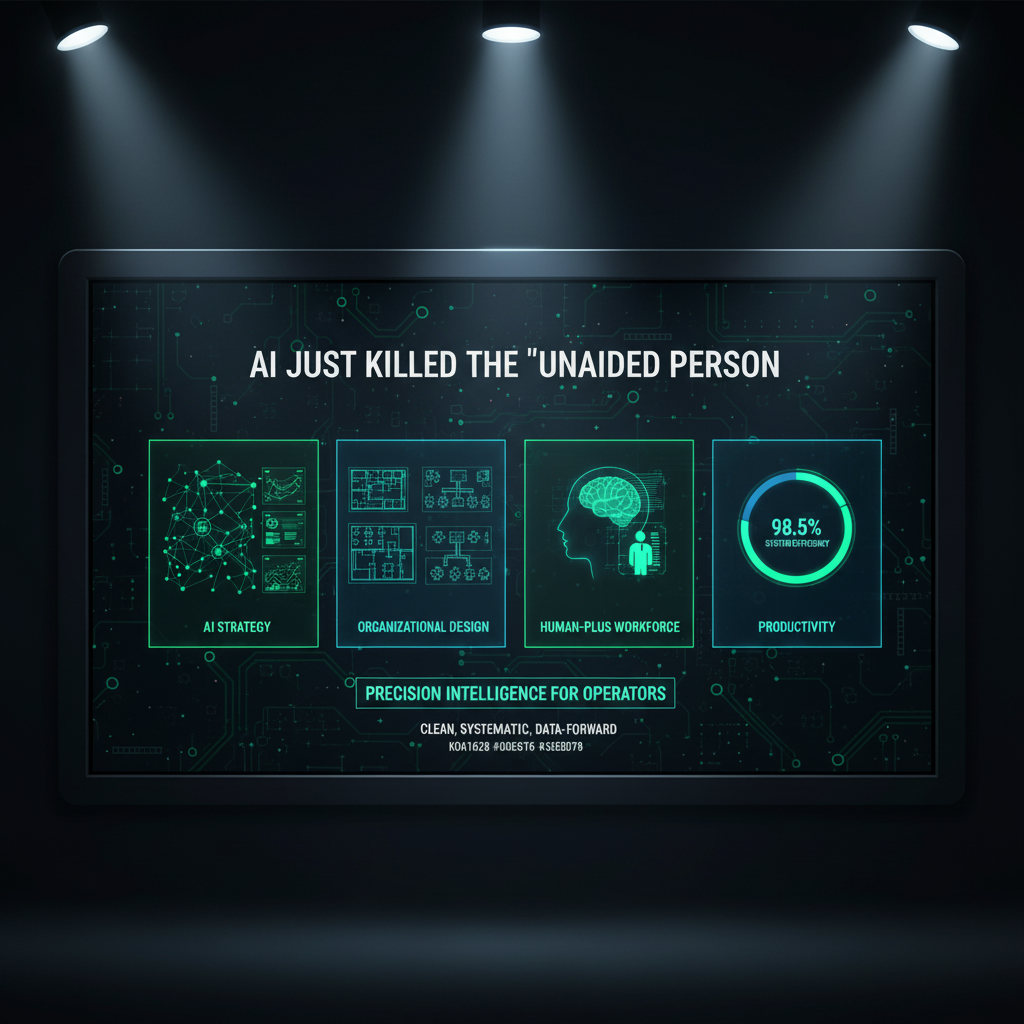
While everyone’s debating immediate AI ROI, the real strategic play is emerging: a quiet shift in core operating philosophy driven by “belief ahead of measurement” and an overhaul of the “basic unit of work” itself.
📊 11 episodes across 8 podcasts
⏱ 346 minutes of intelligence analyzed
🎙 Featuring: Dave Ritterbush, Daniel Diermeier, Juan Hernandez
|

The Lead
The C-suite conversation around AI has evolved beyond mere efficiency gains and immediate ROI. We’re seeing a profound shift towards a “belief ahead of measurement” operating philosophy, where CEOs are placing strategic bets on AI for competitive advantage and redefining the fundamental structure of work. This isn't just about plugging a new tool into existing workflows; it's about fundamentally rethinking how organizations operate and what constitutes a unit of productivity.
Nate Suda, VP Analyst at Gartner, highlights that executives who are still solely focused on short-term financial outcomes from AI are already behind the curve. The forward-thinking leaders are leveraging AI to re-architect their human capital, transforming the basic unit of work from the "unaided person" to "human-plus." This means an individual’s capabilities are augmented by AI, leading to a structural recomposition of work and significantly increased output per person.
"Every major management doctrine, it starts with redefining what counts as the basic unit of design or organization... With AI, we're talking about Human plus, not the unaided person."
— Nate Suda, VP Analyst at Gartner on Gartner ThinkCast
This strategic reset implies a longer-term view for AI investment, focusing on mission outcomes like "higher list growth" or market leadership rather than just quarterly cost savings. It’s an acknowledgment that the true leverage of AI will come from transforming the organization itself, not just optimizing existing processes. Organizations not embracing this philosophical shift risked being outmaneuvered by competitors who bet on belief and structural change.
What immediate organizational design changes are required to leverage this "human-plus" unit of work effectively?
The Rundown
① The "First Day Naivete" Mindset Drives Innovation.
Dave Ritterbush, CEO of Califia Farms, emphasized the importance of a "first day naivete" approach, encouraging leaders to challenge established norms and foster a culture of continuous innovation by adopting fresh perspectives during his discussion on How Leaders Lead with David Novak.
→ The Operator Take: Implement leadership exercises that simulate a "first day" perspective to identify ingrained inefficiencies and foster breakthrough thinking, especially in mature industries often seen as "commoditized."
② Sludge is a Silent Tax on Healthcare and Consumer Spending.
Nobel laureate Richard Thaler and Professor Benjamin Handel discussed how "sludge"—unnecessary friction in processes—costs the U.S. healthcare system hundreds of billions annually and leads to significant consumer overspending via subscription traps on Freakonomics Radio.
→ The Operator Take: Conduct a "sludge audit" of internal and customer-facing processes to identify and eliminate wasteful friction points, potentially reducing operational costs and improving customer retention.
③ AI-Generated Content Floods Markets, But Quality Remains Elusive.
Economists Imka Reimers and Joel Walfogel found a near tripling of new books on Amazon between 2022 and 2025, largely due to LLMs, but concluded these AI-generated books are generally "worse" than human-written counterparts, lacking any breakout hits, on The Indicator from Planet Money.
→ The Operator Take: While AI dramatically increases content volume, prioritize quality control and human oversight for any AI-generated outputs to avoid diluting brand value and ensure content meets market expectations.
④ Nevada's Corporate Law Offers Significantly Broader Director Protection.
Professor Michal Barzuza detailed how Nevada's exculpation statutes and limited shareholder inspection rights provide significantly broader protection for directors and officers compared to Delaware, intentionally designed to attract companies and insulate them from litigation, on The Voice of Corporate Governance.
→ The Operator Take: For companies considering incorporation or reincorporation, thoroughly evaluate Nevada’s corporate governance laws against Delaware's to assess the implications for director liability and shareholder rights, especially concerning change of control or fiduciary duties.
⑤ Financial Advisors Prioritize "Permission" and Anxiety Relief for Retention.
Anders Jones, CEO of Facet, revealed that clients engaging with financial advisors for "permission" and anxiety relief, leading them to take action on advice (even managing a token $1), exhibit nearly 3x higher retention rates than those only receiving advice during his discussion on Summation (formerly World of DaaS).
→ The Operator Take: Focus product and service design in financial or consultative industries on enabling client action and providing psychological reassurance, as active engagement—even symbolic—is a stronger retention driver than passive advice consumption.
The Stack
🔥 HEATING UP
• Organizational Design with AI: Redefining the basic unit of work from "unaided person" to "human-plus" for structural recomposition. (Nate Suda on Gartner ThinkCast)
• Institutional Neutrality: Universities like Vanderbilt are adopting this stance to navigate political pressures and maintain focus on core mission. (Daniel Diermeier on Freakonomics Radio)
• Private Credit Risk and Interconnectedness: Concerns are escalating due to liquidity mismatches and the intricate links with banks and insurance companies. (Itai Goldstein on This Week in Business)
👀 ON WATCH
• GLP-1 Impact on Women's Employment: New research shows a 26.9 percentage point increase in employment for women taking GLP-1s, pointing to a "first impression obesity penalty." (Waylon Wong on The Indicator from Planet Money)
• AI Pressure on Software Companies and Private Credit: AI's impact on software company viability is igniting concerns in the private credit market for loans made to these firms. (Itai Goldstein on This Week in Business)
• AI Companies Leasing NYC Office Space: AI companies have leased over 1 million square feet in New York City this year, suggesting an unexpected boom saving commercial real estate. (Juan Cooper Katz McKim on The Indicator from Planet Money)
❄️ COOLING OFF
• AI Replacing Financial Advisors: The nuanced human factor of "reading the room" and providing anxiety relief makes direct AI replacement unlikely in the near term. (Anders Jones on Summation (formerly World of DaaS))
• Originality for its Own Sake in Product Development: Obsession with pure originality often leads to failure; building on proven concepts is more effective. (Mark Pincus on HBR IdeaCast)
• CEO Ego and RTO Mandates: A new study suggests a correlation between CEO narcissism and strict return-to-office policies, rather than proven productivity gains. (Darian Woods on The Indicator from Planet Money)
The Bottom Line
The smartest operators are leveraging AI to fundamentally redesign their organizational structures and redefine the unit of work, treating it as a strategic transformation rather than just a tactical efficiency play.
📖 Want the full episode breakdowns, guest details, and listen links?
Appendix
The Indicator from Planet Money: "AI is pumping out books. Are they any good?" · 9 min · Featuring Adrienne Ma ▶ Listen · Apple Podcasts
HBR IdeaCast: "Creating Products with Curiosity, Humility, and Play" · 28 min · Featuring Mark Pincus ▶ Listen · Apple Podcasts
Freakonomics Radio: "The World Is (Still) Drowning in Sludge" · 55 min · Featuring Stephen Dubner ▶ Listen · Apple Podcasts
The Voice of Corporate Governance: "Nevada v. Delaware with Michal Barzuza" · 23 min · Featuring Michal Barzuza ▶ Listen · Apple Podcasts
Gartner ThinkCast: "How Executives Actually Talk About AI" · 28 min · Featuring Nate Suda ▶ Listen · Apple Podcasts
Summation (formerly World of DaaS): "Facet CEO Anders Jones on the biggest heist in finance, how advisors really sell permission, and the great boomer wealth transfer" · 50 min · Featuring Anders Jones ▶ Listen · Apple Podcasts
Freakonomics Radio: "679. Why Does Vanderbilt Keep Winning?" · 64 min · Featuring Daniel Diermeier ▶ Listen · Apple Podcasts
This Week in Business: "Private Credit Risks and the Threat of Market Contagion" · 13 min · Featuring Itai Goldstein ▶ Listen · Apple Podcasts
The Indicator from Planet Money: "How stock options made him an overnight millionaire" · 10 min · Featuring Darian Woods ▶ Listen · Apple Podcasts
How Leaders Lead with David Novak: "#297: Dave Ritterbush, CEO, Califia Farms – Build for what’s next" · 57 min · Featuring Dave Ritterbush ▶ Listen · Apple Podcasts
The Indicator from Planet Money: "GLP-1 and women, the AI office boom, and RTO: CEO ego?" · 9 min · Featuring Waylon Wong ▶ Listen · Apple Podcasts
