
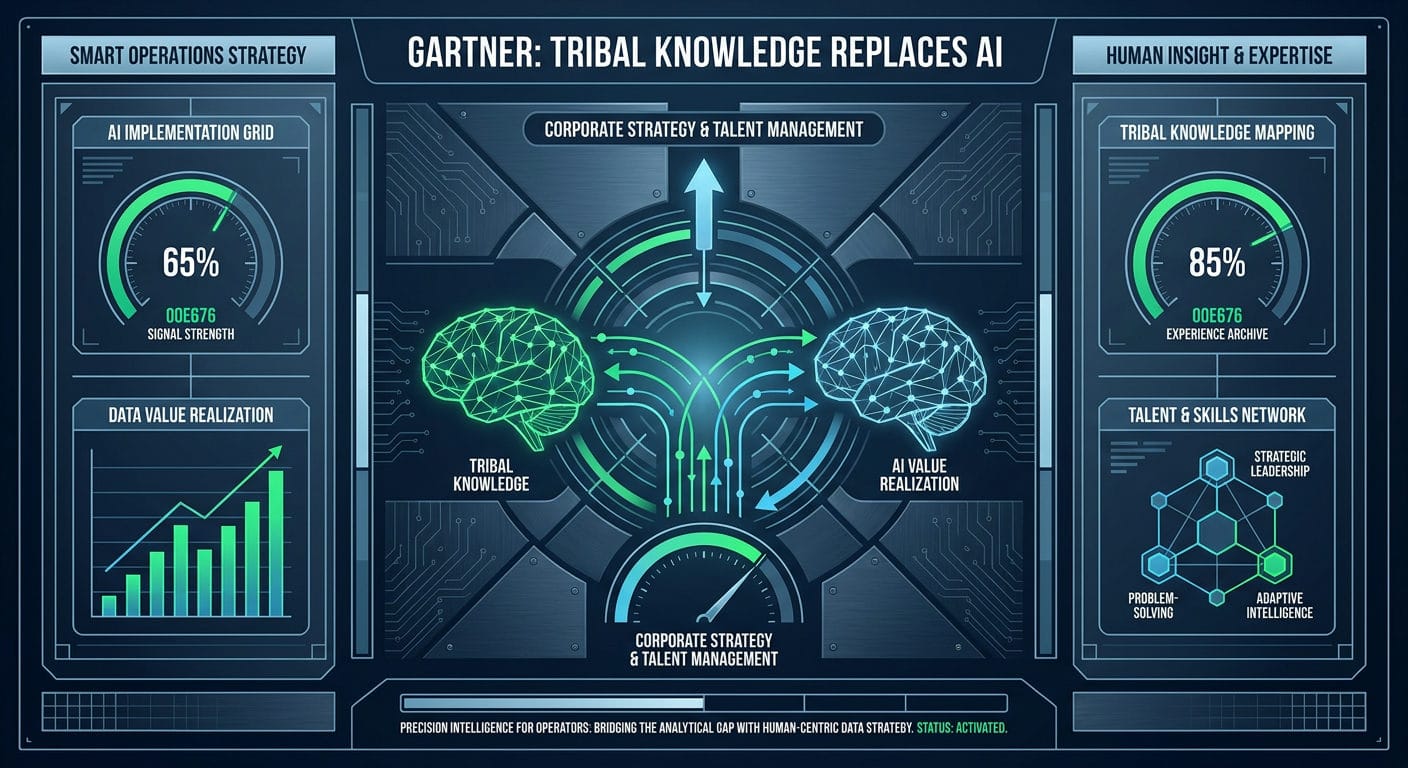
The AI productivity promise is hitting a human-expertise wall; organizations are now rehiring "tribal knowledge" previously deemed obsolete.
📊 11 episodes across 7 podcasts
⏱ 279 minutes of intelligence analyzed
🎙 Featuring: Sara Murray, Alejandro Fiorito, Josh Tyrangiel, Adi Ignatius
|

The Lead
The initial AI-driven quest for pure productivity gains is yielding to a more nuanced reality: successful, transformative AI implementations require deep human expertise and tribal knowledge. Simply put, organizations are realizing that the “blue money” (productivity plays) from AI can only go so far without the “green money” (transformative change) that humans unlock.
Denise McCurdy, Senior Executive Partner at Gartner, noted a surprising course correction: companies are re-hiring talent that was previously dismissed due to AI. This isn’t a step backward, but rather a recognition that the foundational understanding of an organization’s processes and history—the kind AI can't replicate—is critical for achieving genuine monetization and value creation from AI. The rush to automate overlooked the indispensable role of human insight in leveraging AI beyond basic task efficiency.
"We're seeing people hired back because they have this knowledge, this tribal knowledge of the organization that AI is not going to replace."
— Denise McCurdy, Senior Executive Partner at Gartner ThinkCast
This dynamic highlights that AI isn't a silver bullet for all operational challenges. Instead, it amplifies the need for strategic problem-solving and domain-specific knowledge to properly identify and integrate AI solutions. Josh Tyrangiel, Staff Writer at The Atlantic, reinforced this, stating that too many companies are "[solving for AI] instead of thinking about AI as a tool that can help them solve an actual problem" (HBR IdeaCast). This current recalibration suggests that the immediate competitive edge will go not to those who deploy the most AI, but those who best integrate AI with human capabilities to solve specific, high-value business problems.
The Strategic Question: Is your AI roadmap centered on enabling existing human expertise to unlock new value, or is it still trying to replace it?
The Rundown
① Google’s AI Strategy is "Coming Second" for Market Dominance.
Google, despite its DeepMind breakthroughs, deliberately trails in releasing cutting-edge AI to avoid cannibalizing its search revenue, manage reputational risks from AI "hallucinations," and navigate political scrutiny as a dominant tech giant. (Sebastian Mallaby on The Indicator from Planet Money)
→ Key Insight: This "triple innovator's dilemma" is less about technical lag and more about calculated long-term market positioning, prioritizing stability over immediate AI leadership.
② Corporate Venturing Shifts to "Venture Clienting" for De-risked Innovation.
Large corporations are increasingly acting as clients for startups, providing crucial market validation and revenue, which Professor Sergei Netessine called more valuable to startups than mere investment. (Sergei Netessine on This Week in Business)
→ The Operator Take: This model allows big companies to plug into innovation with lower risk, quickly de-coupling from underperforming solutions without significant capital exposure—a win for agile piloting.
③ US Housing Market Sees a "Renter's Market" Emergence, Despite High Asking Prices.
Recent apartment construction boom in the US has outpaced demand, leading to a nationwide rent growth slowdown to 2% year-over-year, often beaten by inflation and wage growth, with landlords offering significant incentives. (Kara Ng on The Indicator from Planet Money)
→ The Operator Take: While overall housing costs remain high, specific geographic markets offer opportunities for renters to negotiate terms and incentives, impacting local talent attraction strategies.
④ AI and Drone Swarms Will Favor Large Nation-States, Not Insurgents.
The complexity of coordinating and managing mass deployments of autonomous weapons, like drone swarms, will disproportionately benefit larger nation-state actors due to their scale and logistical capabilities. (Jim Rebesco on Summation (formerly World of DaaS))
→ The Operator Take: Geopolitical advantages in autonomous warfare systems will likely consolidate with well-resourced, organized entities, influencing defense tech investment and national security strategy.
⑤ Weak Fiscal Policy Design Inflates Fossil Fuel Consumption in Europe.
Fully 86% of European fiscal measures designed to counter the energy crisis inadvertently increased incentives to consume fossil fuels, highlighting a broad failure in targeted policy design with suboptimal outcomes. (Alejandro Fiorito on C-Suite Perspectives)
→ Implication for Leaders: Policy interventions, even when well-intentioned, can have counterproductive second-order effects if not rigorously designed and tested for actual behavioral impact.
The Stack
🔥 HEATING UP
• AI for targeted business problems: Leaders are realizing AI should solve specific, clear challenges rather than being a solution in search of a problem. (Josh Tyrangiel on HBR IdeaCast)
• Human expertise in AI value realization: Companies are finding that 'tribal knowledge' and human oversight are critical for moving beyond basic productivity to transformative AI. (Denise McCurdy on Gartner ThinkCast)
• Venture clienting: Large corporations are partnering with startups as clients, providing market validation and revenue, which is more valuable than just investment. (Sergei Netessine on This Week in Business)
• SK Hynix stock performance and AI demand: The South Korean chipmaker's value septupled in a year due to robust demand for memory chips essential for AI data centers. (Darian Woods on The Indicator from Planet Money)
👀 ON WATCH
• Road to Housing bill impact: A new bipartisan bill aims to streamline permitting and expand manufactured housing, but faces potential limitations from funding constraints and labor shortages. (Ben Keys on This Week in Business)
• Connecticut citizen assembly for tax reform: A unique democratic experiment involving 110 citizens is tackling property tax-dependent local government funding. (Cooper Katz McKim on The Indicator from Planet Money)
• Shift of Engineering Talent to Defense Tech: Top engineers are increasingly moving away from traditional roles in ad tech and financial services towards impactful work in defense and quantum computing. (Jim Rebesco on Summation (formerly World of DaaS))
❄️ COOLING OFF
• Gaming industry pandemic investment miscalculation: Microsoft's Xbox division experienced major layoffs after miscalculating pandemic-era investments, showing losses for every dollar invested. (Adrian Ma on The Indicator from Planet Money)
• Untargeted fiscal responses to energy shock: European fiscal measures for the energy crisis are criticized for incentivizing fossil fuel consumption rather than efficiency. (Alejandro Fiorito on C-Suite Perspectives)
• Inception of "air superiority": The concept of static control over airspace is becoming obsolete, replaced by a focus on "ephemeral access" for specific mission objectives in modern warfare. (Jim Rebesco on Summation (formerly World of DaaS))
The Debate
The long-term impact and sustainability of current global economic risks present a clear divergence of opinion among economic observers.
🐂 The Bull Case: Sara Murray, Managing Director International and Guest Host at The Conference Board, offers an optimistic view, stating that "The current war in Iran and the shock to oil markets has not been as destructive or damaging as the oil shock that we saw in the 1970s" (C-Suite Perspectives). She further argues that the current AI 'bubble' is fundamentally different from the dot-com era, as "hyperscalers are actually solid companies that have real revenue, tangible assets," suggesting a more resilient economic foundation.
🐻 The Bear Case: Alejandro Fiorito, Economist at The Conference Board Europe, highlights a more cautious outlook, noting that while the "global economy has not fallen off a cliff," growth forecasts "have weakened and have become more uneven" (C-Suite Perspectives). He points to tightened monetary policy from the Federal Reserve, which "matters for monetary policy everywhere," and problematic, untargeted fiscal responses in Europe as ongoing concerns that could exacerbate current challenges.
The Operator's Read: While underlying economic fundamentals may be stronger today, the cumulative effect of uneven growth, aggressive central bank policies, and poorly designed fiscal interventions still warrants a cautious approach to cash allocation and investment.
The Bottom Line
Building "AI-powered" solutions is easy; building truly transformative AI that delivers "green money" requires re-embracing human expertise to guide the machine.
📖 Want the full episode breakdowns, guest details, and listen links?
Appendix
C-Suite Perspectives: "Can Policymakers Stay Ahead of Global Risks?" · 32 min · Featuring Sara Murray
Who Should Listen: CEOs and chief strategists navigating global market volatility and policy shifts, looking to understand resilience amidst geopolitical tensions and economic headwinds.
▶ Listen
Gartner ThinkCast: "AI Needs People: Why CIOs Are Rethinking the Productivity Play" · 25 min · Featuring Denise McCurdy
Who Should Listen: CIOs and senior leaders challenged to extract greater value from AI by leveraging human expertise and domain-specific knowledge beyond initial productivity gains.
▶ Listen
HBR IdeaCast: "How Leaders Can Use AI to Solve Real Business Problems" · 27 min · Featuring Josh Tyrangiel
Who Should Listen: Executives and problem-solvers facing the pressure to implement AI effectively, seeking practical strategies to align AI tools with tangible business challenges rather than blindly adopting technology.
▶ Listen
How Leaders Lead with David Novak: "#299: David Dorman, Former CEO, AT&T – See around corners" · 72 min · Featuring David Dorman
Who Should Listen: Aspiring and current senior leaders interested in long-term strategic vision, leadership development, and lessons from navigating significant industry disruption in tech.
▶ Listen
Summation (formerly World of DaaS): "Striveworks CEO Jim Rebesco on drone swarms, AI for warfighters, and the end of air superiority" · 60 min · Featuring Jim Rebesco
Who Should Listen: Defense contractors, tech executives, and investors interested in the evolving landscape of autonomous defense technology, military strategy, and national security innovation.
▶ Listen
The Indicator from Planet Money: "Cracking down on egg prices" · 10 min · Featuring Darian Woods
Who Should Listen: Operators interested in microeconomic trends, antitrust implications, and the impact of digital distribution on consumer markets, delivered in an accessible format.
▶ Listen
The Indicator from Planet Money: "SK Hynix to the moon, Gen-Z to their rooms, and Connecticut tax reform looms" · 9 min · Featuring Darian Woods
Who Should Listen: Anyone tracking hot tech stocks, demographic shifts impacting consumption, or the challenges of local government funding and civic engagement.
▶ Listen
The Indicator from Planet Money: "We're in a renter's market (believe it or not)" · 9 min · Featuring Waylon Wong
Who Should Listen: Real estate investors, HR professionals, and urban planners keen on understanding the shifting dynamics of the housing market and its impact on cost of living and talent.
▶ Listen
The Indicator from Planet Money: "Why Google fell behind in the AI race" · 9 min · Featuring Tarian Woods
Who Should Listen: Tech strategists and competitive intelligence professionals evaluating the long-term plays of tech giants in AI, and the subtle trade-offs between innovation and market dominance.
▶ Listen
This Week in Business: "Can Congress Fix America’s Housing Affordability Crisis?" · 13 min · Featuring Ben Keys
Who Should Listen: Policy advisors, real estate developers, and local government officials seeking insights into legislative efforts to address housing affordability and their potential implementation challenges.
▶ Listen
This Week in Business: "Why Big Companies Are Rethinking How They Work With Startups" · 13 min · Featuring Sergei Netessine
Who Should Listen: Corporate innovation leads, strategists, and venture capital investors aiming to understand evolving models of corporate-startup engagement, particularly 'venture clienting'.
▶ Listen
