
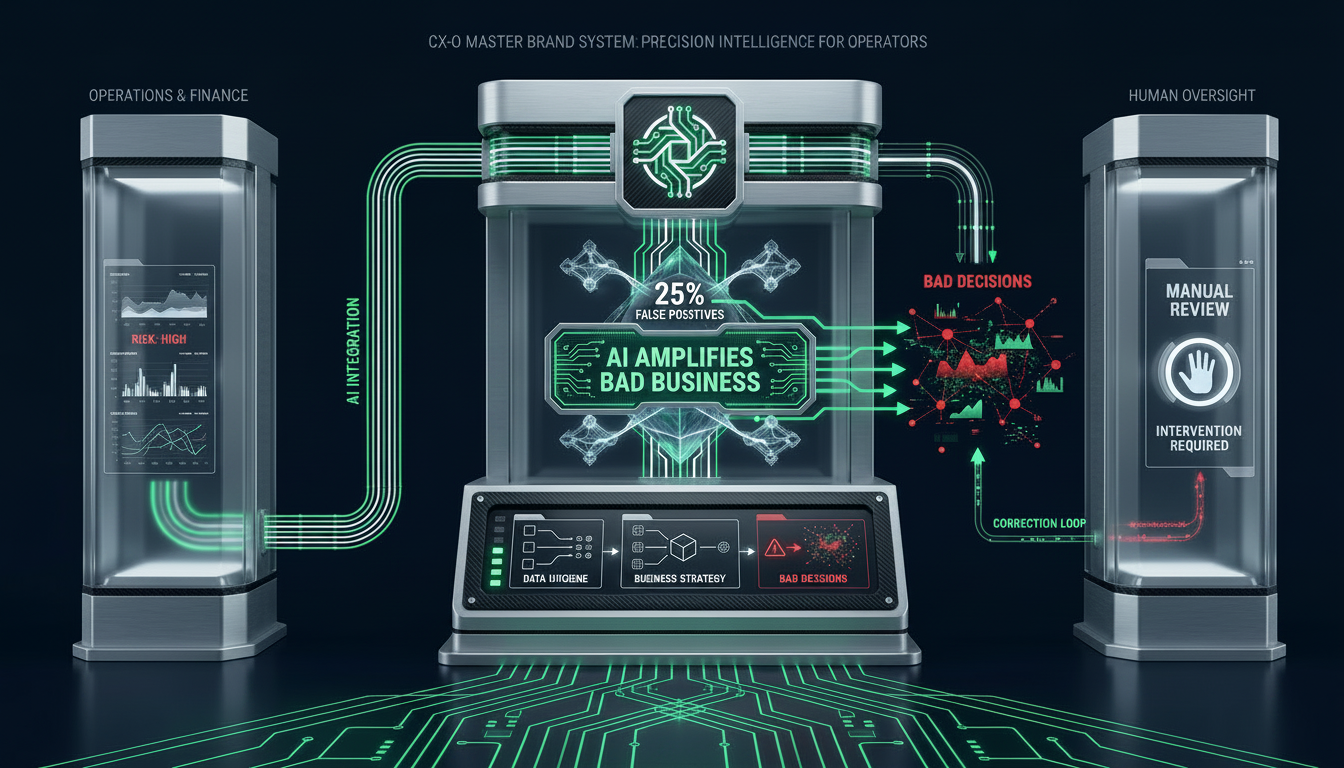
What if Steve Coughran's 25% AI Error Rate Is Your Baseline?
There's a quiet revolution happening at the intersection of AI and operational finance. It’s not just about generative AI tools, it’s about a fundamental re-evaluation of how humans and machines collaborate to drive profit, manage risk, and redefine the CFO’s mandate.
📊 9 episodes across 7 podcasts
⏱ 350 minutes of intelligence analyzed
🎙 Featuring: Steve Coughran, Peter High, Keith Fulton, Keith Gross, Jean Compeau, Martino Cardoni, Lesley Thomas, Carla Cooper, Rohan Hewavisenti
|

The Big Shift
The conversation around AI is moving beyond hype cycles and into the harsh light of operational reality. This week’s episodes reveal a critical shift: operators are realizing that while AI offers unprecedented opportunities, its efficacy is entirely dependent on robust human oversight, strong foundational economics, and meticulous data hygiene. It's becoming evident that AI doesn't solve existing problems; it amplifies them if the underlying business mechanics are flawed.
The New Reality: Operators are learning that AI models, even the most advanced, consistently produce false positives—an average of 20-25% according to Steve Coughran. This isn't just a technical glitch; it has profound implications for critical tasks like cash flow forecasting or KPI generation, where accuracy is paramount. Without human judgment and contextual understanding, AI can quickly lead to misinformed decisions.
"On average, the most sophisticated and advanced models today return somewhere between 20 and 25% false positives."
— Steve Coughran, Host of Strategy Meets Finance at Coltivar Group, LLC
The Data Imperative: This false positive rate underscores an even deeper truth articulated by Martino Cardoni, CFO of DeepL: "AI is as good as your data foundation." Trying to implement AI on messy or incomplete data is a recipe for disaster. Jean Compeau, CFO of Sonar, pointed out that only 3% of developers trust AI code accuracy, and that AI-generated code often increases lines of code by 50%. This creates a new problem space for finance around managing unforeseen token costs, as many enterprises are blowing through annual AI budgets in a single quarter.
The Operator's Imperative: The shift is towards viewing AI as a powerful tool to augment, not replace, human intelligence and well-defined processes. It highlights the need for CFOs and COOs to not only understand the technology but also to ensure their foundational economics and data infrastructure are sound before deploying AI at scale. Without this, AI is just a more expensive way to make bad decisions.
The Rundown
① Don't Confuse Pricing to Win with Pricing to Profit.
Many contractors struggle with profitability despite winning bids because they confuse 'pricing to win' with 'pricing to profit.' Accurate bid conversion rate tracking is crucial; a rate above 50% often indicates underpricing. (Steve Coughran on Strategy Meets Finance)
→ The Operator's Take: If your sales teams are hitting targets but margins are eroding, scrutinize your conversion rates and pricing models. Don't let the chase for top-line revenue mask fundamental profitability issues.
② Your Business Fundamentals Trump AI Hype.
AI is merely an amplifier; if your foundational business economics are unsound (e.g., incorrect margins, inaccurate job costing, poor visibility), AI will compound your problems rather than solve them. (Steve Coughran on Strategy Meets Finance)
→ The Operator's Take: Before investing heavily in AI for optimization, conduct a thorough audit of your core financial and operational processes. AI can accelerate efficiency, but it cannot fix a broken foundation.
③ Online Banking Data Can Predict Dementia.
Jack Henry uses anonymized online banking activity data to predict early-onset dementia up to 10 years in advance. This surprising application, initially for fraud prevention, highlights the untapped potential of behavioral data analytics. (Keith Fulton, Chief Data Officer and Chief AI Officer at Jack Henry, on Technovation with Peter High (CIO, CTO, CDO, CXO Interviews))
→ The Operator's Take: Look beyond obvious use cases for your data assets. Cross-functional analysis can uncover unexpected signals for risk mitigation, customer protection, or entirely new product development.
④ Internal AI Tools Are Becoming External Products.
Jack Henry built an "AI Garage" to support "vibe coding" by non-IT employees, offering guardrails and secure deployment for internal AI applications. They are now productizing this internal solution for their banking clients. (Keith Gross, CTO of Jack Henry, on Technovation with Peter High (CIO, CTO, CDO, CXO Interviews))
→ The Operator's Take: Your internal operational innovations, especially in AI security and governance, could become valuable external product offerings. Look for opportunities to commercialize your internal tools and IP.
⑤ Financial Decisions Are More Emotional Than Rational.
Many financial decisions are driven by emotion and past experiences (especially childhood ones), not purely rational data analysis. CFOs often struggle to separate personal identity from professional choices, leading to "hidden taxes" on performance. (Lesley Thomas, Founder of The Money Confidence Academy, on CFO 4.0 - The Future of Finance)
→ The Operator's Take: Recognize the emotional undercurrents in decision-making, both your own and your team's. Foster a culture where difficult conversations are encouraged, and psychological safety allows for open sharing, leading to better outcomes.
⑥ More Scooters Can Mean More Revenue Per Scooter.
Lime's S-1 reveals a unique network effect: adding more scooters in a city actually increases the revenue per vehicle, contrary to most marketplaces where increased supply dilutes value. This is driven by increased accessibility and user adoption. (CJ Gustafson on Run the Numbers)
→ The Operator's Take: Challenge conventional wisdom in your unit economics. Look for counter-intuitive network effects or scale advantages that may redefine how you think about supply, demand, and profitability. Sometimes, more truly is more.
Signal Board
🔥 HEATING UP
• Amnesty International funding model for independence: The organization actively avoids government funding to preserve its independence, a significant aspect of its operational model. (Rohan Hewavisenti, CFO at Amnesty International, on The CFO Playbook)
• CFO as Chief Finance Vision Officer: Emphasizes the CFO's role in strategic storytelling and articulating long-term vision beyond just crunching numbers. (Carla Cooper, CFO at Contentful, on The Growth-Minded CFO)
• Data Foundation for AI Implementation: AI's effectiveness is directly tied to the quality of the underlying data, making a robust data foundation critical for successful AI adoption. (Martino Cardoni, CFO at DeepL, on CFO THOUGHT LEADER)
🔭 ON WATCH
• Generative AI 🆕: CFOs are advised to experiment with Generative AI daily to understand its transformative potential and learn by doing. (Rohan Gunatillake, CFO of Amnesty International, on The CFO Playbook)
• CFO Playbook 🆕: A framework highlighting the broad remit and strategic decision-making involved in a CFO role, encompassing IT and legal functions in some organizations. (Rohan Hewavisenti, CFO at Amnesty International, on The CFO Playbook)
• False Positives in AI Models 🆕: Current advanced AI models return 20-25% false positives, underscoring the need for human oversight, especially in critical financial tasks. (Steve Coughran, Host of Strategy Meets Finance at Coltivar Group, LLC, on Strategy Meets Finance)
🥶 COOLING OFF
• TNM (Time and Material) billing limitations for profit: This billing method can hinder growth and limit upside potential because costs are linear to work done. (Steve Coughran, Host at Coltivar Group, LLC, on Strategy Meets Finance)
• KPIs are pointless if not tied to strategy and actionable behavior change: KPIs should directly link back to the business strategy to be effective, otherwise, they are just numbers without purpose. (Steve Coughran, Host of Strategy Meets Finance at Coltivar Group, LLC, on Strategy Meets Finance)
The Bottom Line
In the AI era, operational rigor and human judgment are not just complementary to technology, they are the indispensable foundation for its profitable application.
📖 Want the full episode breakdowns, guest details, and listen links?
Quick Appendix
Strategy Meets Finance: "Why Most Contractors Price to Win Instead of Price to Profit | Ep 244" · 20 min · Featuring Steve Coughran ▶ Listen · Apple Podcasts
Go Deep On: The nuances between simply winning bids and truly generating profit, and common missteps in conversion rate and margin calculations.
Strategy Meets Finance: "Listen to This if You're Using AI to Optimize Your Business | Ep 245" · 15 min · Featuring Steve Coughran ▶ Listen · Apple Podcasts
Go Deep On: Why human oversight remains critical in AI's application to finance, especially given high false positive rates in current models.
The CFO Playbook: "The CFO Playbook: What Corporate CFOs Can Learn from Amnesty International" · 41 min · Featuring Rohan Hewavisenti ▶ Listen · Apple Podcasts
Go Deep On: How a non-profit CFO manages finances on a global scale while maintaining independence and embracing broad operational oversight.
Technovation with Peter High (CIO, CTO, CDO, CXO Interviews): "How Jack Henry Uses AI and Data Science to Transform Community Banking" · 45 min · Featuring Keith Fulton, Keith Gross ▶ Listen · Apple Podcasts
Go Deep On: The surprising applications of AI in banking, from predicting dementia to identifying hidden commercial activity, and how internal AI tools can become external products.
CFO THOUGHT LEADER: "1195: When Finance at the Center of the AI Code Revolution | Jean Compeau, CFO, Sonar" · 47 min · Featuring Jean Compeau ▶ Listen · Apple Podcasts
Go Deep On: The critical role of finance in the new AI code economy, focusing on leading indicators and the often-overlooked costs of AI token usage.
The Growth-Minded CFO: "Revisiting: Wall Street to SaaS CFO with Carla Cooper (CFO @ Contentful)" · 44 min · Featuring Carla Cooper ▶ Listen · Apple Podcasts
Go Deep On: The evolution of the CFO role into a "Chief Finance Vision Officer" and the importance of strategic storytelling for both internal and external stakeholders.
Run the Numbers: "Lime’s S-1 Breakdown: The $1.8B Scooter IPO" · 43 min · Featuring CJ Gustafson ▶ Listen · Apple Podcasts
Go Deep On: A deep dive into Lime's operational turnaround, unit economics, and unique network effects that defied traditional marketplace logic.
CFO THOUGHT LEADER: "1196: Your Next Finance Hire Should Think Like a Founder | Martino Cardoni, CFO, DeepL" · 53 min · Featuring Martino Cardoni ▶ Listen · Apple Podcasts
Go Deep On: The founder-like ambition required for finance professionals in hyper-growth AI companies, and the critical importance of a robust data foundation for AI success.
CFO 4.0 - The Future of Finance: "276. The Hidden Tax: How Emotion Shapes Your Financial Decisions with Lesley Thomas" · 42 min · Featuring Lesley Thomas ▶ Listen · Apple Podcasts
Go Deep On: The pervasive impact of emotion on financial decision-making and how leaders' unspoken anxieties can create a "hidden tax" on organizational performance.
