
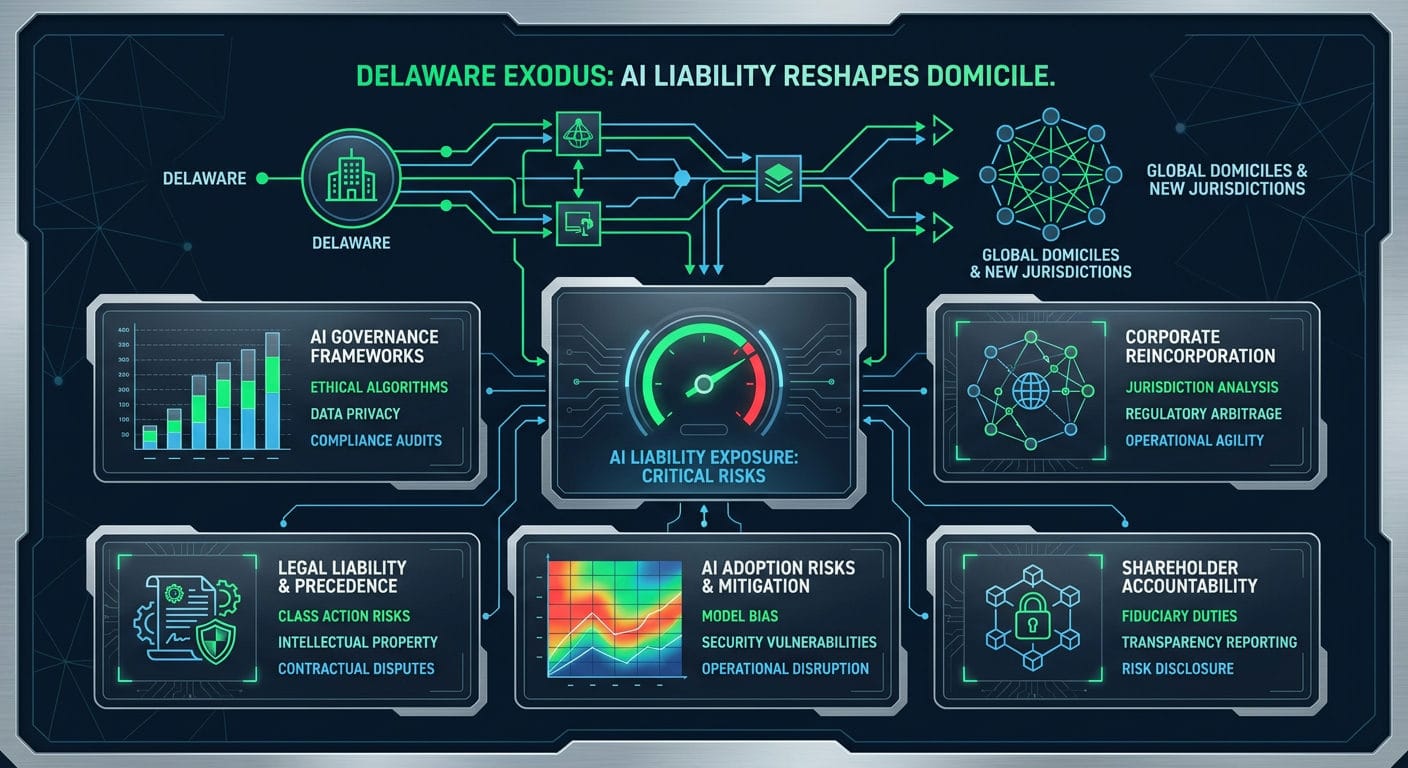
Generative AI’s hidden cost isn’t compute, it’s the legal and operational overhead of integrating untested tools that are now prompting a flight from Delaware for corporate reincorporations.
📊 11 episodes across 9 podcasts
⏱ 397 minutes of intelligence analyzed
🎙 Featuring: Varun Krishna, Gary Gulman, Ronnie Chatterji, Tim Ferriss
|
The Big Shift
Despite the prevailing narrative of AI driving efficiency, a significant disconnect is emerging between AI strategy and execution, forcing operators to confront the hidden costs and risks of widespread AI adoption. Many organizations are struggling to derive tangible value from AI investments, leading to "shadow AI" usage and a failure to adapt business models. This gap is not just about technology; it's about governance, legal liability, and even corporate domicile.
"34% of law firm professionals are using AI tools that firms haven't approved and haven't seen... Usage of unauthorized tools could constitute a violation of attorney client privilege."
— Raghu Ramanathan, President of Legal Professionals at Thomson Reuters
This challenge is so profound that it’s influencing fundamental corporate decisions like reincorporation, as companies seek jurisdictions that offer greater flexibility or protection from new litigation risks associated with AI errors and shareholder accountability. The perceived trade-off between innovation and governance is pushing some to consider moving away from traditional, shareholder-friendly states like Delaware in favor of more corporate-centric environments.
This signals a shift in focus from purely technological capabilities to the broader operational and legal frameworks required to support an AI-powered future. The real unlock in AI isn't just about faster computation, but about navigating the complex, often unquantified, organizational frictions that emerge post-deployment.
The Rundown
① AI demand is creating a "Rampocalypse" with tangible economic impacts.
The insatiable demand from the AI industry for RAM and memory is causing prices to skyrocket, upending Moore's Law and directly affecting consumer tech, with companies like Nintendo and Apple raising prices. (Steve Burke on The Indicator from Planet Money)
→ The Operator Take: AI infrastructure costs are not just for hyperscalers; expect higher component costs to translate into increased CapEx and OpEx for any business building or deploying significant AI, impacting budgets and product pricing.
② Agentic AI is scaling 10x faster than expected within leading tech firms.
The number of people delegating full workday tasks to agentic AI like Codex within OpenAI grew 10x in early 2026, signaling a rapid shift towards advanced AI-driven workflows that go beyond simple chatbot interactions. (Ronnie Chatterji on Summation (formerly World of DaaS))
→ The Operator Take: The internal adoption rates of advanced agentic AI within tech pioneers indicate a coming wave of radical productivity gains, making it critical to identify and integrate these tools for specific, high-value workflows to stay competitive.
③ Corporate leadership is underestimating client pressure for AI value.
Only 11% of law firms are concerned about 32% of in-house legal teams being ready to switch firms due to a lack of clear AI value, highlighting a significant perception gap between professional service providers and their clients. (Mike Abbott on Clarity)
→ The Operator Take: Professional services firms must prioritize demonstrating concrete AI value to retain clients, moving beyond exploratory phases to actual deployment and ROI, or risk client attrition to more AI-forward competitors.
④ Company culture is a behavioral operating system, not just a mission statement.
Varun Krishna, CEO of Rocket Companies, emphasizes that true culture is built through shared experiences and behaviors, guided by "ISMs" that act as behavioral tenets, rather than just words on a slide deck. (Varun Krishna on How Leaders Lead with David Novak)
→ The Operator Take: To successfully navigate AI integration and other strategic shifts, leaders need to operationalize culture through observable behaviors and shared experiences, ensuring company values translate into daily actions and decision-making.
⑤ The US economy is shifting from consumption-led to AI-driven investment-led growth.
Despite initial downgrades, The Conference Board upgraded its global GDP growth forecast due to an unexpected boost from AI-driven private investment, indicating a fundamental shift in the primary driver of economic growth in the US. (Erik Lundh on C-Suite Perspectives)
→ The Operator Take: Businesses should re-evaluate market strategies to align with an investment-led growth cycle, focusing on capital expenditure, R&D, and AI integration to capture new value rather than solely relying on consumer spending.
Signal Board
🚀 HEATING UP
• AI-driven private investment: Unexpectedly boosted global GDP forecasts and is shifting the US economy from consumption-led to investment-led growth. (Erik Lundh on C-Suite Perspectives)
• Prediction Markets: Gaining traction as a robust mechanism for forecasting, operating under CFTC oversight and leveraging the "wisdom of crowds." (Abraham Wyner on This Week in Business)
🆕 ON WATCH
• Planetary intelligence concept for AI alignment: The idea that training AI on Earth's vast physical data could foster pro-social alignment with humanity and the planet. (Alex Macdonald on Freakonomics Radio)
• Space-based AI computing: A prediction that 90% of AI computing will happen in space within 40 years, driven by the energy demands of AI and proven engineering. (Steve Levitt on Freakonomics Radio)
• Reincorporation Trends from Delaware: Companies are exploring moves to other states like Nevada and Texas, or even the Cayman Islands, due to concerns over shareholder accountability and new litigation risks. (Ann Lipton on The Voice of Corporate Governance)
🧊 COOLING OFF
• Moore's Law: The long-held assumption of continuously cheaper and better tech is breaking down due to the massive demand for memory from the AI industry. (Iris Behar on The Indicator from Planet Money)
• AI slop makes writing sound the same: A concern that over-reliance on AI for writing leads to generic and homogenized communication, impacting brand voice. (Varun Krishna on How Leaders Lead with David Novak)
The Debate
The rise of AI and its associated risks is creating a tension between corporate flexibility and shareholder protection, particularly concerning reincorporation strategies.
🐂 The Bull Case: Michael Levin, an investor, argues that the push for reincorporation, particularly away from Delaware, is driven by a desire for tax and regulatory benefits, suggesting that for some companies, these financial incentives might outweigh the perceived risks to shareholder rights. He notes that some jurisdictions might offer a more sympathetic ear to corporate decisions that could be challenged elsewhere. (Michael Levin on The Voice of Corporate Governance)
🐻 The Bear Case: Ann Lipton, Professor of Law, contends that reincorporating from Delaware, especially to places like Texas or the Cayman Islands, fundamentally diminishes shareholders' ability to hold management accountable. She highlights that the differences are generally about the ability of shareholders to challenge management failures and that certain new jurisdictions are creating an environment where shareholders are "essentially powerless." (Ann Lipton on The Voice of Corporate Governance)
The Operator's Read: While the financial and regulatory benefits of reincorporation might be appealing in the short term, the long-term cost to shareholder trust and accountability in an increasingly complex and AI-driven business landscape could be substantial.
The Bottom Line
The operational reality of AI is forcing leaders to focus less on pure capability and more on the foundational legal, cultural, and financial plumbing required to realize its value.
Appendix
Freakonomics Radio: "How Gary Gulman Turned Depression Into Comedy Gold | Better in Person" · 47 min · Featuring Stephen Dubner, Gary Gulman
Recommended for: Leaders and managers looking for insights into fostering resilience and mental well-being within their teams, offering a candid look at leveraging personal struggles for professional and social impact.
▶ Listen
How Leaders Lead with David Novak: "#302: Varun Krishna, CEO, Rocket Companies – Culture is rooted in behavior, not words" · 73 min · Featuring Varun Krishna, David Novak
Recommended for: CEOs and operational leaders interested in building and scaling company culture through concrete behaviors and shared experiences, rather than just rhetoric.
▶ Listen
The Indicator from Planet Money: "Even Moore’s law can't save affordable tech" · 9 min · Featuring Waylon Wong, Darian Boedes, Steve Burke
Recommended for: CTOs and procurement managers assessing future hardware costs and supply chain risks in an AI-driven economy, providing a concise overview of the "Rampocalypse" in memory pricing.
▶ Listen
Clarity: "Are organizations ready for an AI-powered future?" · 27 min · Featuring Mike Abbott, Raghu Ramanathan, Elizabeth Beastrom
Recommended for: Professional services leaders (legal, tax, corporate) grappling with AI strategy, shadow AI, and client expectations, offering actionable advice on bridging the execution gap.
▶ Listen
Summation (formerly World of DaaS): "OpenAI Chief Economist Ronnie Chatterji: measuring the greatest technology of our time" · 57 min · Featuring Ronnie Chatterji, Auren Hoffman
Recommended for: Strategy and product leaders seeking to understand the advanced adoption patterns of agentic AI and its economic implications, particularly how it's shaping productivity and future job descriptions.
▶ Listen
This Week in Business: "Why Prediction Markets Are More Than a Passing Trend" · 15 min · Featuring Dan Loney, Abraham Wyner
Recommended for: Decision-makers and strategists interested in advanced forecasting techniques and the regulatory landscape of prediction markets, offering insights into their potential beyond traditional betting.
▶ Listen
Clarity: "Are organizations ready for an AI-powered future?" · 27 min · Featuring Mike Abbott, Raghu Ramanathan, Elizabeth Beastrom
Recommended for: Corporate leaders needing to understand the current state of AI adoption in professional services and the increasing pressure from clients for demonstrable AI value.
▶ Listen
The Voice of Corporate Governance: "Investors & Reincorporations with Ann Lipton and Michael Levin" · 32 min · Featuring Jeff Mahoney, Ann Lipton, Michael Levin
Recommended for: Legal and finance executives navigating corporate governance, shareholder rights, and the implications of reincorporation decisions in an evolving regulatory and litigation landscape.
▶ Listen
HBR IdeaCast: "Introducing The Founder Mindset: Tim Ferriss on Experiments, Risk, and Freedom" · 33 min · Featuring Reza Satchu, Tim Ferriss
Recommended for: Entrepreneurs and innovation leaders looking to cultivate a mindset of calibrated risk-taking, rapid experimentation, and minimizing losses in venture building.
▶ Listen
Freakonomics Radio: "683. In the New Space Race, Who Makes the Rules?" · 56 min · Featuring Steve Levitt, Alex Macdonald, Rosanna Hoffman
Recommended for: Technology strategists and R&D leaders exploring the future of computing infrastructure and the regulatory challenges of space-based AI, offering a glimpse into long-term strategic shifts.
▶ Listen
C-Suite Perspectives: "The State of the Economy for July 2026" · 21 min · Featuring Erik Lundh, Allen Li
Recommended for: Business leaders and economists tracking macroeconomic shifts, particularly the move towards AI-driven investment-led growth and its global implications.
▶ Listen
