
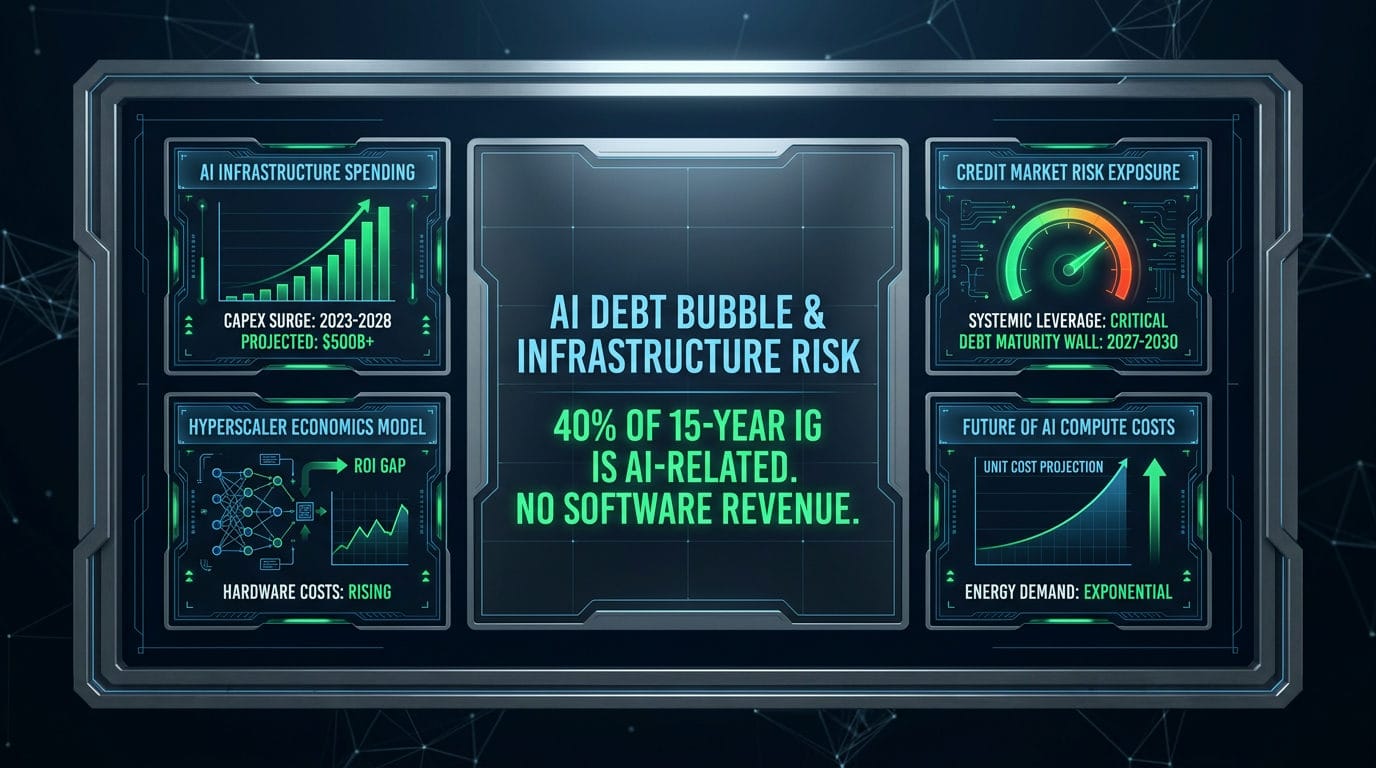
The infrastructure build-out is hiding the actual adoption metrics; right now, AI is a debt-fueled hardware boom waiting for the software revenues to catch up.
📊 11 episodes across 10 podcasts
⏱ 358 minutes of intelligence analyzed
🎙 Featuring: Gary Gensler (MIT), Freakonomics Radio + Stitcher (Freakonomics Radio + Stitcher), Moritz Baier-Lentz (General Intuition), Auren Hoffman (Summation (formerly World of DaaS))
|
The Lead: The Great AI Debt Binge
We are treating AI like a software deployment, but the hyperscalers are financing it like a physical infrastructure build—and the credit markets are starting to feel the weight. The narrative that Big Tech is simply funding AI out of its massive cash reserves is incomplete. The reality is that we are witnessing a historic debt cycle that is reshaping global capital allocation.
This week, operators and macro-analysts zeroed in on a fundamental misalignment: massive, debt-fueled capital expenditure in data centers and chips without the corresponding native software revenues to justify it. At Goldman Sachs, Zach Ablon noted that an astonishing 40% of 15-year-plus Investment Grade issuance this year is AI-related. The U.S. IG market is becoming saturated, forcing hyperscalers to tap private credit and regional bond markets to fill the void.
"We have a parlay bet right now. It's that the model companies like OpenAI and Anthropic and so forth, and the hyperscalers like Microsoft and Google, that their capital expenditures will lead to enough revenues."
— Gary Gensler, Professor of the Practice of Global Economics, Management, and Finance at MIT on Freakonomics Radio
Why it matters: If the gross profit margins of chip and memory companies collapse because end-user software revenues don't materialize, the hyperscalers will be left holding massive debt obligations. For operators, this means the current subsidized cost of AI compute is temporary. If the bond market balks, the cost of running your AI pipelines will spike. Build your unit economics on the assumption that API and compute costs will eventually have to reflect the actual cost of this debt.
The Rundown
① Successful AI Deployments Cost 4x More in Data Prep.
Gartner's data shows that while 4 out of 5 AI investments fail to show ROI, the 20% that succeed share a specific trait: they spend four times more on data foundations, governance, and people transformation. (Rita Sallam on Gartner ThinkCast)
→ The Operator Take: If your AI budget is heavily skewed toward model licenses rather than data engineering and hygiene, you are building a demo, not a product.
② The "Agentic" Shift Will Kill Traditional BI.
Organizations are preparing to phase out static reporting; Cisco’s food company division is actively working to eliminate 14,000 traditional dashboards by 2030, replacing them with conversational agentic workflows. (Rita Sallam on Gartner ThinkCast)
→ The Operator Take: Stop buying long-term BI dashboard licenses; the future of operational visibility is autonomous data agents executing workflows, not humans reading charts.
③ A 24-Year-Old Startup is Eating Nvidia's Inference Lunch. 🆕
A team of 24-year-olds foresaw the AI inference crunch three years ago, built a specialized inference chip called etched2, and just emerged from stealth with $1 billion in orders. (Moritz Baier-Lentz on Summation (formerly World of DaaS))
→ The Operator Take: Don't lock your hardware strategy exclusively into Nvidia architectures; specialized inference silicon is reaching production scale faster than anticipated.
④ The Supply Chain Crisis You Aren't Watching. 🆕
Iranian missile strikes on Qatar have knocked out roughly 33% of the global helium supply, severely impacting the manufacturing of semiconductors, fiber optics, and medical equipment. (Waylon Wong on The Indicator from Planet Money)
→ The Operator Take: Audit your hardware and cloud vendors for supply chain vulnerabilities tied to raw material shocks, particularly if you are scaling physical tech infrastructure.
⑤ Boards Are Flying Blind on Operational Reality.
Despite the speed of current market and technology shifts, more than 50% of corporate boards receive no real-time data updates between their formal meetings. (Dr. Sabine Dembkowski on The Better Boards Podcast Series)
→ The Operator Take: If you are a CTO or COO, build automated, asynchronous data feeds for your board members; forcing them to wait for quarterly packets is a governance liability.
⑥ Brand Moats Require Independent Science.
Olipop retook the category lead from Poppy despite being outspent on marketing, largely because they are part of the less than 1% of beverage brands conducting independent, rigorous microbiome research on their products. (Ben Goodwin on How Leaders Lead with David Novak)
→ The Operator Take:: In a market flooded with venture-backed consumer marketing, verifiable scientific validation has become the strongest customer acquisition moat.
⑦ AI Requires a structural Org Redesign.
Henning Piezunka noted that "people who use AI will outperform people who do not," but warned that simply buying the tools isn't enough; companies must fundamentally overhaul their incentive systems and organizational structures to leverage it. (Henning Piezunka on This Week in Business)
→ The Operator Take: If you haven't rewritten your team's KPIs and compensation structures to reward AI-driven leverage rather than raw hours worked, your adoption will stall.
The Stack
🔥 HEATING UP
• etched2: The specialized AI inference chip company founded by 24-year-olds that secured $1 billion in orders before exiting stealth. (Moritz Baier-Lentz on Summation (formerly World of DaaS))
• Agentic Analytics: Moving beyond static dashboards to AI agents that automate 75% of data engineering workflows by 2029. (Rita Sallam on Gartner ThinkCast)
• Olipop: The functional soda brand whose stringent hiring process is statistically harder to clear than making an NBA roster. (Ben Goodwin on How Leaders Lead with David Novak)
👀 ON WATCH
• US IG Credit Market: 40% of 15-year plus issuance is now AI-related, raising concerns about saturation and a potential pivot to private credit. (Zach Ablon on Exchanges)
• Global Helium Supply: 33% of the world's supply has been disrupted due to geopolitical conflict in the Middle East, threatening tech manufacturing. (Waylon Wong on The Indicator from Planet Money)
🧊 COOLING OFF
• Traditional BI Dashboards: Enterprise leaders are actively planning the obsolescence of static reporting in favor of conversational data interfaces. (Rita Sallam on Gartner ThinkCast)
• Defined Benefit Pensions: The ongoing shift to defined contribution plans means retail retirement savings are highly exposed to market crashes without government bailout guarantees. (Nikolai Roussanov on This Week in Business)
The Bottom Line
Stop looking at AI as a software upgrade; it is a debt-financed infrastructure build-out that will either deliver the greatest productivity boom in history, or trigger a massive correction when the hyperscalers can no longer service the bonds funding your cheap compute.
📖 Want the full episode breakdowns, guest details, and listen links?
The Appendix
1. Freakonomics Radio: "684. He Helped Clean Up the Last Crash. Does He See Another One Coming?"
Guests: Gary Gensler (Professor of the Practice of Global Economics, Management, and Finance, MIT), Freakonomics Radio + Stitcher (Host, Freakonomics Radio + Stitcher)
Runtime: 67 min | Vibe: Macro reality check
Key Signals:
- The Infrastructure Imbalance: AI capital expenditures are vastly outpacing native software revenues, creating a setup for a potential market correction if productivity gains don't materialize quickly.
"What you usually have, history tells us, is this investment phase, big capital expenditure phase. We're having that right now. It's in the data centers and the chips and the memory and the like, and revenues do not match it."
— Gary Gensler, Former Chair of the Securities and Exchange Commission (SEC) and Commodity Futures Trading Commission (CFTC), Professor at MIT
2. The Indicator from Planet Money: "Why we're short on blood, water and helium"
Guests: Adrienne Ma (Host, NPR), Ricky Mulvey (Host, NPR), Waylon Wong (Host, NPR), Jessica Merrill (Communications Director, American Red Cross), Jack Schmidt (Director of the Center for Colorado River Studies, Utah State)
Runtime: 9 min | Vibe: Supply chain warnings
Key Signals:
- Resource Scarcity Impacts Tech: Geopolitical conflict and climate change are creating severe bottlenecks in physical resources, notably knocking out a third of the global helium supply critical for manufacturing.
"The U.S. geological Survey says Qatar accounted for 35% of global helium production in 2024. And Iranian Dr. Missile strikes have knocked out that supply. They've knocked out like a third of the helium supply."
— Waylon Wong, Host at NPR
3. This Week in Business: "Will the Government Bail Out Your 401(k) in a Market Crash?"
Guests: Dan Loney (Host, The Wharton School), Nikolai Roussanov (Finance Professor, The Wharton School)
Runtime: 18 min | Vibe: Financial pragmatism
Key Signals:
- No Bailouts for Portfolios: Government intervention during crises targets corporate survival and market function, not the protection of retail retirement portfolios, making glide-path planning essential.
"It's not really...the idea is not to kind of to prop up the stock prices. The idea is not to support the investors. The idea is support the firms to some extent, support them as employers of workers."
— Nikolai Roussanov, Finance Professor at The Wharton School
4. CEO 2 CEO: "Ep 26. The Corporate Athlete: Why Game Time Isn't the Time to Practice"
Guests: Chris Heim (CEO, Board Director, Endurance Athlete, Heim Leadership), Scott Sustacek (Host, The CEO Roundtable)
Runtime: 27 min | Vibe: Executive performance
Key Signals:
- Intentional Preparation: Leaders must manage their energy and practice under controlled stress, as their response during high-stakes "game time" sets the operational tone for the entire company.
"The way that we respond sets the tone for how others will respond. The way that we treat each other at that moment of the highest moment of stress is what sets the tone for how the company is going to respond."
— Chris Heim, CEO, Board Director, Endurance Athlete at Heim Leadership
5. How Leaders Lead: "#303: Ben Goodwin, Cofounder, CEO & Formulator, OLIPOP"
Guests: Ben Goodwin (Cofounder, CEO & Formulator, OLIPOP), David Novak (Host, How Leaders Lead with David Novak)
Runtime: 55 min | Vibe: Brand differentiation
Key Signals:
- Science as a Moat: In consumer goods, investing in genuine, independent scientific validation (like microbiome research) creates a stronger market position than pure marketing spend.
"Less than 1% of these brands are doing any independent research on whether this premium product that they're charging customers for is actually conferring a real benefit."
— Ben Goodwin, Cofounder, CEO & Formulator of OLIPOP
6. Summation: "Moritz Baier-Lentz on why the future of AI runs on video games"
Guests: Moritz Baier-Lentz (Founding Member & Investor, General Intuition), Auren Hoffman (Host, Summation (formerly World of DaaS))
Runtime: 65 min | Vibe: Frontier tech investing
Key Signals:
- Gaming Data Drives AI: Spatial-temporal data from video games is becoming the most valuable training set for teaching AI agents how to solve complex, real-world problems beyond language.
"The sum of coupled action and environment data was accumulated through the preceding company and platform Metal ultimately led to what is as far as we are concerned... the best data set for world and action modeling."
— Moritz Baier-Lentz, Founding Member & Investor at General Intuition
7. The Better Boards Podcast Series: "When Experience Isn't Enough: Governing in a World Without Precedent"
Guests: Dr Sabine Dembkowski (Founder and Managing Partner, Better Boards), Dorothy Burwell (Global Head of Board Advisory, FGS Global)
Runtime: 21 min | Vibe: Governance modernization
Key Signals:
- The Real-Time Data Gap: Corporate boards are severely hindered by a lack of continuous, real-time data flows, relying too heavily on sanitized, periodic reporting that fails to capture rapid market shifts.
"When you have to put everything together in a pretty, pretty bow and wrap it up for the board meeting, it's disruptive."
— Dorothy Burwell, Global Head of Board Advisory at FGS Global
8. Exchanges: "How AI Debt Is Reshaping Credit Markets"
Guests: Alison Nathan (Host, Goldman Sachs), Amanda Lynam (Head of Credit Strategy Research, Goldman Sachs), Zach Ablon (Head of Credit Sales Desk, Global Banking & Markets, Goldman Sachs)
Runtime: 25 min | Vibe: Capital markets structural shift
Key Signals:
- The Hyperscaler Debt Binge: Cash-rich tech giants are flooding the bond market to fund AI infrastructure, pushing the U.S. Investment Grade market near saturation and forcing a reliance on alternative financing.
"40% of 15 year plus issuance in IG this year has been by AI companies or companies that are funding the AI thematic... Google I believe is now 18. Last year was 86."
— Zach Ablon, Head of Credit Sales Desk, Global Banking & Markets at Goldman Sachs▶ Listen
9. Gartner ThinkCast: "Data and Analytics 2030: The Future AI-Native Enterprise"
Guests: Rita Sallam (Distinguished Vice President Analyst and Chief of Research, Gartner), Alexis Wehranga (Host, Gartner)
Runtime: 25 min | Vibe: Enterprise architecture
Key Signals:
- The Death of Dashboards: The future of BI is agentic; companies that successfully deploy AI are spending heavily on data foundations to enable AI agents to automate data engineering and replace static reporting.
"By 2029 agentic data management using adaptive context aware AI agents will have automated 75% of data engineering workflows, freeing capacity for higher value reinvestment."
— Rita Sallam, Distinguished Vice President Analyst and Chief of Research at Gartner
10. This Week in Business: "Why AI Makes Collective Intelligence More Valuable Than Ever"
Guests: Henning Piezunka (Associate Professor of Management, The Wharton School), Dan Loney (Host, The Wharton School)
Runtime: 13 min | Vibe: Organizational design
Key Signals:
- Structural Adaptation Required: AI's true value lies in unlocking collective intelligence, but companies will fail to capture this ROI unless they fundamentally redesign their incentive systems and organizational structures.
"How do we adjust our organizational structure, our incentive system? How do we build a company that to a large degree is building or leveraging AI?"
— Henning Piezunka, Associate Professor of Management at The Wharton School
11. C-Suite Perspectives: "America at 250: Can Americans Still Compromise?"
Guests: David Young (President, The Conference Board CEO Center), Joe Manchin (Senator, Former US Senator)
Runtime: 33 min | Vibe: Civic leadership
Key Signals:
- The Business of Division: The current political duopoly operates as a lucrative business model driven by polarization and massive campaign spending, posing a direct threat to stability and practical governance.
"If you don't open that system up, we're done. If you allow unscrupulous amounts of money, the 2024 presidential election, I'm told... about 24 billion with a B, billion dollars have been spent."
— Joe Manchin, Former US Senator
