
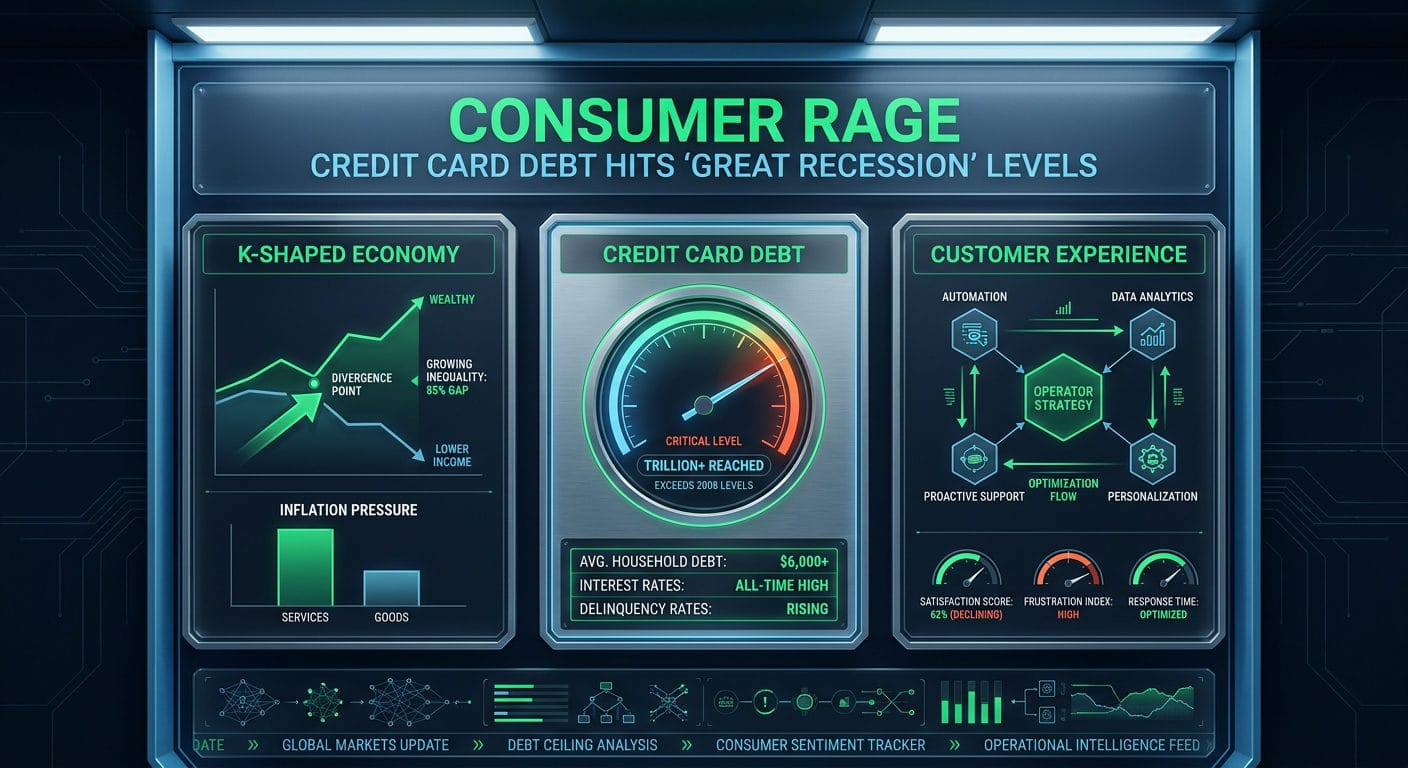
The honeymoon phase is over: consumers are raging, credit card debt is piling up, and the economy is bifurcating into a K-shape, forcing a tactical pivot for operators.
📊 11 episodes across 6 podcasts
⏱ 296 minutes of intelligence analyzed
🎙 Featuring: Angela Buchdahl, Stephen Dubner, Matthew Bogdanos
|
The Lead
The prevailing narrative of a soft landing is being challenged by a groundswell of consumer dissatisfaction and economic divergence. While markets remain fixated on macro indicators, the operational reality on the ground is that customers are furious about rising costs, hidden fees, and abysmal service, creating a critical inflection point for companies.
This isn't just about inflation; it's about a fundamental erosion of trust. Heather Timmons, Consumer Rights Correspondent for The Guardian, pointed out that "much of the big, big business coverage that we see right now really is for investors, but it's not at all focused on how is this company treating its customers." Forrest Morgeson, Research Director Emeritus for the University of Michigan's American Customer Satisfaction Index, adds that "if your number one focus is on squeezing as much profit as you can out of your company, you're not going to be as focused on the things that you need to do to make customers happy."
The data reinforces this: two-thirds of consumers felt rage after a problem last year, and companies prioritizing profit over customer experience are now facing a reckoning. This rage isn't just venting; it's driving consumer behavior. Adrienne Ma on The Indicator from Planet Money highlighted that seriously delinquent credit card debt is at Great Recession levels, indicating a segment of the economy under severe pressure, despite overall market optimism.
This bifurcated reality is creating a 'K-shaped economy' where high-income earners continue to thrive while lower-income segments struggle, a shift Mike Strain, Economist at American Enterprise Institute, noted has evolved beyond pandemic-era specifics to general inequality. The implication for operators is clear: treating all customers equally is a risk when a significant portion feels exploited and financially stressed. A one-size-fits-all customer experience strategy is now a liability.
"Last year in a survey of American consumers, two thirds of those who experienced a problem with the product or service said they felt rage about it."
— NPR, Host at NPR
Strategic Question: How are you proactively segmenting your customer base by financial health and sentiment, and tailoring your service and pricing models to mitigate rising "consumer rage" among your most vulnerable segments?
The Rundown
① AI Shifts Dev Bottleneck from Code Writing to Review.
AI's code generation capabilities are causing a "deluge of pull requests," moving the software development bottleneck from writing code to reviewing it, and breaking traditional SDLC processes. (Harjot Gill on Summation (formerly World of DaaS))
→ The Operator Take: Your engineering team's efficiency is now governed by review capacity; invest in AI-powered review tools and redefine 'senior' roles to focus on higher-order architectural validation, not line-by-line checks.
② Gen Z Is Opting for Entrepreneurship Over Traditional Careers.
A softening entry-level job market, desire for flexibility, and easier access to AI tools are driving a surge in Gen Z entrepreneurship, with AI reducing barriers to entry but increasing overall competition. (Lori Rosenkopf on This Week in Business)
→ The Operator Take: Prepare for a talent market where top young talent expects more autonomy and impact; adapting your internal culture and offering 'intrapreneurial' opportunities can be a critical retention strategy.
③ Customer Experience is an Act of Love, and Leadership is About Bringing People Along.
Ron Johnson, the creator of the Apple Store, emphasized that great customer experiences stem from a culture of "love," and that his failure at JCPenney highlighted the critical need for leaders to build buy-in and bring teams along during organizational change. (Ron Johnson on How Leaders Lead with David Novak)
→ The Operator Take: The 'hard' numbers on customer retention and loyalty are driven by 'soft' skills like empathy and inclusion; if your change initiatives are failing, look first at how effectively you're engaging your people.
④ Tokenization of Equities Is Moving from Concept to Production.
The DTCC successfully converted securities into tokens for live production trades with over 30 major financial firms, paving the way for a full tokenization service launch in October 2026. (Jeff Mahoney on The Voice of Corporate Governance)
→ The Operator Take: The plumbing for tokenized financial assets is being laid; evaluate your treasury and finance stacks for future compatibility, as this will impact settlement times, liquidity, and potentially, capital raising strategies.
The Stack
🔥 HEATING UP
• Everything as Code (marketing, accounting, legal): Harjot Gill on Summation (formerly World of DaaS) predicted that the concept of 'explainability' for AI agent outputs will become a larger category than 'observability' was for fast-moving environments, as agents generate massive amounts of work across various domains.
• Explainability in AI agents: This Week in Business noted that AI tools and techniques are becoming table stakes for new ventures, built into the fabric of how companies do business more efficiently. (Lori Rosenkopf on This Week in Business)
👀 ON WATCH
• New York's antiquities trafficking unit 🆕: Matthew Bogdanos on Freakonomics Radio highlighted the complexities of repatriating looted antiquities, noting the strict U.S. approach that considers stolen items "always stolen."
• Multi-class Stock Company Voting Transparency Act 🆕: Glenn Davis on The Voice of Corporate Governance noted that this bill would give investors necessary data to fully understand the gaps between different classes of stock voting.
• DTCC tokenization service (launching October 2026) 🆕: The DTCC's successful live production trades for tokenized securities indicate a significant step toward broader adoption. (Jeff Mahoney on The Voice of Corporate Governance)
🧊 COOLING OFF
• Dating app business model challenges: Bumble's 16% decline in paying users and Match Group's 70% stock drop signal fundamental issues in the dating app business model, with Ricky Mulvey noting that if the product works well, users no longer need it. (Ricky Mulvey on The Indicator from Planet Money)
• Illicit antiquities market size (not $10 billion): Jim Marone on Freakonomics Radio stated that the illicit antiquities market is probably a couple hundred million dollars annually, debunking common, inflated figures.
The Bottom Line
While AI unlocks new efficiencies, the operational spotlight is shifting to human factors: customer experience, team buy-in for change, and the growing economic strain creating a bifurcated reality for your market.
📖 Want the full episode breakdowns, guest details, and listen links?
Appendix
The Indicator from Planet Money: "Retiree benefits bump, credit repayment slump, and a dating app in the dumps" · 9 min · Featuring Waylon Wong ▶ Listen · Apple Podcasts
Why listen: Understand the rising consumer debt burden and the struggles of digital-first business models like dating apps, impacting overall consumer spending power.
The Indicator from Planet Money: "Consumers are mad as hell and aren't gonna take it anymore" · 9 min · Featuring Waylon Wong ▶ Listen · Apple Podcasts
Why listen: Grasp the critical shift in customer sentiment and the operational imperative to address "consumer rage" driven by perceived corporate profiteering.
The Indicator from Planet Money: "Did you know companies can vote in Delaware?" · 9 min · Featuring Ricky Mulvey ▶ Listen · Apple Podcasts
Why listen: Gain insight into unconventional corporate governance and voting rights, particularly in jurisdictions like Delaware, affecting policy and shareholder influence.
The Indicator from Planet Money: "Borrowing money to invest! What could go wrong?" · 9 min · Featuring Waylon Wong ▶ Listen · Apple Podcasts
Why listen: Evaluate the risks of soaring margin debt and its potential impact on market stability, especially if economic conditions tighten further.
The Indicator from Planet Money: "C is for C-shaped economy" · 9 min · Featuring Wayland Wong ▶ Listen · Apple Podcasts
Why listen: Unpack the nuances of a K-shaped economy where economic gains are unevenly distributed, influencing market segmentation and growth strategies.
Freakonomics Radio: "What if Being a Stranger Is Actually Your Superpower? | Better in Person" · 34 min · Featuring Angela Buchdahl ▶ Listen · Apple Podcasts
Why listen: Explore perspectives on overcoming polarization and fostering empathy, offering frameworks for more constructive engagement in diverse teams and markets.
Freakonomics Radio: "The Case of the $4 Million Gold Coffin (Update)" · 54 min · Featuring Stephen Dubner ▶ Listen · Apple Podcasts
Why listen: Understand the complexities of international legal standards and provenance, relevant for any organization dealing with high-value assets and global supply chains.
How Leaders Lead with David Novak: "#304: Ron Johnson, Creator of the Apple Store – A great customer experience is an act of love" · 71 min · Featuring Ron Johnson ▶ Listen · Apple Podcasts
Why listen: Learn direct lessons from a retail visionary on building customer-centric cultures and the critical role of leadership in guiding teams through significant organizational change.
Summation (formerly World of DaaS): "CodeRabbit CEO Harjot Gill on software's new bottleneck and zero to $50m ARR in 2 years" · 55 min · Featuring Harjot Gill ▶ Listen · Apple Podcasts
Why listen: Get a direct read on how AI is fundamentally altering software development workflows, product-led growth strategies, and the evolving role of developers in the enterprise.
The Voice of Corporate Governance: "CII’s Monthly Governance and Capital Market Regulation Update (July 2 - 30)" · 26 min · Featuring Jeff Mahoney ▶ Listen · Apple Podcasts
Why listen: Stay informed on critical regulatory updates impacting corporate governance, particularly around shareholder rights, climate disclosures, and the emerging landscape of tokenized assets.
This Week in Business: "Why Gen Z Is Choosing Entrepreneurship Over Traditional Careers" · 11 min · Featuring Lori Rosenkopf ▶ Listen · Apple Podcasts
Why listen: Understand the drivers behind Gen Z's shift towards entrepreneurship, which will profoundly impact talent acquisition, retention, and innovation dynamics within your organization.
