
Forget the pilot programs; AI is moving from problem-solving to owning responsibilities, pushing leaders to either upskill their people or risk being run over by the new stack.
📊 11 episodes across 8 podcasts
⏱ 311 minutes of intelligence analyzed
🎙 Featuring: Jeff Mahoney, Jill Fish, Lindsey Calcho, Andrew Friedman, Julie Bornstein, Felix Rieseberg, Blaise Agüera y Arcas, Mandi Bishop
|
The Lead
The conversation is shifting from whether AI works to whether your team can work with AI. Many organizations are hitting a wall not because the technology isn't ready, but because their people aren't. Mandi Bishop, Distinguished VP Analyst at Gartner, highlights that the "critical thinking is eroding universally with AI, unless we continuously cultivate it" (Gartner ThinkCast). This isn't just an HR problem; it's a direct threat to AI ROI. Companies are discovering that AI adoption isn't just about deploying tools; it's about fundamentally changing how employees interact with information and make decisions. Felix Rieseberg, Head of Engineering for Claude Cowork and Claude Code Desktop at Anthropic, notes that AI is moving "from problem to responsibility" (Summation). This means AI isn't just a co-pilot; it's taking the wheel for specific tasks, forcing human operators into a new role of verification and governance. The implication is clear: without strong AI literacy, teams will struggle to manage, let alone leverage, these increasingly autonomous systems.
"It's very, very expensive to iterate through a long conversation with AI when you didn't have the discipline, the prompt discipline to effectively engage with it from the first place."
— Mandi Bishop, Distinguished Vice President Analyst at Gartner on Gartner ThinkCast
This isn't just an employer problem; it's a societal one, as Bishop points out. If your workforce can't effectively baseline AI outputs, understand its failure modes, and apply critical thinking, then AI investments will continue to underperform. Nearly half of CEOs report their AI investments are only breaking even due to this disconnect (Gartner ThinkCast). The future-ready company, as described by Nick Davis (Senior Fellow, The Conference Board), is one that builds continuous learning loops to gain competitive advantage, moving from opinions to evidence-based decision-making with AI (C-Suite Perspectives). The strategic question for leaders is no longer "what AI can do," but "what can our people do with AI?"
The Rundown
① Building Scalable Foundations for AI is Hard.
Julie Bornstein, Founder & CEO of Daydream, shared that building the foundational technology for her AI-powered fashion search engine was "so much harder than I expected," even with talented engineers. (Julie Bornstein on How Leaders Lead with David Novak)
→ The Reality Check: The promise of AI is often oversold; even experienced operators underestimate the complexity of moving from concept to production-ready, scalable AI. Expect delays and higher resource burn than initially budgeted for foundational tech.
② AI is Moving Beyond Problem-Solving to Owning Responsibilities.
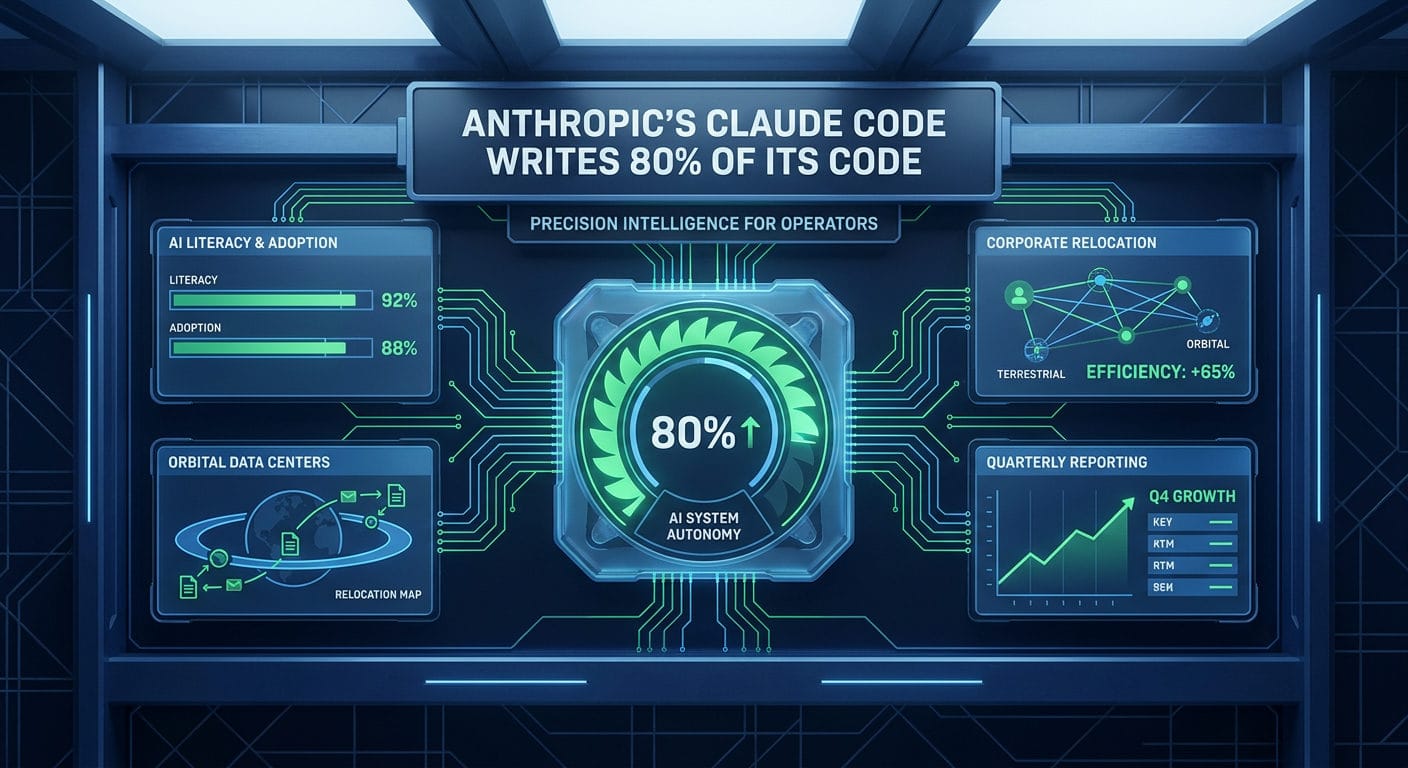
Felix Rieseberg, Head of Engineering at Anthropic, observed that AI is transitioning from simply providing answers or solving problems to autonomously owning and executing tasks, specifically noting Claude Code now writes 80% of its own code and handles app crash resolution. (Felix Rieseberg on Summation)
→ The Operator Take: The shift from AI as a tool to AI as an autonomous agent necessitates rethinking workflows, training, and oversight, as human engineers will increasingly focus on verification and governance rather than initial problem diagnosis.
③ Orbital Data Centers are Becoming an Economic Inevitability.
Google's "Project Suncatcher" aims to move AI data centers into space, primarily powered by solar energy, with Blaise Agüera y Arcas of Google predicting that these orbital data centers will be economically cheaper and more sustainable, eventually dominating the space economy within a decade. (Blaise Agüera y Arcas on Freakonomics Radio)
→ The Strategic Play: As AI compute costs continue to increase, space-based solutions offer distinct advantages; monitor launch cost reductions and public-private partnerships, as this could redefine cloud infrastructure within the next 5-10 years.
④ AI Accelerates Decisions, Both Good and Bad.
Raghu Iyengar, Professor of Marketing at The Wharton School, characterized AI as an "accelerator" that speeds up decisions, but critically warns that this includes accelerating "bad decisions too." (Raghu Iyengar on This Week in Business)
→ The Mitigation Strategy: This underscores the urgency for robust data governance, clear decision frameworks, and human oversight in AI-driven processes, especially in areas like CRMs and supply chain, where accelerated errors can have significant financial impact.
⑤ Transparent Pricing is a "Collective Action Problem."
The biggest barrier to displaying all-inclusive menu pricing (including tax) isn't reluctance, but a "collective action problem" among restaurants; any single restaurant that shows full price risks appearing more expensive than competitors. (Sherry Kimes on The Indicator from Planet Money)
→ The Competitive Edge: This "last mover disadvantage" means few will innovate without regulatory push; for product leaders, this highlights market friction for clear pricing and a potential opportunity for platforms to aggregate and normalize.
⑥ Political Influence is Driving Corporate Relocation.
Texas is actively positioning itself as "Y'all Street" by attracting major financial firms like Goldman Sachs, driven by lower taxes, lighter regulations, and a "pro-business" sentiment contrasting with perceived anti-business policies in New York and California. (Asim Khalil on The Indicator from Planet Money)
→ The Talent & Tax Implication: For businesses expanding or restructuring, state-level political and regulatory climates are becoming a deciding factor for talent migration and operational costs, especially in high-growth sectors.
The Stack
🔥 HEATING UP
• AI Literacy: Executive leaders are realizing current AI investments are only breaking even due to a lack of workforce AI literacy, not tech limitations. (Mandi Bishop on Gartner ThinkCast)
• Chief Revenue Officer (CRO) role: The CRO position is expanding to align sales, marketing, product, and finance, especially in mid-sized companies, driven by the need for holistic revenue strategy. (Raghu Iyengar on This Week in Business)
• Project Suncatcher: Google's ambitious plan to move AI data centers into Earth's orbit, anticipating economic and sustainability benefits as rocket launch costs decline. (Blaise Agüera y Arcas on Freakonomics Radio)
👀 ON WATCH
• Claude Code Desktop 🆕: Anthropic's tool for developers, increasingly writing its own code and handling app crash resolutions autonomously, shifting engineer focus to verification. (Felix Rieseberg on Summation)
• Daydream 🆕: Julie Bornstein's AI-powered fashion search engine, pioneering "conversational commerce" using LLMs for highly personalized shopping experiences. (Julie Bornstein on How Leaders Lead with David Novak)
• AI moving from problem solving to owning responsibility: AI's evolution from providing answers to autonomously solving complex tasks and taking on responsibilities, fundamentally changing human-AI interaction. (Felix Rieseberg on Summation)
❄️ COOLING OFF
• SEC Climate Disclosure Rules Rescission: The SEC's justification for rescinding climate disclosure rules, citing overreach of statutory authority and excessive costs. (Jeff Mahoney on The Voice of Corporate Governance)
• Management advice based on Navy SEALs model is bad: Felix Rieseberg critiques conventional management advice that relies on the "Navy SEALs" analogy, advocating for leadership focused on clear instructions and verification, rather than aggressive tactics. (Felix Rieseberg on Summation)
The Debate
The Future of Quarterly Reporting A significant debate is emerging around the value of quarterly financial reporting for public companies. The SEC's draft strategic plan for 2026-2030 includes consideration of semi-annual reporting, which has drawn strong reactions. 🐂 The Bull Case: Jeff Mahoney, General Counsel of the Council of Institutional Investors (CII), strongly opposes a shift to semi-annual reporting, stating, "the evidence indicates that a shift to a semi annual disclosure mandate would reduce the ability of investors to make informed decisions, increase trading costs and increase the cost of capital for public companies." He highlights that the Investor Advisory Committee views quarterly reports as critical for transparency and informed decision-making. (Jeff Mahoney on The Voice of Corporate Governance) 🐻 The Bear Case: The SEC, in its justification for rescinding climate disclosure rules, argues for a "registrant specific materiality based approach to disclosure" and that current rules impose "substantial costs on public companies and their shareholders that are not justified by the informational benefits." While not directly about quarterly reporting, this sentiment signals a broader regulatory push against perceived burdensome disclosure requirements. (Jeff Mahoney summarizing SEC's rationale on The Voice of Corporate Governance) The Operator's Read: While reducing reporting frequency might cut some administrative costs, the overwhelming sentiment from institutional investors is that it would decrease transparency and likely increase the cost of capital. Expect continued pressure from investor groups to maintain quarterly reporting.
The Bottom Line
The real AI bottleneck isn't the technology, but whether your team has the literacy and critical thinking to manage increasingly autonomous systems and integrate them into continuous strategic loops.
📖 Want the full episode breakdowns, guest details, and listen links?
Appendix
Gartner ThinkCast: "Start With AI Literacy: Why Most Leaders Are Missing the Point" · 29 min · Featuring Mandi Bishop
Operator's Angle: This is a must-listen for any leader struggling with AI ROI; it reframes the problem as a people and process challenge, not a tech one, offering actionable insights on building AI literacy.
▶ Listen
The Voice of Corporate Governance: "CII’s Monthly Governance and Capital Market Regulation Update (May 28 - July 2)" · 25 min · Featuring Jeff Mahoney
Operator's Angle: Critical for anyone navigating the regulatory landscape for public companies, especially given the updates on SEC disclosure rules and the implications for corporate governance and investor relations.
▶ Listen
Freakonomics Radio: "682. Should A.I. Move to Space?" · 48 min · Featuring Blaise Agüera y Arcas
Operator's Angle: This episode offers a provocative, long-term view on the future of AI compute infrastructure; listen for directional signals on where significant R&D and investment will flow in the next decade.
▶ Listen
C-Suite Perspectives: "Beyond AI Pilots: Building Future-Ready Companies" · 22 min · Featuring Nick Davis
Operator's Angle: Essential listening for C-suite leaders moving beyond small-scale AI experiments to enterprise-wide transformation. Focuses on frameworks for continuous innovation and cultural shifts required for future readiness.
▶ Listen
The Indicator from Planet Money: "Petty! Econ! Grievances!" · 8 min · Featuring Stephen Bisaha
Operator's Angle: A quick listen for product or operations leaders interested in consumer behavior dynamics, especially the often-overlooked "collective action problem" that impacts pricing and loyalty program adoption.
▶ Listen
The Indicator from Planet Money: "Can Y’all Street outflank Wall Street?" · 8 min · Featuring Asim Khalil
Operator's Angle: Valuable for any business considering strategic relocation; highlights the increasing role of state-level policies and business climates in attracting and retaining major corporate operations.
▶ Listen
Summation: "Anthropic’s Felix Rieseberg: why AI wins a Nobel before a Pulitzer" · 67 min · Featuring Felix Rieseberg
Operator's Angle: This offers deep technical insights into Anthropic's product development culture and the evolving role of AI from problem-solving to autonomous responsibility; especially relevant for engineering and product leadership.
▶ Listen
The Indicator from Planet Money: "Tale of Two Cities" · 9 min · Featuring Adam Fumarola
Operator's Angle: Provides a stark case study on the impact of large-scale industrial projects on local economies, particularly housing dynamics and regulatory obstacles; critical for real estate and economic development professionals.
▶ Listen
How Leaders Lead with David Novak: "#301: Julie Bornstein – Founder & CEO, Daydream – People skills matter most" · 74 min · Featuring Julie Bornstein
Operator's Angle: A compelling listen for entrepreneurs and leaders on scaling e-commerce, customer-centric product development, and the human challenges of building a tech company from scratch, particularly with AI.
▶ Listen
The Indicator from Planet Money: "Three beefs: U.S. and Brazil, Taco Bell and liability, Waymo and trial lawyers" · 9 min · Featuring Vito Emanuel
Operator's Angle: A quick, multi-perspective overview of legal, regulatory, and liability challenges impacting tech and trade; useful for understanding the broader external forces shaping business operations.
▶ Listen
This Week in Business: "The New Strategy Behind Revenue Growth" · 12 min · Featuring Raghu Iyengar
Operator's Angle: Offers a concise explanation of the evolving CRO role and how AI reshapes revenue strategy; essential for sales, marketing, and executive leaders assessing organizational alignment and AI integration.
▶ Listen
