
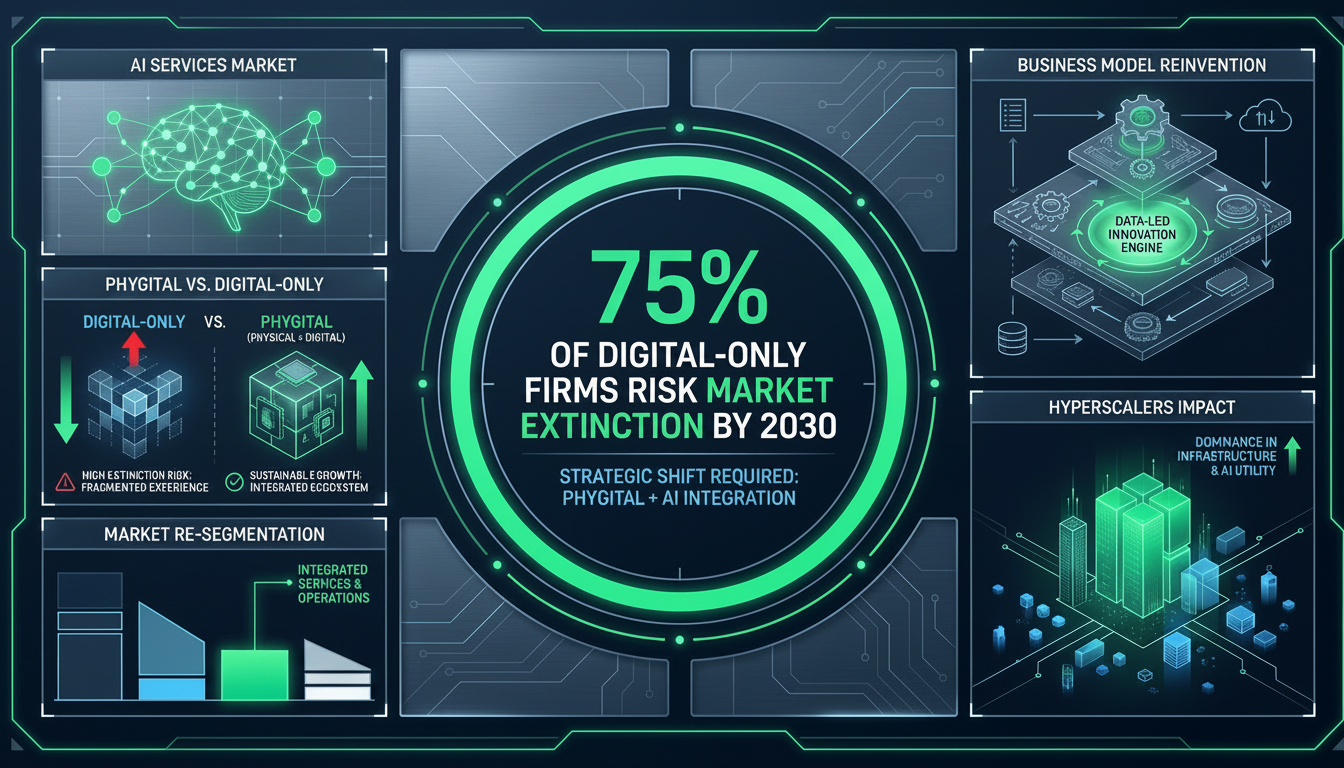
The AI services market is splitting into 'phygital' leaders and 'digital-only' laggards, forcing enterprises to rethink outsourcing and talent development or risk being consumed by hyperscalers.
📊 11 episodes across 9 podcasts
⏱ 339 minutes of intelligence analyzed
🎙 Featuring: Gartner, Craig Lowery, Scott Frederick, Adrian Ma
|

The Lead
The AI services landscape is undergoing a massive re-segmentation, creating a stark divide between "phygital" providers leveraging deep domain expertise and physical integration, and traditional digital-only players facing an existential threat from hyperscalers. This isn't just about new tech; it's about a fundamental shift in how services are delivered and valued, demanding a proactive dismantling of legacy business models.
Gartner analysts Craig Lowery and Scott Frederick highlighted this bifurcation, noting that the ability to integrate AI agents for "growth without growth" is becoming paramount. They predict that by 2030, a staggering 75% of tech service providers sticking to opex-heavy digital-only strategies will struggle for market share. This means the days of simply offering digital services without a tangible, physically integrated component or unique domain specialization are numbered.
"To survive, managed service providers have to proactively cannibalize their own legacy business models. Pivot to higher value opportunities."
— Scott Frederick, VP Analyst and Research Manager at Gartner
This isn't a slow burn; it's an urgent call for reinvention. As Lowery put it, "Deep domain expertise and physical integration are the moats, the new moats that are protecting providers from the hyperscalers." This shift directly impacts build-vs-buy decisions, talent development, and ultimately, competitive leverage. For operators, the question isn't if AI will change their service model, but how quickly they can adapt to a "phygital" future and use AI to scale without proportionally scaling headcount.
The Rundown
① VC Sourcing Shifts to Agent-to-Agent Meetings.
Venture Capital is rapidly adopting AI agents for initial deal sourcing and evaluation, with predictions that first meetings will be fully automated within two years. (Auren Hoffman on Summation)
→ The Operator Take: If VCs are cutting humans out of the initial contact, early-stage companies must ensure their digital footprint and AI-facing materials are optimized to speak to agents, not just people.
② Legal AI Delivers 400% ROI, Expands Capacity.
Law firms are seeing tangible, significant ROI from AI adoption, with one firm reporting a 400% ROI and a 20-25% increase in caseload capacity. (Nina Lund on Clarity)
→ The Operator Take: AI is moving past efficiency gains to direct revenue generation and capacity expansion; evaluate how to redeploy talent from labor-intensive tasks to higher-value activities.
③ Remote Work, Not AI, Blamed for Junior Hire Struggles.
New research suggests that remote work, not AI, is the primary factor limiting first job opportunities for recent graduates, accounting for nearly two-thirds of the recent rise in unemployment among young college graduates. (Darian Woods on The Indicator from Planet Money)
→ The Operator Take: Consider the potential impact of hiring model choices on junior talent pipelines, and ensure remote work policies are not inadvertently creating barriers for new entrants.
④ US Political Deadlock Traced to Two "Minority Parties".
Yuval Levin argues that American politics is trapped in a deadlock because both major parties effectively function as minority parties, leading to a focus on mobilization over coalition-building, reminiscent of the Gilded Age. (Yuval Levin on C-Suite Perspectives)
→ The Operator Take: Political gridlock can significantly impact long-term regulatory and fiscal stability; factor this persistent instability into strategic planning for markets reliant on government action or consistent policy.
The Stack
🔥 HEATING UP
• AI agents 🆕: Rapidly evolving, powering VC sourcing and poised to make up 50% of cloud managed and business process services by 2030. (Auren Hoffman on Summation; Scott Frederick on Gartner ThinkCast)
• Phygital Experiences: The new competitive moat for service providers, integrating physical infrastructure and deep domain expertise with AI. (Craig Lowery on Gartner ThinkCast)
• Continuous innovation: An absolute market demand, where established companies must significantly improve products monthly to avoid losing customers. (Max Altschuler on Summation)
• Sustainable Finance: Becoming a business imperative rather than a "nice-to-have," driven by regulations and investor demand for impact plus return. (Tashmeem Muntazir Chowdhury on C-Suite Perspectives)
👀 ON WATCH
• Growth without growth 🆕: A new strategy enabled by AI agents, allowing companies to scale rapidly without proportional headcount increases. (Scott Frederick on Gartner ThinkCast)
• Synthetic contact 🆕: Using AI to impersonate outgroup members to reduce political animosity, showing promising early research results. (Stefano Puntoni on This Week in Business)
• Black unemployment as a leading indicator 🆕: A 1 percentage point rise often precedes a 0.2 percentage point increase in overall unemployment within months. (Waylon Wong on The Indicator from Planet Money)
• Client expectations for AI adoption in legal 🆕: Law firms are increasingly seeing AI discussed in procurement, becoming a baseline expectation rather than a differentiator. (Gregory Ginex on Clarity)
❄️ COOLING OFF
• Digital-only service models: Struggling against hyperscalers and at risk of losing significant market share by 2030. (Scott Frederick on Gartner ThinkCast)
• Libertarian myth of the internet: The idea of social media as a neutral platform is under fire, seen as having enabled Big Tech's unchecked power and lack of accountability. (Olivier Sylvain on The Indicator from Planet Money)
• Section 230 legal immunity: Increasing calls for narrowing protections to hold tech companies accountable for known harms caused by their services. (Olivier Sylvain on The Indicator from Planet Money)
• Traditional venture capital sourcing: Being disrupted by AI agents, shifting from human-led initial meetings to automated evaluations. (Auren Hoffman on Summation)
The Bottom Line
The AI services market transformation is accelerating, separating forward-thinking "phygital" operators from digital-only incumbents, demanding a strategic refocus across every sector from legal to venture capital.
📖 Want the full episode breakdowns, guest details, and listen links?
Appendix
Gartner ThinkCast: "The AI Services Split: From Digital to Phygital" · 24 min · Featuring Craig Lowery
The Operator Read: For CTOs evaluating outsourcing partners, understand whether a vendor is genuinely 'phygital' or just a digital-only provider vulnerable to hyperscalers, as their long-term viability and innovation capacity directly impact your roadmap. ▶ Listen
This Week in Business: "How Artificial Intelligence Is Reshaping Business and Society" · 15 min · Featuring Stefano Puntoni
The Operator Read: Keep track of the 'two races' in AI development (scale vs. efficiency) to inform both your build-vs-buy decisions and your strategic planning for emerging models and compute requirements. ▶ Listen
Freakonomics Radio: "676. Has America Lost the Plot?" · 65 min · Featuring Fareed Zakaria
The Operator Read: Geopolitical instability, particularly in the Middle East, continues to be driven by complex, long-standing dynamics and could have ongoing implications for global supply chains and energy markets. ▶ Listen
C-Suite Perspectives: "America at 250: How Can We Move Past Political Deadlock?" · 31 min · Featuring David Young
The Operator Read: Political deadlock is an ongoing factor in the US economy; leaders should build resilience into their strategies, assuming continued policy gridlock rather than expecting sweeping reforms. ▶ Listen
HBR IdeaCast: "Reinventing an Organization to Do More With Less" · 28 min · Featuring Kelly T. Clements
The Operator Read: Learn from large, resource-constrained organizations like the UNHCR about motivating teams and managing change in complex, bureaucratic environments, as these challenges are increasingly universal. ▶ Listen
The Indicator from Planet Money: "Can the internet be reclaimed from Big Tech?" · 9 min · Featuring Adrian Ma
The Operator Read: Keep a close eye on legal reforms to Section 230 and data protection laws; changes could significantly impact digital advertising, content moderation, and data-driven business models. ▶ Listen
Summation: "GTMnow Podcast | Your First VC Meeting Will Be Agent-to-Agent" · 40 min · Featuring Auren Hoffman
The Operator Read: Prepare for a future where initial business interactions, including investor pitches, are mediated by AI agents, requiring a shift in how you present and optimize your enterprise's digital presence. ▶ Listen
How Leaders Lead with David Novak: "#294: Bobby Long, Partner and Co-Founder, Piedmont Capital Partners – See the best in people" · 68 min · Featuring Bobby Long
The Operator Read: Prioritize long-term impact and relational capital in your business ventures, even when facing high-risk, long-timeline projects, as this can open doors to significant, overlooked opportunities. ▶ Listen
The Indicator from Planet Money: "Who should new grads boo more? AI or remote work?" · 9 min · Featuring Adrienne Ma
The Operator Read: Re-evaluate your remote work policies to ensure they are not inadvertently hindering the entry and development of junior talent, particularly if your organization relies on a strong talent pipeline. ▶ Listen
C-Suite Perspectives: "Building Investor Trust Through Sustainable Finance" · 21 min · Featuring Barbara Mendes-Jorge
The Operator Read: Accelerate your organization's ESG performance and reporting, as it's no longer just compliance but a core business imperative for investor trust and access to lower-cost capital. ▶ Listen
Clarity: "What is the real business value of AI for today's law firms?" · 29 min · Featuring Steve Assie
The Operator Read: Consider AI not just for efficiency gains but as a tool to significantly increase operational capacity and reshape talent development, turning junior staff into 'profit centers' earlier in their careers. ▶ Listen
