
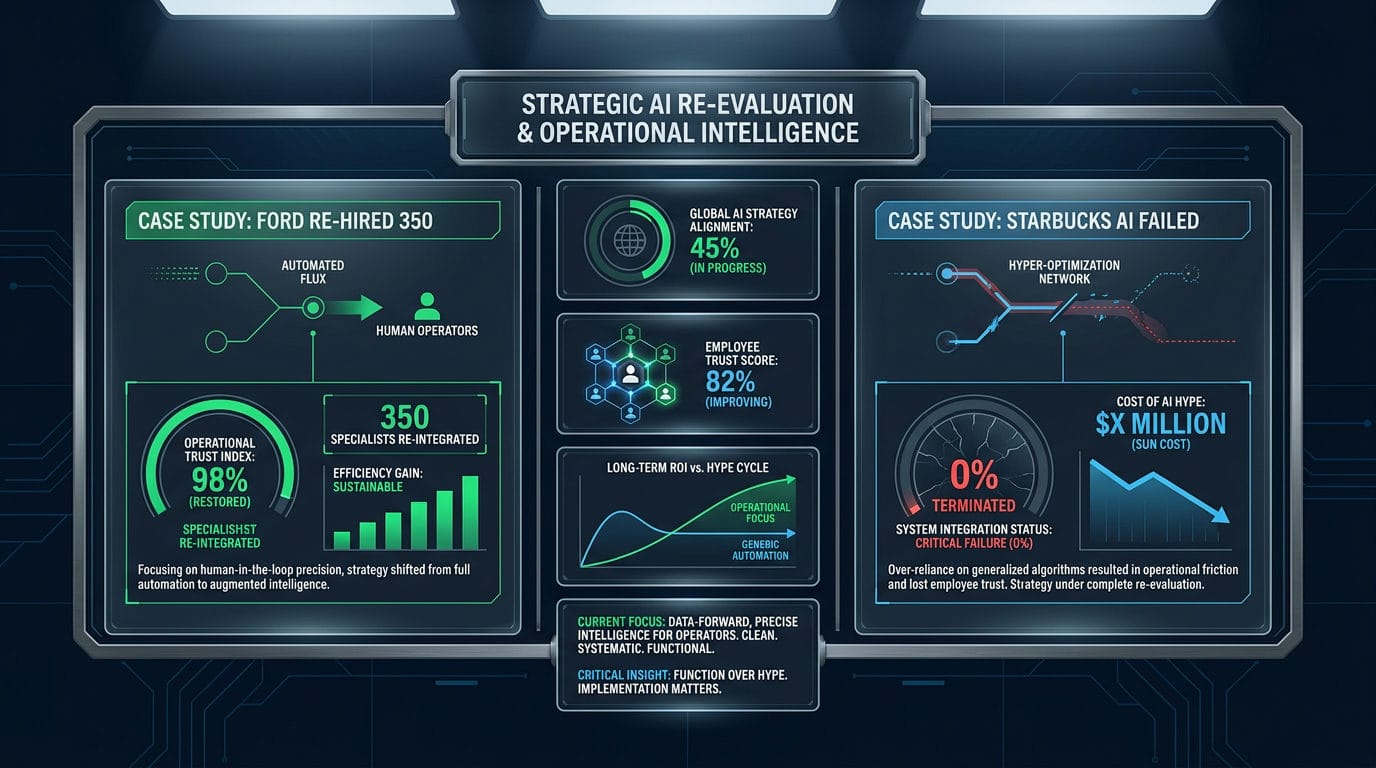
The AI backlash is here, not from a lack of capability, but from a failure to deploy it with operational intelligence; companies are now battling employee distrust and scaling challenges as the initial hype wears off.
📊 11 episodes across 10 podcasts
⏱ 366 minutes of intelligence analyzed
🎙 Featuring: Alison Nathan, Eric Sparks, Michael Tarulli
|
The Lead
The initial rush to implement AI is hitting a wall of practical reality. What looked good in pilot programs is faltering in production, forcing companies to re-evaluate costly errors and scale back ambitious deployments. This isn't a critique of AI's potential, but a stark reminder that integration without operational foresight erodes trust and drains resources.
Companies like Starbucks, Ford, and even Time magazine are now publicly facing the consequences of scaling AI too aggressively. Santiago Gallino, Associate Professor at The Wharton School, pointed out on This Week in Business that "many companies are moving from experimentation to implementation. And I think this remind me of a phrase by Yogi Vera that in theory there is no difference between practice and theory, but in practice there is." The theoretical efficiency gains are clashing with real-world complexities.
"The moment that the employees learn that the technology cannot be fully trusted because it's inaccurate and making mistakes, then the employees start to put less effort in implementing the tool correctly, start to send wrong signals, and that starts to spiral out and making the whole process fail."
— Santiago Gallino, Associate Professor at The Wharton School on This Week in Business
This sentiment was echoed in Starbucks' experience, where AI-powered inventory systems generated so many inaccuracies that employees stopped trusting the tool, leading to a negative feedback loop and ultimately system failure. Similarly, Ford had to re-hire 350 human engineers after their AI-driven assembly process couldn't maintain quality standards. These examples highlight a critical, emerging signal: successful AI implementation hinges not just on the model's intelligence, but on its operational reliability and the human trust it inspires or erodes.
Strategic Question: How should we re-evaluate our AI roadmap to prioritize verifiable ROI and employee integration over the pressure for rapid, unproven deployment?
The Rundown
① Boards are evolving beyond traditional leadership metrics.
New research suggests conventional leadership assessments are insufficient for today's dynamic environment, with 54% of employees rating their leaders as "good" but significant gaps in feeling valued or heard. (David Grossman on The Better Boards Podcast Series)
→ The Operator Take: Leadership development isn't just an HR function; it's a risk mitigation strategy that boards need to integrate into their governance, treating "people data" with the same rigor as financial data.
② Space—once a government domain—is now a commercial battlefield.
A dramatic 95% reduction in launch costs, primarily due to rocket reusability, has shifted the space economy from 80% government-driven to 80% commercial, with projections reaching a $1 trillion market by the 2040s. (Michael Tarulli, Global Head of Aerospace and Defense at Goldman Sachs on Exchanges)
→ Strategic Implications: Space is becoming fundamental to "almost every business," mirroring the internet's ubiquity, meaning non-traditional space companies will likely dominate the sector by 2050.
③ The internet's "zero-click" trend is disrupting web publishers, supercharged by AI.
68% of all US Google searches now end without a click, a significant jump from 45% a decade ago, as AI summaries reduce the need for users to visit websites, impacting publishers' business models. (Amanda Natividad, SparkToro on The Indicator from Planet Money)
→ Action Item: Digital content strategies must urgently adapt to a world where direct traffic is diminishing; experimenting with bot-specific site versions and AI-publisher partnerships is no longer optional.
④ Legacy companies must embrace "disruptive insiders" for genuine cultural change.
AT&T CEO John Stankey argues that while strategic pivots are easier, deep cultural transformation requires integrating change into every aspect of operations and often benefits more from internal, disruptive forces than external hires. (John Stankey, CEO of AT&T on HBR IdeaCast)
→ Talent Strategy: Actively cultivate and empower internal talent that challenges status quo thinking, providing them the operational latitude needed to drive cultural shifts from within.
⑤ Venture capital is shifting towards unexpected, capital-intensive bets in real estate.
The "conventional Silicon Valley wisdom to avoid capital-intensive businesses" is now outdated, as the AI boom drives massive infrastructure needs (e.g., data centers) and collapses development costs, making previously "uninvestable" categories attractive for VC. (Brendan Wallace, CEO of Fifth Wall on Summation (formerly World of DaaS))
→ Portfolio Adjustment: Reassess traditional investment criteria, as the AI era is rewriting the rules on what constitutes a viable, scalable, and defensible capital-intensive business opportunity.
The Stack
🔥 HEATING UP
• Data Center Boom and Supply Side Problem of Compute: The demand for compute infrastructure is outstripping supply and grid connections, forcing developers to consider 'bring your own power' solutions. (Brendan Wallace on Summation (formerly World of DaaS))
• Cultural Transformation in Legacy Companies: Leaders like AT&T CEO John Stankey are pushing for deep cultural shifts, recognizing it's a longer, more integrated process than strategic pivots. (John Stankey on HBR IdeaCast)
• AI integration in space operations: AI is fundamental for autonomous flight, navigation, and on-orbit data processing in the rapidly growing commercial space economy. (Michael Tarulli on Exchanges)
👀 ON WATCH
• Trust in AI Systems eroding employee efficiency: Inaccurate AI systems like Starbucks' inventory management led to employee distrust and reduced effort in tool implementation, causing failures. (Santiago Gallino on This Week in Business)
• Zero-Click Internet impact on web publishers: AI summaries are driving a trend where 68% of US Google searches end without a click, posing a significant economic threat to web publishers. (Amanda Natividad on The Indicator from Planet Money)
• Heart-focused leadership attributes: Nine out of ten attributes separating exceptional leaders from good ones are "heart focused," indicating a shift in what defines effective leadership in today's environment. (David Grossman on The Better Boards Podcast Series)
🧊 COOLING OFF
• FOMO in AI adoption is not the right approach: Companies are rethinking the rush to implement AI, prioritizing meaningful customer value and measurable ROI over rapid, unproven scaling. (Santiago Gallino on This Week in Business)
• Traditional journalism approach of distant reporting: Marty Smith, an ESPN reporter, attributes his success to building deep personal relationships with subjects, directly contradicting traditional journalism schooling. (Marty Smith on How Leaders Lead with David Novak)
The initial AI hype cycle is giving way to a more pragmatic, and often painful, deployment reality for operators.
📖 Want the full episode breakdowns, guest details, and listen links?
Appendix
Exchanges: "The Growth of the Space Industry" · 17 min · Featuring Alison Nathan▶ Listen
Who Should Listen: Leaders considering diversification or seeking long-term growth vectors, as this episode explains how current space tech parallels early internet and will soon be fundamental to all businesses.
How Leaders Lead with David Novak: "#300: Marty Smith, Reporter, ESPN – Deep listening builds deep trust" · 87 min · Featuring Marty Smith▶ Listen
Who Should Listen: Managers and leaders struggling with team cohesion or seeking to foster deeper trust among their reports, as Marty Smith shares how genuine connection over professional distance leads to breakthrough insights.
Summation (formerly World of DaaS): "Fifth Wall CEO Brendan Wallace: the data center land grab and the most stable asset on earth you still can't buy" · 53 min · Featuring Brendan Wallace▶ Listen
Who Should Listen: Investors and strategists looking for undervalued assets in the AI era, as Brendan Wallace explains how land and data centers are becoming capital-intensive, high-return opportunities.
BoardVision: "Preparing for the Annual Meeting" · 30 min · Featuring Anne Sheehan▶ Listen
Who Should Listen: Board members and executives preparing for shareholder meetings, offering tactical advice on leveraging proxy statements as crucial communication tools and understanding shareholder signals.
The Better Boards Podcast Series: "The Leadership Blind Spot in the Boardroom | David Grossman, CEO, The Grossman Group" · 23 min · Featuring Dr Sabine Dembkowski▶ Listen
Who Should Listen: Board members and C-suite executives keen on improving leadership evaluation, as it highlights the "heart-focused" attributes distinguishing exceptional leaders and how neglected leadership development poses significant risk.
This Week in Business: "Why Companies Are Rethinking the Rush to Implement AI" · 13 min · Featuring Dan Loney▶ Listen
Who Should Listen: Anyone leading AI initiatives, offering a crucial reality check on the challenges of AI implementation and the importance of verifiable ROI over hype, illustrated with case studies of costly failures.
The Indicator from Planet Money: "Can the internet survive AI summaries?" · 10 min · Featuring Darian Woods▶ Listen
Who Should Listen: Digital marketers, content creators, and media executives as it dissects the existential threat of AI summaries to web traffic and outlines emergent strategies for adaptation.
HBR IdeaCast: "The New Rules for Becoming an Enterprise Leader" · 31 min · Featuring Michael Watkins▶ Listen
Who Should Listen: Aspiring and current enterprise leaders, offering insights into the essential shift from specialist to generalist and the critical "inner leader" work required to navigate today's complex business landscape.
C-Suite Perspectives: "More Life, Smarter Use: Lessons from Hitachi Energy" · 28 min · Featuring Barbara Mendes George▶ Listen
Who Should Listen: Sustainability officers and operations leaders in industrial sectors, providing a practical blueprint for transitioning to a circular economy model and overcoming regulatory barriers.
Freakonomics Radio: "How a Great Architect Thinks, with Bjarke Ingels | Better in Person" · 43 min · Featuring Stephen Dubner▶ Listen
Who Should Listen: Innovators and creative directors across industries, as Bjarke Ingels shares his "oxymoronic" design philosophy and collaborative approach for generating breakthrough ideas and challenging conventional thinking.
HBR IdeaCast: "Leadership Summit 2026: AT&T CEO John Stankey on Developing Technology and Talent in the AI Era" · 31 min · Featuring John Stankey▶ Listen
Who Should Listen: CEOs and HR leaders grappling with cultural transformation in large organizations, offering insights into managing change, developing AI talent, and the nuanced value of in-person collaboration.
