
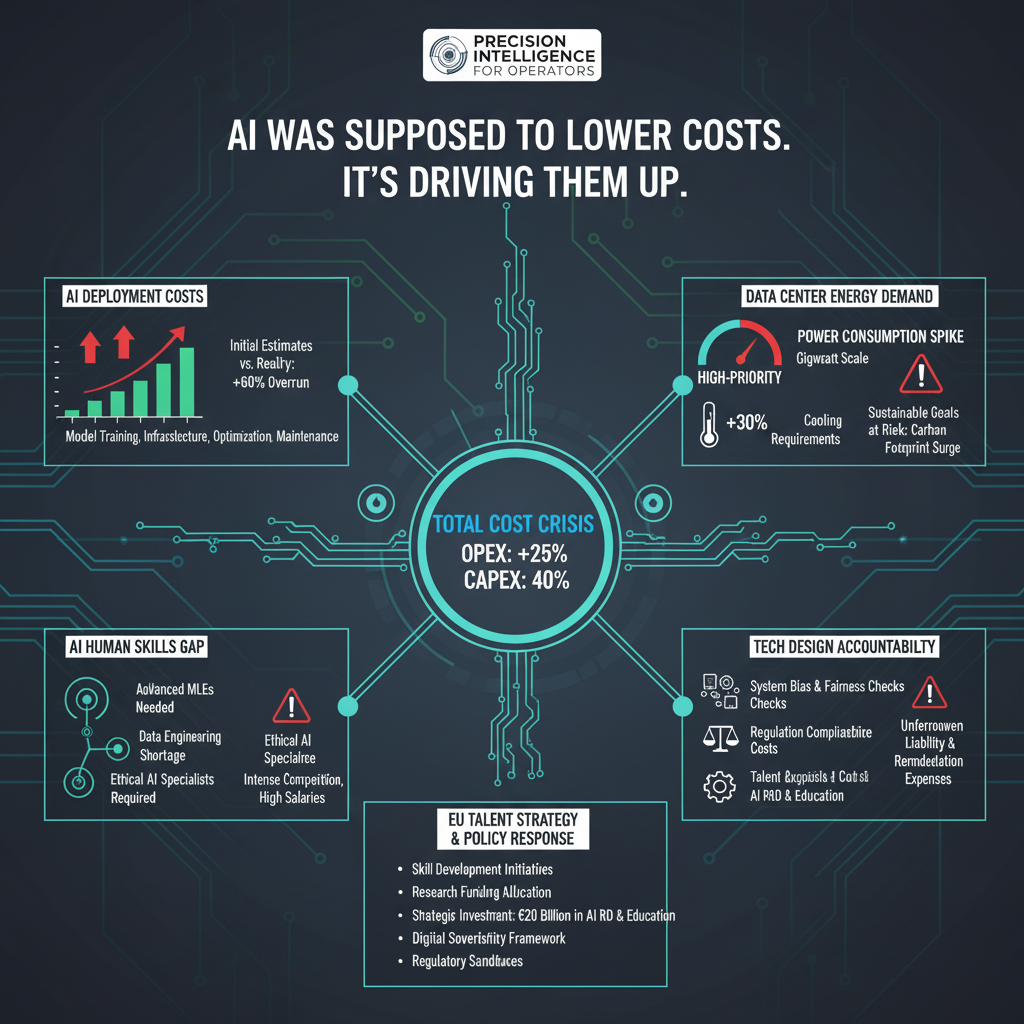
The honeymoon phase for AI is over; operators are now laser-focused on the human and infrastructure costs of deployment, not just model capabilities.
📊 11 episodes across 9 podcasts
⏱ 348 minutes of intelligence analyzed
🎙 Featuring: Alexis Wearinga, Mandi Bishop, Sara Murray, Robin Maillard
The Lead
The conversation around AI is rapidly shifting from theoretical capabilities to ground-level operational impacts and constraints. While impressive demos dominate headlines, the real-world deployment reveals significant challenges in supporting infrastructure and human capital. We're seeing a stark reality: AI projects hitting a "wall" not due to model limitations, but because the foundational elements—like electricity grids, human soft skills, and ethical considerations in design—haven't kept pace.
This week, a particularly striking signal emerged regarding the energy demands of AI data centers. Many assume these centers are universally driving up power prices, leading to local opposition. However, new insights challenge this narrative, suggesting that in some cases, data centers can actually contribute to lower electricity rates by enabling economies of scale for utilities. J.J. Asseria, Utilities Consultant at Sendero Consulting, argues that "I think data centers are a factor, but to say that they're the ones solely responsible for higher electricity prices I think is perhaps misleading." This nuanced view suggests that while the grid certainly needs expansion, data centers might be scapegoated for long-standing underinvestment.
But the energy issue isn't just about demand; it's about innovative supply. Some data centers are now investing in co-located power generation, including everything from natural gas plants to small nuclear options. The truly surprising part? These facilities could potentially feed excess power back into the grid, turning a perceived burden into a potential asset for local electricity supply. This shift from pure consumption to integrated generation points to a critical evolution in how we think about AI infrastructure.
Beyond the physical infrastructure, the human element is equally critical. Mandi Bishop, Distinguished VP Analyst at Gartner, highlights that "Our people have to become the critical differentiator between AI value and AI failure." She stresses the overlooked importance of soft skills like critical thinking, judgment, and skepticism in a world augmented by AI. Without these abilities, human operators risk automation bias and over-reliance, which can undermine the very value AI is meant to create. The emerging picture is that successfully integrating AI isn't just a technical problem; it's a systems problem encompassing energy, economics, and human behavior.
What this means for your roadmap: Are your AI deployment plans accounting for the full infrastructure lifecycle from power to people, or are you just focused on the models?
The Rundown
① The AI Upskill You’re Overlooking.
Gartner's Mandi Bishop highlighted that critical thinking and judgment are more important than ever for IT teams in an AI-augmented environment, with nearly half of surveyed CIOs agreeing. (Mandi Bishop on Gartner ThinkCast)
→ The Operator Take: Prioritize human-centric AI enablement: implement "hallucination hunts" and "reflect precision prompting" to address automation bias and empower your teams, knowing that basic prompt training significantly boosts AI value.
② Tech Design Accountability Is Shifting.
Aza Raskin, inventor of infinite scroll, revealed how social media companies knowingly design addictive apps and supports legal action against them by focusing on inherent design flaws rather than user-generated content for accountability. (Aza Raskin on The Indicator from Planet Money)
→ The Operator Take: The legal and regulatory focus on app design for addiction and harm provides a template for future scrutiny on AI-powered attention-seeking mechanisms, creating a new type of design risk to manage.
③ Europe's Talent Strategy is Beyond Cost.
The Conference Board’s "Where to Hire Index" emphasizes that strategic hiring in Europe needs to consider skills, productivity, and institutional stability over just labor costs, with competitive countries often being more expensive but yielding higher returns. (Robin Maillard on C-Suite Perspectives)
→ The Operator Take: Shift your global talent acquisition strategy from "lowest cost" to "highest long-term ROI" by evaluating comprehensive talent ecosystems, especially in smaller, agile European economies that offer superior productivity and stability despite higher price tags.
④ Circadian Rhythms Impact Performance Evaluations.
Professor Stefan Volk shared research indicating leader bias against employees whose chronotypes differ from their own, frequently leading to misjudged performance. (Stefan Volk on HBR IdeaCast)
→ The Operator Take: Implement flexible work schedules that allow employees to align demanding tasks with their natural energy peaks, ensuring fair performance evaluations and optimizing team efficiency beyond rigid 9-to-5 expectations.
⑤ Credit Scores Outweigh Climate Risk in Homeowners Insurance.
Research from Professor Ben Keys indicates that a homeowner’s credit score is a greater determinant of insurance costs than climate risk in most US states, with lower credit score households paying significantly more. (Ben Keys on This Week in Business)
→ The Operator Take: Audit your operational and customer-facing risk models for hidden credit score biases; identify areas where traditional financial metrics might be disproportionately impacting costs for vulnerable customer segments, beyond direct environmental factors.
The Stack
📈 HEATING UP
• AI Data Center On-Site Generation: Data centers are investing in co-located power generators, including natural gas plants and small nuclear options, possibly feeding excess power back to the grid. (J.J. Asseria on The Indicator from Planet Money)
• Human Critical Thinking & Judgment Skills for AI: These soft skills are now a "critical differentiator" between AI success and failure, countering automation bias and over-reliance. (Mandi Bishop on Gartner ThinkCast)
• Outside-in Strategic Planning: Leaders are increasingly adopting "outside-in" thinking, focusing on external market changes and customer needs to drive strategy and agility. (John Donahoe on How Leaders Lead with David Novak)
🆕 ON WATCH
• Impact of credit scores on homeowners insurance premiums 🆕: A homeowner's credit score is a more significant determinant of insurance costs than climate risk in most of the US. (Ben Keys on This Week in Business)
• Chronotypes and work schedules 🆕: Designing workflow around individual circadian rhythms to optimize performance is gaining traction. (Stefan Volk on HBR IdeaCast)
• Legal Liability for App Design 🆕: Legal strategies are now bypassing Section 230 by focusing on inherent design flaws of apps to hold social media companies accountable for addiction. (Aza Raskin on The Indicator from Planet Money)
😴 COOLING OFF
• German Auto Industry: The once-mighty German auto sector, exemplified by Volkswagen, is seeing relative decline, highlighted by Rheinmetall surpassing its market cap. (Auren Hoffman on Summation)
• Unanimity in EU Decision-Making: The traditional requirement for unanimous decisions in the EU is being challenged as "coalitions of the willing" emerge for more agile problem-solving. (Karl-Theodor zu Guttenberg on Summation)
• State-Level Shareholder Rights Restrictions: New legislation in states like Texas is significantly restricting shareholder rights, potentially chilling corporate governance activism. (Jeff Mahoney on The Voice of Corporate Governance)
The Debate
The underlying cause of rising electricity costs near AI data centers is a point of contention.
🐂 The Bull Case: J.J. Asseria, Utilities Consultant at Sendero Consulting, argues that data centers are often scapegoated, stating, "I think data centers are a factor, but to say that they're the ones solely responsible for higher electricity prices I think is perhaps misleading." He suggests that historical underinvestment in the grid is the core problem, and data centers could actually help by providing economies of scale and even on-site generation. On The Indicator from Planet Money, he noted that "Whatever access they have, they can provide into the grid. Another way data centers could actually help. The grid is paying for fixed costs."
🐻 The Bear Case: Professor Philip Krein from the University of Illinois Urbana-Champaign sharply disagrees, asserting that the rapid, unpredictable demand from data centers is the primary driver. He countered, "I don't accept that. I think that what's going on right now is data centers are walking in and say, hey, we want 20% more capacity than we want it today. That's just not a normal situation." (The Indicator from Planet Money). He posits that this sudden, massive load increase overwhelms existing infrastructure, making them direct contributors to current price surges.
The Operator's Read: While both sides acknowledge the need for grid investment, the immediate operational impact seems to lean towards data centers being a significant, albeit not sole, factor in escalating short-term costs and local grid strain.
The next frontier for AI isn't just about scaling models, but scaling the energy, human judgment, and design ethics required for responsible deployment.
Your Move
• Assess AI Infrastructure Costs: Review your AI scaling plans to ensure they fully account for energy grid capacity and potential co-located power generation, rather than just cloud compute.
• Invest in Human AI Skills: Develop internal training programs focused on "hallucination hunts" and "reflect precision prompting" to foster critical thinking and judgment in employees using AI.
• Audit Tech Design Practices: Evaluate product design for features that might inadvertently incentivize addictive behaviors or over-reliance, considering the increasing legal scrutiny on app design liability.
• Optimize Global Talent Strategy: Re-evaluate international hiring against the "Where to Hire Index," prioritizing long-term productivity and institutional stability over minimum cost locations.
📖 Want the full episode breakdowns, guest details, and listen links?
Appendix
C-Suite Perspectives: "Where to Hire in Europe in a Changing Market" · 23 min · Featuring Sara Murray
For Global HR Leaders: Essential listening for HR and talent acquisition leaders navigating strategic hiring decisions in the complex European market. ▶ Listen
Freakonomics Radio: "Ten Myths About the U.S. Tax System (Update)" · 64 min · Featuring Stephen Dubner
For Policy Wonks: Crucial for anyone looking to understand the nuanced realities of US tax policy, the national debt, and political rhetoric beyond partisan soundbites. ▶ Listen
Gartner ThinkCast: "The AI Upskill Most Teams Are Overlooking" · 31 min · Featuring Alexis Wearinga
For CTOs and CIOs: Highly recommended for technology leaders focused on successfully integrating AI by developing crucial human soft skills and mitigating automation bias. ▶ Listen
HBR IdeaCast: "The Case for Designing Work Around Circadian Rhythms" · 26 min · Featuring Stefan Volk
For Operations & People Leaders: Valuable for leaders seeking innovative ways to optimize team performance and well-being through flexible work designs aligned with natural human rhythms. ▶ Listen
How Leaders Lead with David Novak: "#286: John Donahoe, Former CEO of Nike, Director of Athletics at Stanford – Create strategy from the outside in" · 83 min · Featuring David Novak
For C-Suite Executives: Insightful for leaders navigating complex strategic shifts, emphasizing customer focus and adaptive leadership in periods of significant disruption. ▶ Listen
Summation (formerly World of DaaS): "Fmr. German Defense Minister Karl-Theodor zu Guttenberg on NATO, nuclear energy, and how to disagree without blood" · 61 min · Featuring Karl-Theodor zu Guttenberg
For Geopolitical Strategists: Critical listening for those interested in European economic challenges, defense reorientation, and the dynamics of global political decision-making. ▶ Listen
The Indicator from Planet Money: "Where AI data centers are reducing power bills" · 8 min · Featuring Darian Woods
For Infrastructure/Utility Operators: Highly relevant for utility companies and data center managers examining the complex interplay between AI demand and grid stability. ▶ Listen
The Indicator from Planet Money: "Why infinite scroll's inventor wants to kill his creation" · 9 min · Featuring Darian Woods
For Product & Legal Teams: Essential for product designers and legal professionals to understand the evolving landscape of digital addiction liability and ethical design. ▶ Listen
The Voice of Corporate Governance: "CII’s Monthly Governance and Capital Market Regulation Update (March 3-26)" · 19 min · Featuring Jeff Mahoney
For Legal & Governance Professionals: Important for corporate secretaries, legal counsel, and institutional investors tracking key developments in shareholder rights and market regulation. ▶ Listen
This Week in Business: "How Credit Scores Shape Homeowners Insurance Costs Nationwide" · 12 min · Featuring Ben Keys
For Risk & Financial Officers: Crucial for financial services leaders and risk managers to understand the disproportionate impact of credit scores on insurance costs and the ethical implications. ▶ Listen
This Week in Business: "Scaling a Local Favorite: The Strategy Behind Wawa’s Growth" · 12 min · Featuring Dan Loney
For Retail & Expansion Strategists: Insightful for business leaders looking to understand the strategic principles behind successful regional brand expansion and market density in competitive retail sectors. ▶ Listen
