
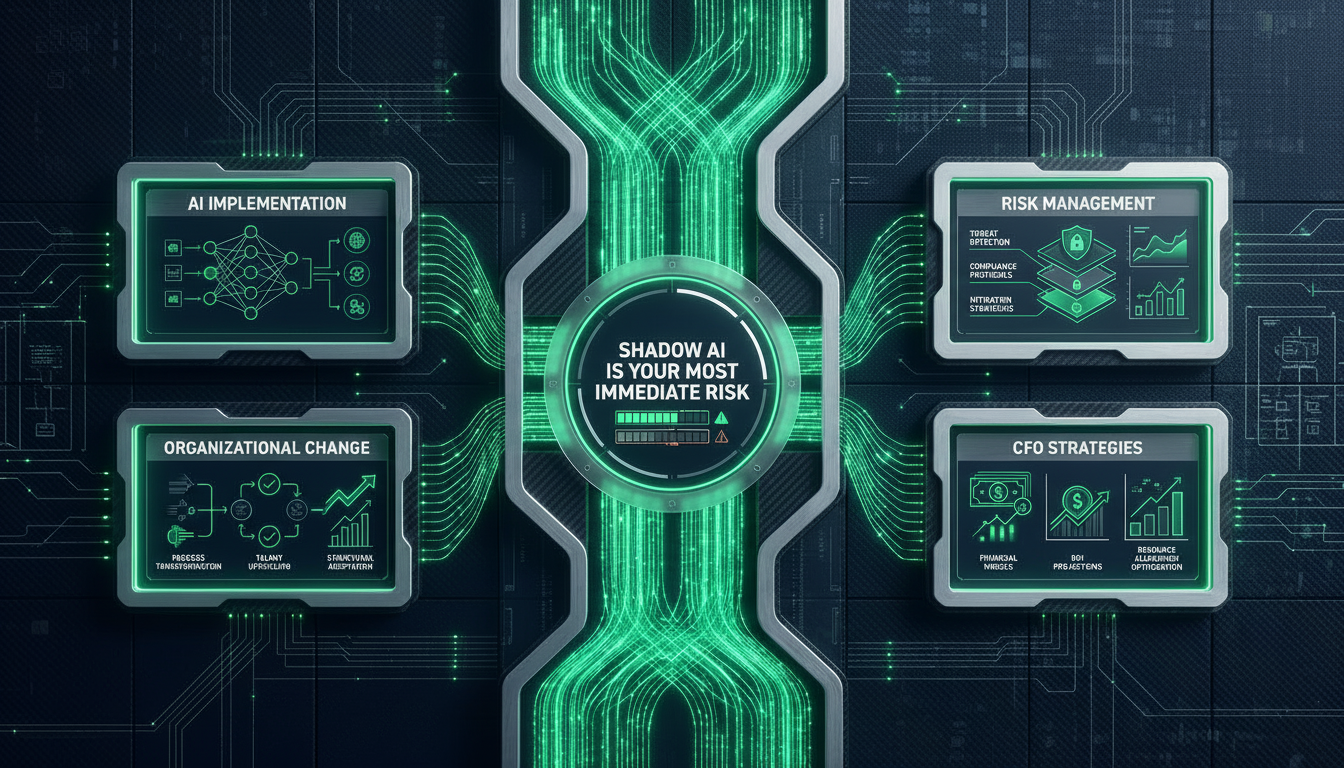
Navigating the AI landscape isn't just about speed; it's about strategic velocity, governance, and a deep understanding of organizational culture.
📊 10 episodes across 5 podcasts
⏱ 444 minutes of intelligence analyzed
🎙 Featuring: Eva Majercsik (Genesys), Alan Imberman (CFO, Wealthfront), Michael Krigsman (Host, CXOTalk), Marie Myers (Chief Financial Officer, HPE), Amy Wang (CFO, Procurify), Jack (Host, CFO THOUGHT LEADER), David Larson (CFO, Feedzai), Bill Gurley (General Partner, Benchmark), Peter High (Host, Metis Strategy), Tom DiDesidero (CFO, SmartRecruiters), Laura Belmont (General Counsel, The L Suite), Justin Watt (CEO and Co-founder, Switchboard), Pravina Ladva (Group Chief Digital and Technology Officer, Swiss Re), Steve Isom (COO and CFO, Bloomerang)
The Big Shift: AI's Human Element — From Tech Stacks to Cultural Shifts
The conversation around AI is rapidly maturing beyond just technological capabilities. While the hype around generative AI continues, seasoned operators are zeroing in on a critical, often overlooked aspect: the human and cultural elements that dictate successful AI transformation.
This isn't just a tech rollout; it's a profound organizational shift. Eva Majercsik, CPO at Genesys, highlighted this, stating, "One of the things that we did from the get go was not managing this as yet another technology transformation, but rather we have been very strong on managing this as a cultural transformation." This perspective, shared by both CIOs and CFOs this week, anchors AI adoption in change management and human psychology rather than just algorithms.
The emphasis is on augmentation, not replacement. Trevor Schulze, CIO at Genesys, noted that "humans are going to have a lot of capabilities they've never had before and they're going to augment their role." This move means prioritizing AI literacy, psychological safety, and fostering a "learn-it-all" culture, as opposed to a "know-it-all" one. This isn't just soft skills; it's foundational to preventing the 70% failure rate often seen in AI initiatives, particularly in mid-market companies (Kevin Craine on Digital Transformation Podcast).
Marie Myers, CFO of HPE, reinforced that successful AI integration "demands a proactive redesign of core workflows and operating models BEFORE applying AI, rather than simply layering AI onto existing, potentially inefficient, processes." This points to a strategic imperative to look inward at processes and culture, not just outward at new tech. The CFO-GC collaboration is central to managing the inherent risks, as Laura Belmont, General Counsel of The L Suite, pointed out, "The real question isn't how quickly you adopt AI, it's whether you're moving in the right direction." Organizations must prioritize "velocity" – movement in a strategic direction – over mere "speed" to unlock true AI value and mitigate substantial reputational and regulatory risks.
"One of the things that we did from the get go was not managing this as yet another technology transformation, but rather we have been very strong on managing this as a cultural transformation."
— Eva Majercsik, Chief People Officer at Genesys on Technovation with Peter High (CIO, CTO, CDO, CXO Interviews)
The takeaway for operators is clear: AI success is less about deploying the latest model and more about meticulously managing the human and organizational change it necessitates. Without a cultural foundation for adoption, even the most advanced AI tools will fall flat, becoming "shadow AI" risks or failed pilots.
Why it matters:
Focusing on the human element ensures AI tools are genuinely integrated and utilized, moving beyond siloed experimentation to enterprise-wide impact. It mitigates critical risks like data privacy, regulatory non-compliance, and employee resistance, which can tank even the most promising AI investments.
The Rundown
① Prioritize deterministic AI for financial accuracy.
For critical financial applications, probabilistic generative AI is a non-starter; HPE's CFO Marie Myers emphasized the necessity of deterministic AI that provides consistent, accurate answers, noting their co-engineering efforts with NVIDIA NIMs to achieve this for half a million data elements. (Marie Myers on CXOTalk)
→ The Operator's Take: Don't just chase the newest generative models for finance; insist on deterministic outputs and verifiable accuracy for any AI deployed in core financial functions to prevent catastrophic errors and build trust.
② Shadow AI is your immediate, unmanaged risk.
Laura Belmont, General Counsel of The L Suite, warned that critical AI risks already exist through 'shadow AI'—employees using personal accounts or integrated SaaS features—even before official corporate deployment. (Laura Belmont on CFO THOUGHT LEADER)
→ The Operator's Take: Before building new AI policies, conduct an audit of existing SaaS tools and employee usage patterns to identify and manage unapproved AI exposure, as this is where your biggest hidden vulnerabilities lie.
③ Operational leadership is becoming a CFO mandate.
Steve Isom, COO and CFO of Bloomerang, shared that his "working definition of what strategic actually means is helping to make decisions around resource allocation throughout the company using unit economics," blurring the lines between finance and operations. (Steve Isom on Run the Numbers)
→ The Operator's Take: CFOs must move beyond just financial reporting to embed themselves in operations, using unit economics to drive resource allocation and making strategic decisions based on real-world customer and employee insights.
④ Strategic product choices are driven by automation, not features.
Wealthfront's CFO Alan Imberman stated, "If we can't automate something, we won't build it," highlighting a rigorous philosophy where product development is constrained by the ability to automate, ensuring cost efficiency at scale. (Alan Imberman on Run the Numbers)
→ The Operator's Take: Challenge your product and engineering teams to adhere to a strict automation-first principle for all new features, especially in scaling operations, to protect your gross margins and drive long-term cost efficiency.
⑤ Talent acquisition is evolving with AI capabilities.
SmartRecruiters' CFO Tom DiDesidero noted that their early adoption of embedded AI in their product positioned them as an attractive acquisition target for SAP, signaling how AI capabilities are now a key differentiator in talent acquisition tech. (Tom DiDesidero on CFO THOUGHT LEADER)
→ The Operator's Take: Ensure your HR tech stack and talent acquisition strategies leverage embedded AI, not just for efficiency but as a competitive advantage that can significantly enhance candidate experience and recruiter productivity.
Signal Board
🔥 Heating Up
• AI for rapid application development: AI tools like Claude Code and Replit are drastically increasing efficiency and accelerating prototyping for finance professionals, leading to higher expectations for throughput. (Steve Isom on Run the Numbers)
• Agentic AI as a very real thing by 2026: Trevor Schulze (CIO, Genesys) predicts that if built and integrated responsibly, agentic AI will deliver serious value by 2026, especially when tailored for specific business processes. (Trevor Schulze on Technovation with Peter High (CIO, CTO, CDO, CXO Interviews))
• Human-in-the-loop AI deployment: Marie Myers (CFO, HPE) emphasized that a human-in-the-loop approach is critical for AI implementation, especially in finance, to combine algorithmic efficiency with human judgment and oversight. (Marie Myers on CXOTalk)
👀 On Watch 🆕
• Wealthfront's 'Wealth Builders' Strategy: Wealthfront's focus on serving "wealth builders" starting with just $1, rather than exclusively the ultra-rich, highlights a growing market segment that values automated, accessible financial services. (Alan Imberman on Run the Numbers)
• AI for executive information synthesis: Eva Majercsik (CPO, Genesys) and Trevor Schulze (CIO, Genesys) both personally use AI to synthesize vast amounts of information and stay informed, indicating a shift in executive-level productivity tools. (Eva Majercsik on Technovation with Peter High (CIO, CTO, CDO, CXO Interviews))
• Evolution of Finance Professional Skills with AI: Marie Myers (CFO, HPE) points to the necessity for finance professionals to develop technological acumen beyond traditional financial expertise, including understanding AI's practical applications and implications. (Marie Myers on CXOTalk)
❄️ Cooling Off
• Manual processes in an automated world: Justin Watt (CEO and Co-founder, Switchboard) highlights the ingrained challenge of overcoming manual, spreadsheet-driven workflows, which often hinder effective AI adoption in mid-market companies. (Justin Watt on Digital Transformation Podcast)
• Speed without direction in AI adoption is a strategic risk: Laura Belmont (General Counsel, The L Suite) warns that companies optimizing for AI "speed" (mere movement) rather than "velocity" (movement in a strategic direction) incur significant unmanaged risks. (Laura Belmont on CFO THOUGHT LEADER)
• 59% of people disengaged in work: Bill Gurley (General Partner, Benchmark) cited Gallup poll data revealing that a significant majority of the workforce feels disengaged, attributing this to overly programmed career paths that stifle creativity. (Bill Gurley on Technovation with Peter High (CIO, CTO, CDO, CXO Interviews))
The Bottom Line
True AI advantage comes not from chasing every shiny new tool, but from disciplined governance, cultural preparation, and an unwavering focus on how these technologies strategically augment your best people and processes.
Your Move
- Implement a "Shadow AI" Audit: Task your IT and legal teams to investigate unapproved AI usage across SaaS tools and employee accounts, then establish clear guidelines and acceptable use policies to mitigate immediate risks.
- Re-evaluate Product Automation Principles: Challenge your product development teams to articulate a rigorous "automation-first" principle for every new feature, using it as a gate to ensure long-term cost efficiency and scalability.
- Embed CFOs in Operational Workflows: Mandate that your CFO or senior finance leaders spend time directly engaging with customer-facing teams and operational leaders to gain qualitative insights that complement financial metrics, informing better resource allocation.
- Prioritize Human-Centric AI Pilots: Launch small, cross-functional AI pilot projects with a strong emphasis on change management, AI literacy training, and psychological safety to build internal trust and overcome resistance to new technologies.
📖 Want the full episode breakdowns, guest details, and listen links?
Quick Appendix
Run the Numbers: "Wealthfront’s CFO on Automation, Compounding Growth, and Going Public" · 54 min · Featuring Alan Imberman ▶ Listen
Technovation with Peter High (CIO, CTO, CDO, CXO Interviews): "Why AI Transformation Fails Without Culture: CIO & CPO Insights from Genesys" · 40 min · Featuring Trevor Schulze ▶ Listen
CXOTalk: "AI Agents in Finance with HPE's Chief Financial Officer (CFO) | CXOTalk 914" · 56 min · Featuring Marie Myers ▶ Listen
CFO THOUGHT LEADER: "1178: From Numbers to Narrative: Seeing the Business End-to-End | David Larson, CFO, Feedzai" · 55 min · Featuring David Larson ▶ Listen
Technovation with Peter High (CIO, CTO, CDO, CXO Interviews): "The Career Insight Most People Miss: Bill Gurley on Fascination & The Dream" · 63 min · Featuring Bill Gurley ▶ Listen
CFO THOUGHT LEADER: "1177: Navigating an Acquisition at the Edge of Change | Tom DiDesidero, CFO, SmartRecruiters" · 47 min · Featuring Tom DiDesidero ▶ Listen
CFO THOUGHT LEADER: "Special Episode: Why AI Speed Without Direction Is a Strategic Risk | Laura Belmont, General Counsel, The L Suite" · 25 min · Featuring Laura Belmont ▶ Listen
Digital Transformation Podcast: "AI Adoption in Mid-Market Companies" · 27 min · Featuring Justin Watt ▶ Listen
Technovation with Peter High (CIO, CTO, CDO, CXO Interviews): "Inside Swiss Re’s AI Strategy: Faster Claims, Smarter Insights, Better Outcomes" · 24 min · Featuring Pravina Ladva ▶ Listen
Run the Numbers: "How Strategic CFOs Get It Wrong" · 53 min · Featuring Steve Isom ▶ Listen
