
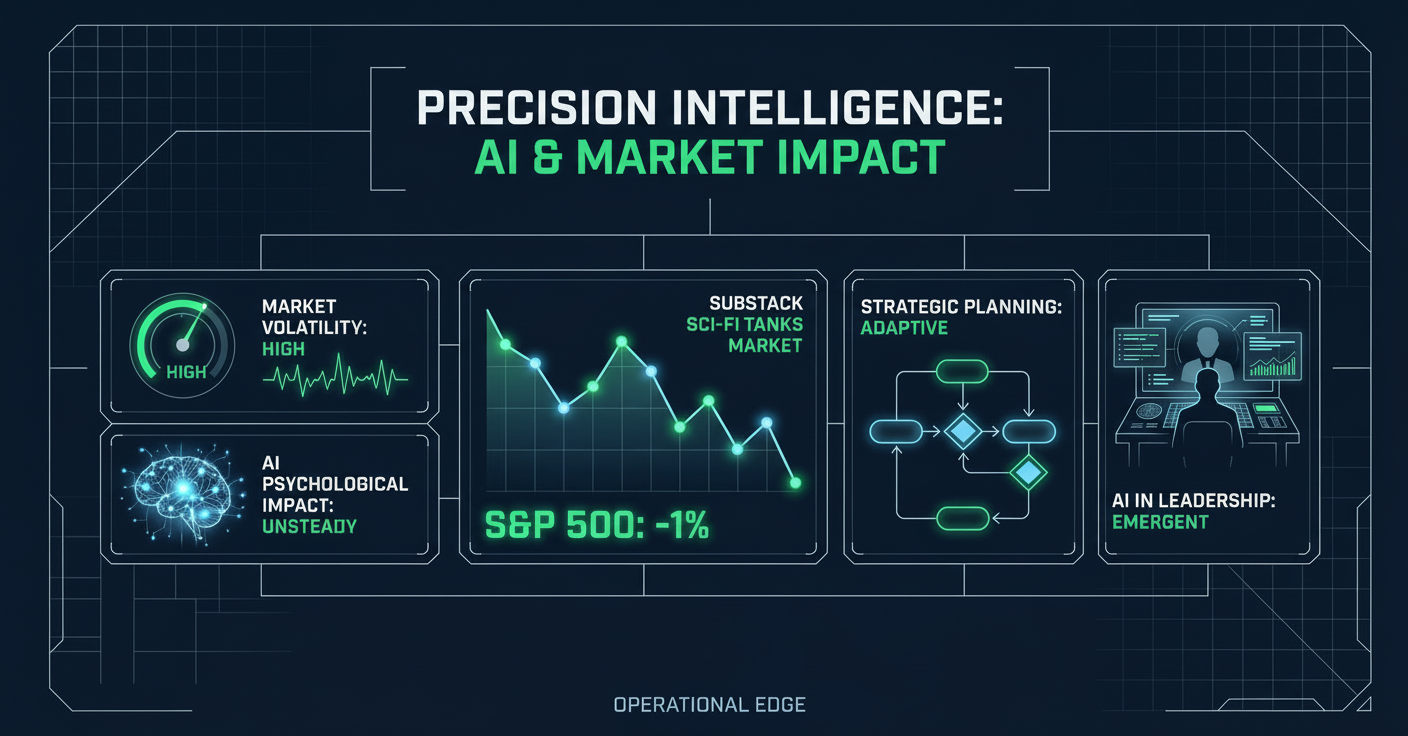
AI's impact on business is accelerating—not just in tech, but visibly reshaping economic indicators, geopolitical risk, and the very fabric of leadership's decision-making frameworks.
📊 11 episodes across 10 podcasts
⏱ 320 minutes of intelligence analyzed
🎙 Featuring: Tod Sacerdoti, Auren Hoffman, Christine Lee, Leigh McMullen
The Lead
AI's Ghost in the Machine: The Psychological & Strategic Impact of Digital Narratives
This week, a recurring and critical signal emerged: the increasingly tangible and often irrational impact of AI on market dynamics and strategic planning. We're seeing a direct line drawn from speculative AI narratives to real-world economic shifts, underscored by both investor behavior and corporate strategy. This isn't just about AI tools, but the psychological overlay of how we perceive AI's role in the future.
The market's visceral reaction to hypothetical AI scenarios is now a quantifiable risk factor. Darian Woods, Host on The Indicator from Planet Money, noted a 1% S&P 500 drop "amidst AI doom and gloom, which was partly than to basically a sci-fi story posted on Substack." This wasn't a bank run or an earnings miss; it was a fictional narrative about an "AI global intelligence crisis" that spooked the market. This extreme investor sensitivity, despite critiques from firms like Citadel, highlights a new, volatile dimension in market psychology driven by AI narratives—real or imagined.
"My indicator is 1%, which is roughly how much the S&P 500 fell on Monday morning amidst AI doom and gloom, which was partly than to basically a sci fi story posted on Substack."
— Darian Woods, Host at NPR
This sensitivity extends to strategic business vulnerabilities. Tod Sacerdoti, General Partner at Flex Capital, raised a critical concern for early-stage AI firms, stating, "I'm a little concerned for what I call like the first generation AI companies... they were building feature sets where the models didn't have capabilities... These adjacent concentric circles like faster and faster." This suggests that companies built on current AI limitations risk rapid disintermediation as foundational models evolve. The strategic implication for operators is clear: building an AI product too close to the current capabilities of large language models is a temporary play at best, a competitive minefield at worst.
Paradoxically, some leaders are embracing AI not just as an external threat or opportunity, but as an internal operational and psychological tool. Blake Mycoskie, Founder of TOMS Shoes and ENOUGH, shared a surprisingly personal application: using an AI therapy bot (SONIA AI) for daily emotional support and simulating expert roundtables for strategic decision-making. This reflects a willingness to leverage AI for deeply personal and internal processes, indicating a profound shift in how leaders are integrating AI into their own workflows, from mental health to C-suite strategy. It raises the question: Are we moving into an era where AI-driven narratives and personal AI assistants profoundly influence everything from market stability to CEO well-being?
The Rundown
① Founder Quality Trumps Initial Product for Seed Investments. The majority of successful seed investments come from companies that pivoted significantly, underscoring that the betting on the founding team is more crucial than the initial product vision. (Tod Sacerdoti on Summation (formerly World of DaaS))
→ The Operator Take: When evaluating early-stage ventures, prioritize the resilience, adaptability, and vision of the founders over the product's current market fit; teams that can pivot are more valuable than perfect initial ideas.
② Geopolitical Risk Now Carries a Significant & Quantifiable Oil Price Premium. The oil market is currently pricing in a $13 per barrel risk premium, equating to a hypothetical full closure of the Strait of Hormuz for about four weeks, despite current conditions being less severe. (Daan Struyven on Exchanges)
→ The Operator Take: Recognize that global supply chain and energy costs are increasingly decoupled from raw supply-demand fundamentals and heavily front-loaded with geopolitical risk premiums, demanding more robust scenario planning for input costs.
③ Unconventional Experiences Drive Innovation. Having "absolutely zero experience" in an industry can be a significant advantage for entrepreneurs, enabling them to break established rules and foster true innovation. (Blake Mycoskie on How Leaders Lead with David Novak)
→ The Operator Take: Actively seek out and empower "outsider" perspectives within your organization or during new venture evaluation, as their lack of ingrained assumptions can be a powerful catalyst for disrupting stagnant processes or market norms.
④ The Illusion of Board-Management Risk Alignment. While 87% of directors believe their board and management agree on risks, a third still desire management to take more aggressive risks, pointing to a subtle but significant misalignment in strategic ambition. (Pat Niemann on The Voice of Corporate Governance)
→ The Operator Take: Proactively surface and clarify risk appetite differences with your board, ensuring that perceived alignment isn't masking a divergent strategic intent that could stifle growth or create blind spots.
⑤ CEOs Overlook Board Diligence as an Opportunity for Improved Performance. CEOs often misinterpret challenging board questions as a lack of trust rather than an effort to improve performance and facilitate informed decision-making. (Wayne Peacock on BoardVision)
→ The Operator Take: Frame board interactions as opportunities for collective improvement and openly address questions, understanding that thorough board diligence is a mechanism to strengthen, not undermine, executive leadership.
The Stack
🔥 HEATING UP
• Corporate Agility: Boards are increasingly defining agility as a structured, collaborative, and iterative approach to adapt to rapid technological shifts like AI. (Pat Niemann on The Voice of Corporate Governance)
• QSBS tax benefit: This US tax paradigm allows seed investors to pay no federal taxes if their early-stage investments meet specific criteria, driving significant capital into startups. (Tod Sacerdoti on Summation (formerly World of DaaS))
• US Consumer Confidence Index increase in February 2026: The slight uptick was driven primarily by consumers being less pessimistic about the future, despite worsening present conditions. (Malala Lin on C-Suite Perspectives)
👀 ON WATCH
• Gartner Hype Cycle: Cybersecurity leaders are leveraging the AI hype cycle strategically, using it to drive organizational change and gain executive buy-in for AI investments. (Gartner on Gartner ThinkCast)
• Founder Compensation Being Broken: Investors rarely proactively discuss founder compensation, leading to founders reaching a breaking point before the topic is addressed. (Tod Sacerdoti on Summation (formerly World of DaaS))
• AI as a tool for personal therapy and decision-making: Leaders like Blake Mycoskie are using AI bots for emotional support and simulating expert roundtables for strategic planning, signaling a new frontier for AI adoption. (Blake Mycoskie on How Leaders Lead with David Novak)
🧊 COOLING OFF
• First-Gen AI Company Disintermediation Risk: Early-stage AI companies building features where foundation models currently have gaps are highly vulnerable as large models rapidly gain capabilities. (Tod Sacerdoti on Summation (formerly World of DaaS))
• Presidential tariff authority limitations: Recent Supreme Court rulings have limited the president's direct tariff-setting power, though other broad authorities remain. (Jeremy Siegel on This Week in Business)
• MCP (Context Protocol): A contrarian view suggests that MCP or similar protocols won't solve the majority of AI integration and middleware problems, indicating potential overhype in their capabilities. (Tod Sacerdoti on Summation (formerly World of DaaS))
The Bottom Line
The market is now trading on AI narratives, not just data, demanding a new level of strategic agility from every C-suite.
Your Move
① Audit AI Vulnerability: Review your current and planned AI implementations to assess their susceptibility to rapid disintermediation as foundational models advance, particularly for "first-gen" AI tools or features built on current LLM limitations.
② Test Board-Executive Alignment on Risk: Initiate explicit conversations with your board to ensure genuine alignment on risk appetite and strategic aggressiveness, moving beyond assumed consensus to identify and address any subtle disconnects.
③ Explore AI for Internal Strategic Planning: Consider piloting AI tools to simulate expert discussions or aid in personal reflection and decision-making, exploring its potential beyond customer-facing applications to enhance internal strategic processes.
📖 Want the full episode breakdowns, guest details, and listen links?
Appendix
The Indicator from Planet Money: "ICE is bad for business, heat is bad for coffee, and sci-fi is bad for markets" · 9 min · Featuring Waylon Wong ▶ Listen
The Indicator from Planet Money: "What an Epstein recording reveals about how elites get jobs" · 9 min · Featuring Darian Woods ▶ Listen
Freakonomics Radio: "665. Werner Herzog Isn’t Afraid ..." · 49 min · Featuring Werner Herzog ▶ Listen
BoardVision: "What CEOs Expect from Their Boards" · 20 min · Featuring Mallory Bucher ▶ Listen
Summation (formerly World of DaaS): "Tod Sacerdoti (Flex GP and Pipedream CEO) on seed at scale and SaaS mispricing" · 62 min · Featuring Tod Sacerdoti ▶ Listen
Exchanges: "Oil Market Impacts from Iran" · 13 min · Featuring Allison Nathan ▶ Listen
Gartner ThinkCast: "Mastering the Hype Cycle: How Cybersecurity Leaders Win With AI" · 35 min · Featuring Christine Lee ▶ Listen
This Week in Business: "Fed Leadership, Rate Cuts, and Geopolitical Risks Ahead" · 11 min · Featuring Jeremy Siegel ▶ Listen
C-Suite Perspectives: "The State of the Economy for February 2026" · 27 min · Featuring Dana M. Peterson ▶ Listen
How Leaders Lead with David Novak: "#280: Blake Mycoskie, Founder, TOMS Shoes and ENOUGH – Stay connected to your why" · 65 min · Featuring Blake Mycoskie ▶ Listen
The Voice of Corporate Governance: "Winning in the Face of Change with Pat Niemann" · 20 min · Featuring Jeff Mahoney ▶ Listen