
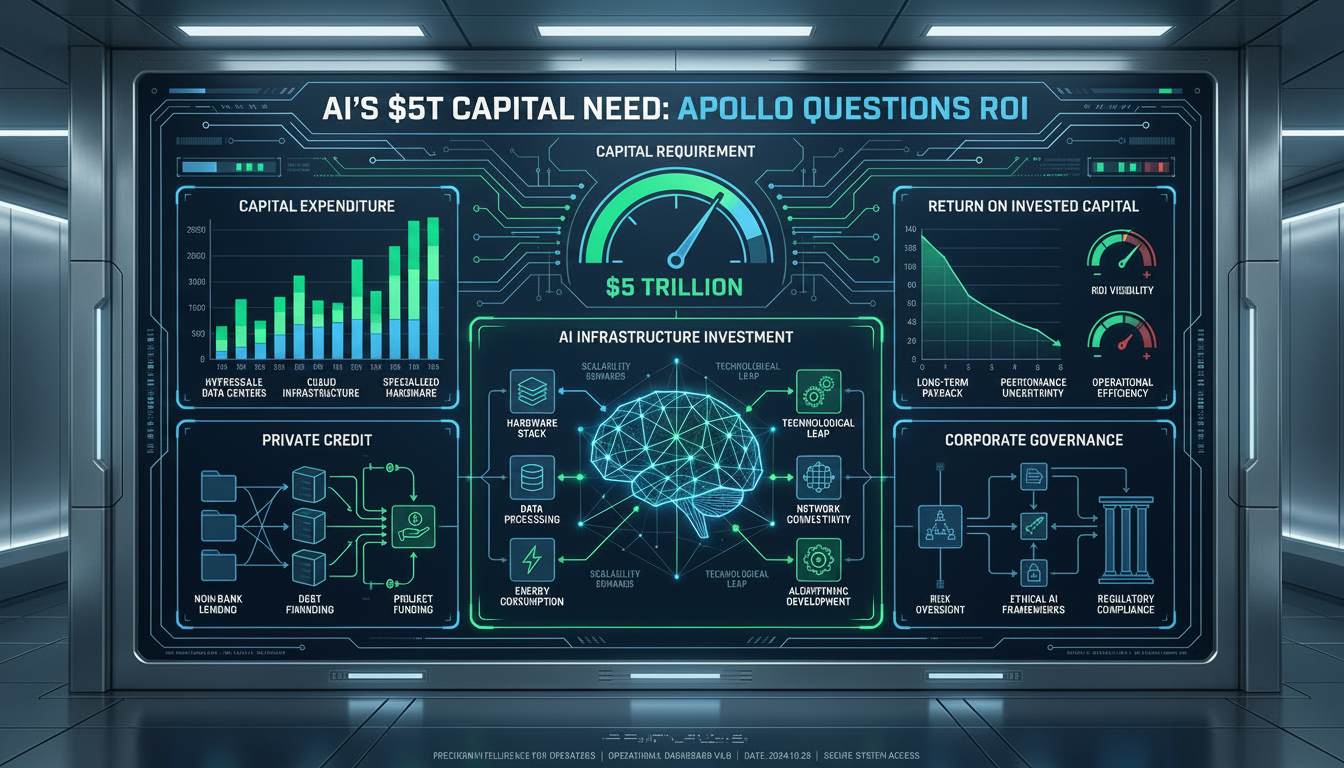
The market is increasingly skeptical of AI's return on invested capital as asset-light businesses transition to asset-heavy models, forcing a re-evaluation of long-term strategic bets.
📊 11 episodes across 9 podcasts
⏱ 362 minutes of intelligence analyzed
🎙 Featuring: Dan Loney (The Wharton School), Alison Beard (Harvard Business Review), Marcus Buckingham (Author of Design Love In: How to Unleash the Most Powerful Force in Business), Adi Ignatius (Harvard Business Review)
The Lead
The enthusiasm around artificial intelligence is encountering a hard wall of economic reality. While AI's potential is undeniable, operators are increasingly scrutinizing the actual return on invested capital (ROIC) for massive AI infrastructure projects. The shift from asset-light digital operations to asset-heavy physical infrastructure—think data centers and specialized hardware—is fundamentally changing investment calculus and raising serious questions about long-term profitability.
This concern was sharply articulated this week. Jim Zelter, President of Apollo Global Management, highlighted the enormous capital expenditure cycle underway, particularly for data centers. He pointed out that while the capital outlay is staggering—"5 to 6 trillion capital need over the next five years" for US data centers alone (Jim Zelter on Exchanges)—the true economic returns to shareholders remain unproven.
"I think the return on invested capital of AI. There's a massive capex cycle going on that's turning an asset light business into asset heavy. What are going to be the true economic returns to shareholders from these businesses?"
— Jim Zelter, President of Apollo Global Management on Exchanges
This isn't just about initial investment; it's about a fundamental reorientation of business models. What once required minimal physical footprint now demands massive power grids, cooling systems, and specialized hardware. This shift makes it imperative for CTOs and COOs to move beyond hype cycles and demand clear, defensible ROIC projections before committing significant capital. The market has been quick to price in AI's potential, but operators are realizing that turning that potential into profit is a capital-intensive, high-risk game.
The Strategic Question: How confident are you that your projected AI investments will generate superior, defensible economic returns given the rapidly increasing capital intensity of AI infrastructure?
The Rundown
① "Bad Governance" Actually Outperforms.
Companies rated with "bad governance" have outperformed those with "good governance" since 2008, challenging the conventional wisdom that shareholder primacy leads to long-term success. (Eric Ries on Summation (formerly World of DaaS))
→ The Operator Take: Reassess your corporate governance benchmarks; blindly following "best practices" pushed by proxy advisors might be sacrificing long-term durability for short-term optics.
② Extreme Positive Experiences Drive Loyalty, Not Incremental Improvements.
The relationship between customer or employee experience and outcomes is curvilinear; only "extreme positives" (5-star experiences) significantly drive loyalty and behavior, while moving from a 2 to a 3 yields negligible results. (Marcus Buckingham on HBR IdeaCast)
→ The Operator Take: Stop chasing marginal gains in customer/employee experience and focus resources on designing truly exceptional, "love-generating" interactions that differentiate your brand.
③ AI’s True Impact on Blue-Collar Work is Through Digital, Not Physical, Evolution.
The largest threat and transformation for blue-collar jobs from AI will come from rapid advancements in digital AI, which currently outpace physical AI development, redefining tasks rather than eliminating entire job classes. (Lynn Wu on This Week in Business)
→ The Operator Take: Prioritize upskilling programs for your blue-collar workforce to adapt to AI-driven digital toolsets now, as physical automation remains a slower, less immediate shift.
④ Private Credit is a $40 Trillion Market, Not Just Direct Lending.
While the market often narrowly defines private credit as a $1.7 trillion direct lending space, it's actually a much broader $40 trillion investment-grade market critical for unprecedented capital expenditure cycles in AI and energy transition. (Jim Zelter on Exchanges)
→ The Operator Take: Explore broader private credit avenues for financing major CapEx initiatives, recognizing its expanding role beyond traditional direct lending to support strategic growth and infrastructure.
⑤ ESG Regulations are Moving Beyond Compliance to Transformational Change.
New European legislations like CSRD and CSDDD are forcing companies to move beyond surface-level ESG compliance, revealing gaps in reported sustainability efforts and compelling genuine transformational change due to increasing pressure from younger generations. (Radhika Ralhan on C-Suite Perspectives)
→ The Operator Take: Proactively identify and address your Scope 3 emissions and social metrics; Gen Z and millennial talent are actively factoring these into hiring decisions, making genuine commitment a competitive advantage.
The Stack
🔥 Heating Up
• AI theme resurgence with strong semiconductor stocks: Markets are once again aggressively pricing in AI's potential, particularly in semiconductor stocks, after briefly being overshadowed by geopolitical concerns. (Dominic Wilson on Exchanges)
• Love as a driver for business success: Designing for "extreme positive experiences" is being recognized as the key to customer and employee loyalty, moving beyond incremental improvements. (Marcus Buckingham on HBR IdeaCast)
• Expanding Private Market for unicorns: The private market, especially in FinTech, is seeing unicorns surpass the valuation of many listed companies, offering compelling opportunities for board members and investors. (Susanne Chishti on The Better Boards Podcast Series)
🆕 On Watch
• Reverse Morris Trust (RMT): This rare (only 50 since 1998) but effective transaction structure combines a spinoff and a merger, offering unique tax benefits and imposing strategic discipline. (Emilie Feldman on This Week in Business 🆕)
• McCormick (in merger with Unilever's food business): The acquisition of Unilever's food business by McCormick is highlighted as a prime example of a strategically sound RMT due to its focus on flavor synergy and cost savings. (Emilie Feldman on This Week in Business 🆕)
• Unilever (spinning off food business): Unilever is using a Reverse Morris Trust to spin off its food business, demonstrating a complex strategic move for shareholder value creation. (Emilie Feldman on This Week in Business 🆕)
🧊 Cooling Off
• Scientific Fraud in Alzheimer's Research: Decades of Alzheimer's research, primarily focused on the amyloid cascade hypothesis, are under scrutiny due to widespread evidence of manipulated image data and fraudulent studies. (Matthew Schrag on Freakonomics Radio)
• Simufilam: This Alzheimer's drug, developed by Cassava Sciences, is facing intense scrutiny due to whistleblower allegations and FBI investigations into manipulated data and fraudulent studies. (Matthew Schrag on Freakonomics Radio)
• Market underestimation of downside tail risk: Despite geopolitical tensions, markets are quickly pricing out extreme downside risks, potentially underestimating the severity of potential future events. (Dominic Wilson on Exchanges)
The Debate
The Efficacy of Conventional Corporate Governance.
🐂 The Bull Case: "Good governance"—defined by shareholder primacy and "best practices" promoted by proxy advisors—is essential for corporate accountability and long-term value creation. This structure aligns management with investor interests, fostering transparency and reducing risk. Eric Ries points out that this is the prevailing legal and practical framework (Eric Ries on Summation (formerly World of DaaS)).
🐻 The Bear Case: "Since 2008, in aggregate, companies that have been rated to have bad governance have outperformed those rated to have good governance." — Eric Ries, Author of Incorruptible on Summation (formerly World of DaaS). Ries argues that shareholder primacy, often driven by proxy advisors, actually pulls companies away from their founding missions and leads to short-term financial gains at the expense of long-term durability and value destruction, with alternative structures outperforming.
The Operator's Read: The data on "bad governance" outperforming is compelling enough to warrant a critical review of your governance framework; blindly adhering to shareholder primacy might be an organizational liability, not an asset.
The Bottom Line
AI's accelerating capital requirements are forcing operators to scrutinize actual ROI, not just potential, changing investment strategies across the board.
Your Move
• Model the long-term ROI of AI investments: Challenge assumptions that AI is inherently asset-light; forecast the CapEx for data centers, power, and specialized hardware over a 5-year horizon, and benchmark against projected returns.
• Re-evaluate corporate governance frameworks: Examine whether your current governance, particularly around shareholder primacy, incentivizes short-term gains over long-term strategic durability, using insights from companies like Mars or Novo Nordisk as alternative models.
• Audit customer and employee experience "smoking Minis": Identify small but critical touchpoints that are eroding loyalty (Marcus Buckingham on HBR IdeaCast) and prioritize their redesign into "extreme positive experiences" that genuinely delight, focusing resources where impact is curvilinear.
Quick Appendix
How Leaders Lead with David Novak: "#287: Julie Hansen, CEO, Babbel – Don’t fear change" · 65 min · Featuring Julie Hansen (CEO, U.S. and Chief Revenue Officer, Global, Babbel)
For CTOs: Deep dive into how a language-learning app leverages AI for personalization and innovation, offering insights on leadership in rapidly changing tech landscapes.
▶ Listen
Exchanges: "Apollo's Jim Zelter on the Future of Private Credit" · 38 min · Featuring Jim Zelter (President, Apollo Global Management)
For CEOs: Understand the expansive role of private credit in financing next-gen infrastructure like AI and energy transition, and what it means for your capital strategy.
▶ Listen
C-Suite Perspectives: "What's Next for ESG Legislation in Europe?" · 37 min · Featuring Radhika Ralhan (ESG and sustainability global impact leader and Guest Lecturer, Maastricht School of Management)
For COOs: Get a handle on evolving European ESG legislation, stakeholder engagement, and the growing pressure from Gen Z talent to move beyond mere compliance to genuine sustainability.
▶ Listen
This Week in Business: "How AI Is Reshaping Blue-Collar Work and Skills" · 12 min · Featuring Lynn Wu (Associate Professor of Operations, Information and Decisions, The Wharton School)
For Heads of HR: Learn how AI is quickly reshaping blue-collar jobs, emphasizing the evolving demand for human judgment and social intelligence, and the need for new career pathing and upskilling.
▶ Listen
Exchanges: "Why Aren’t Investors More Worried?" · 20 min · Featuring Dominic Wilson (Senior Markets Advisor, Goldman Sachs Research)
For CFOs: Gain insights into market reactions to geopolitical events, the resurgence of AI themes in investor focus, and why deeper downside hedges might be warranted for equities and credit.
▶ Listen
The Indicator from Planet Money: "How the workplace helps you win Survivor" · 8 min · Featuring Yul Kwon (VP, Former Management Consultant at McKinsey, Google)
For Leaders at All Levels: Discover how tactical workplace skills like game theory, communication, and negotiation, particularly in management, directly translate to success in high-stakes environments.
▶ Listen
Summation (formerly World of DaaS): "Eric Ries on why "bad governance" outperforms, the case against shareholder primacy, and AI's Chernobyl moment" · 59 min · Featuring Eric Ries (Author, Founder, Executive Chairman, Co-founder, Author, Founder, Executive Chairman of Long-Term Stock Exchange, Co-founder of Answer AI)
For Board Directors: Challenge conventional wisdom on corporate governance; explore why structures that prioritize mission over mere shareholder enrichment often lead to greater long-term durability and value.
▶ Listen
The Better Boards Podcast Series: "Structure your board portfolio career across different life cycles of organisations | Susanne Chishti, Chair of FINTECH Circle" · 20 min · Featuring Susanne Chishti (Chair, Non-Executive Director, best-selling author, FINTECH Circle)
For Aspiring Board Members: Learn how to strategically position yourself for board roles by understanding the evolving skill requirements across different company lifecycles, from startups to pre-IPO.
▶ Listen
Freakonomics Radio: "671. Why Has There Been So Little Progress on Alzheimer’s Disease?" · 61 min · Featuring Charles Piller (Investigative Journalist at Science Magazine, Science magazine)
For R&D Leaders: A critical look into the prevalence of fraudulent research and whistleblowing in highly funded fields like Alzheimer's research, highlighting systemic issues in scientific integrity and regulatory response.
▶ Listen
HBR IdeaCast: "To Gain Customer—and Employee—Loyalty, Go Beyond Good Enough" · 30 min · Featuring Marcus Buckingham (Author and Researcher, Author of Design Love In: How to Unleash the Most Powerful Force in Business)
For Marketing & HR Leaders: Understand the nonlinear relationship between experience and outcomes; learn why only truly "extreme positive experiences" build customer and employee loyalty, and how AI might unintentionally undermine "love."
▶ Listen
This Week in Business: "Why Reverse Morris Trust Deals Demand Strategic Discipline" · 12 min · Featuring Emilie Feldman (Professor of Management, The Wharton School)
For M&A Strategists: Delve into the intricacies of Reverse Morris Trust transactions, understanding their tax benefits, strategic discipline, and the factors that drive significant shareholder returns from these complex deals.
▶ Listen
