
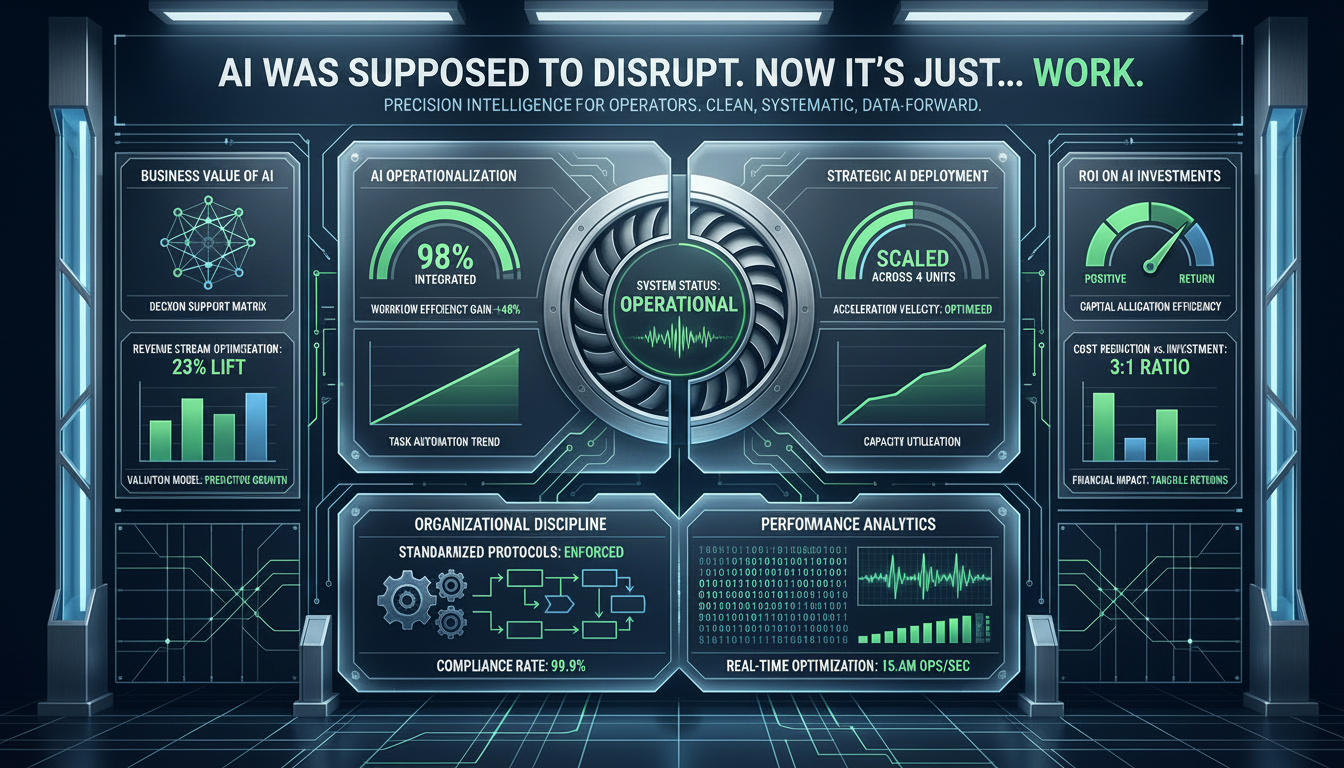
The AI value proposition is shifting from breakthrough use cases to operational efficiencies and disciplined execution, with market dominance less about grand vision and more about granular, consistent deployment.
📊 11 episodes across 10 podcasts
⏱ 385 minutes of intelligence analyzed
🎙 Featuring: Nicolas Giauque (Farallon Capital), Tony Pascarello (Goldman Sachs), Adrian Ma (NPR), Alina Selyuk (NPR)
|

The Lead
What started as a gold rush for flashy AI "breakthroughs" is maturing into a grind for tangible operational value. The conversation this week signals a clear pivot: CIOs and business leaders are now less interested in theoretical AI moonshots and more focused on practical, measured deployment that delivers real change to the business. This means establishing clear "kill criteria" for AI initiatives and embedding AI directly into workflows to realize value, rather than waiting for abstract "readiness." The shift is about discipline over dreams. Tori Paulman, VP Analyst at Gartner, highlighted this, stating, "The CIOs that best capture value, that's recognized by their chief executive, they don't wait... 68% of CIOs deploy AI into live production workflows. And then, and only then, does the business change." This pragmatic approach means less chasing “killer use cases” and more creating conditions where emergent value can be continuously iterated upon.
"Scale doesn't come from one big use case. Now you may find killer use cases out there, but don't look for them. Create the conditions where they emerge."
— Tori Paulman, VP Analyst at Gartner ThinkCast
This maturation reflects a healthy skepticism setting in post-hype. Leaders are now looking for AI to solve real problems and deliver measurable ROI, transitioning from exploration to exploitation. The strategic question is not "What can AI do?" but "What AI is working, and how do we scale it?"
The Rundown
① Navigating US Tariff Refunds Requires Strategic Foresight.
Small businesses claiming Trump-era tariff refunds are finding the government's CAPE tool on the ACE portal surprisingly smooth, yet many remain cautious about future trade policy and the practicalities of passing savings back to consumers (Alfred Mai on The Indicator from Planet Money).
→ The Operator Take: Even with positive government action, geopolitical and policy uncertainty means integrating these refunds into pricing models or long-term financial planning remains a high-risk move for many.
② Proactive Feedback and "Conditions for Success" Drive Leadership Effectiveness.
James "JC" Curleigh, CEO of Pelican Products, emphasized that effective leadership is about creating "conditions for success" and actively seeking feedback from diverse stakeholders, rather than blindly pushing forward (James "JC" Curleigh on How Leaders Lead with David Novak).
→ The Operator Take: Leaders should explicitly define success metrics and establish feedback loops, ensuring that aggressive strategies are only deployed when the operational environment is truly ready.
③ Epic Systems' CEO Prioritizes Patient Care Over Profit Maximization.
Judy Faulkner, CEO of Epic Systems, operates with a unique non-profit-maximizing business model, focusing heavily on customer satisfaction and R&D over shareholder returns, even declining potential clients who don't align with their success criteria (Judy Faulkner on Freakonomics Radio).
→ The Operator Take: This contrarian approach suggests that for market-dominant, mission-driven companies, eschewing traditional profit motives can create stronger long-term value and deepen customer loyalty beyond what public markets typically capture.
④ Delaware's Corporate Lawmaking Process Creates "Second Order Agency Problems."
Charles K. Whitehead, Professor of Business Law at Cornell, highlighted that Delaware's corporate law amendment process is often opaque, driven by a small committee whose insider preferences can overshadow broader public or corporate governance interests (Charles K. Whitehead on The Voice of Corporate Governance).
→ The Operator Take: Leaders in highly regulated industries should scrutinize the legislative process behind seemingly minor amendments, as insular lawmaking bodies can introduce disproportionate systemic risks to corporate governance and investor interests.
⑤ Global Tensions Drive European Corporate Economic Security Strategies.
Across Europe, companies are responding to Middle East tensions and market uncertainty by strengthening supply chains and passing costs to consumers, with 60% expecting to do so, reflecting a defensive posture against ongoing stagflationary pressures (Alejandro Fiorito on C-Suite Perspectives).
→ The Operator Take: Expect continued inflationary pressures and a focus on supply chain resilience as a competitive differentiator, with businesses internalizing geopolitical risk directly into their operational and pricing models.
⑥ The Trillion-Dollar Home Services Market Remains Largely Untapped by Digital.
Marco Zappacosta, CEO of Thumbtack, highlighted that the home services market in the U.S. is a trillion-dollar industry, with less than 10% currently booked online, representing a massive, AI-proof opportunity for digitalization (Marco Zappacosta on Summation (formerly World of DaaS)).
→ The Operator Take: This segment of the economy is ripe for continued digital transformation; early movers who can effectively onboard and manage in-person service providers at scale will capture significant market share.
The Stack
🔥 HEATING UP
• Japan corporate governance transition: Significant shifts in corporate behavior and regulation are opening new avenues for capital deployment, making it a compelling region for long-term investors. (Nicolas Giauque on Exchanges)
• Reframing what you sell: Companies like Pelican Products are finding success by shifting from product-centric to solution-centric narratives, such as moving from "protective cases" to "the protection business." (James "JC" Curleigh on How Leaders Lead with David Novak)
• Superteam concept: Learnable habits that drive exceptional performance and engagement are gaining traction, indicating a focus on actionable team optimization strategies. (Ron Friedman on HBR IdeaCast)
👀 ON WATCH
• Farallon Capital 🆕: This multi-strategy investment firm, with only one down year in 40, is attracting attention for its disciplined approach to risk-adjusted returns and capital preservation. (Nicolas Giauque on Exchanges)
• The Conference Board of Canada 🆕: Gillian Riley's leadership is highlighting Canada's economic challenges, particularly in productivity and AI adoption, signaling a need for strategic interventions. (Gillian Riley on C-Suite Perspectives)
• Gillian Riley 🆕: As President of The Conference Board of Canada, she is a key voice on Canadian economic policy, productivity, and AI adoption. (Gillian Riley on C-Suite Perspectives)
• Nicolas Giauque 🆕: The Managing Partner and CIO of Farallon Capital is being closely watched for his insights into long-term investing and capital allocation strategies. (Nicolas Giauque on Exchanges)
❄️ COOLING OFF
• Trump-era tariff refund process: While payouts are happening, underlying concerns about future tariffs and the complexities of full absorption by small businesses persist, cooling the immediate optimism. (Adrian Ma on The Indicator from Planet Money)
• Delaware's Agency Problem: Concerns about the insular amendment process for corporate law are highlighting potential long-term issues for governance, particularly regarding transparency and insider influence. (Charles K. Whitehead on The Voice of Corporate Governance)
The Bottom Line
Operationalizing AI effectively, rather than chasing hype, is becoming the true differentiator for sustained value and market leadership.
📖 Want the full episode breakdowns, guest details, and listen links?
Appendix
The Indicator from Planet Money: "How to get your tariff cash back" · 9 min · Featuring Adrian Ma
Operator's POV: This episode is essential for any business leader navigating international trade; it provides a real-world look at the complexities and cautious optimism surrounding government refund programs for tariffs. ▶ Listen
How Leaders Lead with David Novak: "#288: James “JC” Curleigh, CEO, Pelican Products – How to reframe what you sell" · 71 min · Featuring James "JC" Curleigh
Operator's POV: Tactical insights here for CEOs on driving strategic re-evolution and empathetic leadership, with a strong emphasis on setting clear "conditions for success" before aggressive growth. ▶ Listen
Freakonomics Radio: "672. What Makes Judy Faulkner Run?" · 61 min · Featuring Judy Faulkner
Operator's POV: A deep dive into Epic Systems' contrarian model offers valuable lessons for leaders questioning profit-first strategies, especially for those in mission-critical industries like healthcare. ▶ Listen
The Voice of Corporate Governance: "Delaware's Agency Problem with Professor Charles Whitehead" · 22 min · Featuring Charles K. Whitehead
Operator's POV: Critical listening for general counsels and board members to understand the nuanced risks and calls for transparency in Delaware's corporate lawmaking process, which affects nearly every major enterprise. ▶ Listen
C-Suite Perspectives: "The Global Impact of Middle East Tensions" · 43 min · Featuring Sara Murray
Operator's POV: This episode provides timely strategic insights for executives on how geopolitical tensions are translating into inflation, supply chain adjustments, and currency market shifts in Europe. ▶ Listen
Gartner ThinkCast: "AI After the Hype: Why Scaling Value Means Quitting More" · 25 min · Featuring Tori Paulman
Operator's POV: A direct and actionable guide for CIOs and technology leaders looking to move beyond AI pilots to true enterprise-level value, emphasizing disciplined execution and knowing when to "quit." ▶ Listen
Summation (formerly World of DaaS): "Thumbtack CEO Marco Zappacosta on why trades are AI-proof, the trillion-dollar home services market, and why software stopped being a capital asset" · 59 min · Featuring Marco Zappacosta
Operator's POV: Essential listening for anyone eyeing the massive, underserved home services market or interested in how AI is changing development, hiring, and the core definition of "capital asset" in software. ▶ Listen
BoardVision: "The Growing Pains of Family Businesses" · 21 min · Featuring Kait Armstrong
Operator's POV: Crucial for leaders in family enterprises or those advising them, offering practical guidance on navigating generational transitions and integrating independent directors for long-term governance. ▶ Listen
HBR IdeaCast: "What Sets Superteams Apart from the Rest" · 25 min · Featuring Ron Friedman
Operator's POV: Actionable strategies for any leader looking to build high-performing teams, focusing on learnable habits that improve collaboration, skill-building, and overall effectiveness. ▶ Listen
Exchanges: "Farallon Capital's Nicolas Giauque on Investing for the Long Term" · 20 min · Featuring Nicolas Giauque
Operator's POV: A masterclass in long-term capital allocation and risk management from a CIO with an exceptional track record, particularly insightful on Japan's governance shifts and event-driven biotech. ▶ Listen
C-Suite Perspectives: "Inside Canada: What Business Leaders Are Seeing Right Now" · 29 min · Featuring Steve Odland
Operator's POV: Provides a strategic overview of the Canadian business landscape, highlighting challenges in productivity and AI adoption that offer lessons for other developed economies. ▶ Listen
