
11 episodes across 10 podcasts
375 minutes of intelligence analyzed
Featuring: Jeff Mahoney (Council of Institutional Investors), Gartner (Gartner), Chiara Girardi (Gartner), William Candrick (Gartner)
|

The Lead
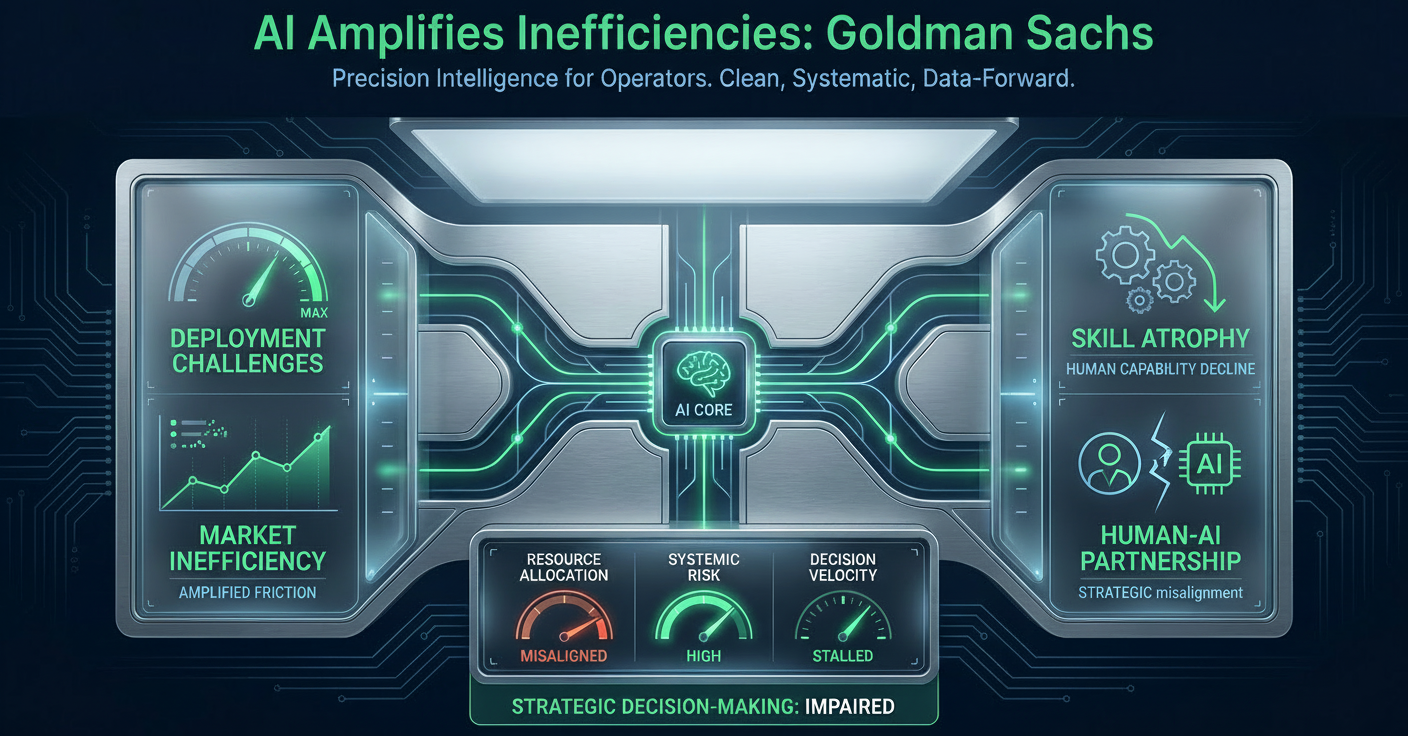
The idea that AI will make markets more efficient, drive skill atrophy, or fundamentally redefine venerable economic theories is a convenient fiction; instead, operators are seeing AI amplify existing inefficiencies, demanding more nuanced human intervention, and revealing forgotten historical insights.
Why it matters: Despite the persistent narrative that AI inherently streamlines and perfects processes, real-world deployment challenges that assumption. This week, operators revealed how AI's broad use creates new forms of market inefficiency (Osman Ali on Exchanges) and how automation can paradoxically erode crucial human skills in cybersecurity (William Candrick on Gartner ThinkCast).
"I think they're creating a different type of predictability and inefficiency in markets as a consequence of their broad use."
— Osman Ali, Global Co-Head of Quantitative Investment Strategies at Goldman Sachs Asset Management
The signal: This reframing extends even to foundational economic thought. Discussions around Adam Smith’s works highlight how AI’s ability to process vast datasets can reveal historical misinterpretations, rather than simply optimizing current models. The "invisible hand" is less a perfect market mechanism and more a nuanced observation often selectively quoted (Craig Smith on Freakonomics Radio), underscoring that human context and historical depth remain irreplaceable.
Strategic question: Are we designing our AI deployments to genuinely augment human judgment and uncover deeper insights, or are we inadvertently letting them automate away critical thinking and create new blind spots?
The Rundown
① Human Intelligence is Harder Than Ever, But More Crucial.
Ubiquitous technological surveillance is making traditional human intelligence operations increasingly difficult, forcing a pivot towards more selective, high-value recruitment and deeper analysis of motivations beyond ideology. (Ralph Goff on Summation (formerly World of DaaS))
→ The Operator Take: For leaders, this means doubling down on the human element in sensitive operations and recognizing that tech-heavy solutions don't negate the need for highly skilled, context-aware human analysts.
② Sustainability is a Direct Revenue Driver, Not Just a Cost Center.
RELX actively uses a small AI model to embed sustainability responses into commercial conversations, directly contributing to measurable financial outcomes, including a $90 million impact on contracts. (Dr. Márcia Balisciano on C-Suite Perspectives)
→ The Operator Take: Integrate sustainability into frontline sales and product development with targeted AI tools to prove ROI, moving beyond compliance to competitive advantage.
③ AI Automation Creates a Critical Cybersecurity Skill Gap.
While AI boosts efficiency in Security Operations Centers (SOCs), it risks atrophying the critical skills of junior analysts, potentially leading to future workforce vulnerabilities as human expertise diminishes. (William Candrick on Gartner ThinkCast)
→ The Operator Take: Balance AI-driven efficiency with clear upskilling and career pathing for junior talent, ensuring a robust human-AI partnership rather than uncritical replacement.
④ Crowdsourcing is a Competitive Moat, Not Just a Business Model.
Mariam Naficy, Founder and Chairman of Minted 🆕, explained how focusing on "atoms over bits" — scaling complex physical processes like custom printing and customer service during peak demand — built an unreplicable competitive advantage. (Mariam Naficy on How Leaders Lead with David Novak)
→ The Operator Take: Identify the physical, "unsexy" operational challenges in your business; these are often the toughest to automate and offer the strongest long-term defensibility when mastered.
⑤ Land Value Taxation Can Drive Urban Growth Without Driving Out Business.
Robert Inman 🆕, Professor Emeritus of Finance at The Wharton School, highlighted how cities like Pittsburgh successfully implemented land value taxation, demonstrating a model that sustains urban revenue without disincentivizing investment or encouraging businesses to leave. (Robert Inman on This Week in Business)
→ The Operator Take: For city and regional leaders, consider tax policy innovations that minimize negative economic incentives, particularly those that keep the "taxable base" fixed, like land itself.
The Stack
🔥 HEATING UP
• AI impact on quantitative investing: AI, particularly LLMs, is creating new forms of market inefficiency and alpha opportunities by fostering herd behavior. (Osman Ali on Exchanges)
• Land Value Taxation 🆕: A sustainable urban revenue model that avoids discouraging investment, housing development, or business growth. (Robert Inman on This Week in Business)
• Democratization of strategic execution: Moving away from top-down change management towards collaborative decision-making within teams. (Nilofer Merchant on HBR IdeaCast)
• Post-quantum cryptography urgency by 2030: CISOs face immense risk due to the long timeline for upgrading systems to quantum-safe encryption. (Chiara Girardi on Gartner ThinkCast)
👀 ON WATCH
• Minted 🆕: A case study in building a defensible e-commerce business by mastering complex "atoms over bits" operations like custom printing and customer service. (Mariam Naficy on How Leaders Lead with David Novak)
• The Wealth of Nations 🆕: Undergoing reinterpretation, emphasizing Adam Smith's nuanced views on government intervention and social welfare, challenging modern laissez-faire readings. (Glory Liu on Freakonomics Radio)
• Arcade AI 🆕: A new venture training AI models specifically for individual manufacturers to ensure generated product images are actually manufacturable. (Mariam Naficy on How Leaders Lead with David Novak)
• Pentagon interceptor drone contract ethics: Questions raised over a Trump family-backed drone company securing a Pentagon contract shortly after investment. (Adrienne Ma on The Indicator from Planet Money)
🧊 COOLING OFF
• Traditional Change Management: Centralized, top-down approaches are proving ineffective in rapidly changing environments, hindering true organizational adaptation. (Nilofer Merchant on HBR IdeaCast)
• Bag-of-words for sentiment analysis: Largely superseded by large language models for nuanced financial sentiment analysis. (Osman Ali on Exchanges)
• Laissez-faire Capitalism (Adam Smith interpretation): The strict "no government intervention" interpretation of Adam Smith is being challenged by scholars who highlight his nuanced views. (Mariana Mazzucato on Freakonomics Radio)
The Bottom Line
Operationalizing AI demands a clear-eyed view of its real-world impact: it’s an amplifier, not a perfector, rewarding those who navigate its complexities with human judgment and strategic nuance.
📖 Want the full episode breakdowns, guest details, and listen links?
Appendix
The Indicator from Planet Money: "Trump crypto, Trump ballroom and Trump drones" · 9 min · Featuring Waylon Wong ▶ Listen
The CTO's Lens: Highlights the ethical complexities at the intersection of business, politics, and emerging tech, prompting consideration of regulatory and reputational risks in your own supply chains and partnerships.
Summation (formerly World of DaaS): "Six-time CIA Station Chief Ralph Goff on the new doctrine of war" · 65 min · Featuring Ralph Goff ▶ Listen
The CTO's Lens: Essential listening for understanding the limits of technology in intelligence, reinforcing the irreplaceable value of human collection and analysis in an age of pervasive surveillance.
The Voice of Corporate Governance: "CII’s Monthly Governance and Capital Market Regulation Update (March 26 – April 30)" · 22 min · Featuring Jeff Mahoney ▶ Listen
The CTO's Lens: Provides critical updates on regulatory shifts affecting corporate governance and proxy advisors, directly impacting how your investment and compliance strategies need to adapt.
Gartner ThinkCast: "Inside the Top Cybersecurity Trends for 2026" · 21 min · Featuring Gartner ▶ Listen
The CTO's Lens: Crucial for understanding how AI is reshaping cybersecurity threats and the critical need to address post-quantum cryptography, demanding immediate strategic planning for skill development and infrastructure upgrades.
C-Suite Perspectives: "How Sustainability Can Drive Real Business Results" · 25 min · Featuring Martin Wiese ▶ Listen
The CTO's Lens: Offers a blueprint for integrating sustainability into core business strategy to drive measurable financial performance, providing actionable insights for leveraging AI to quantify and commercialize ESG efforts.
Exchanges: "Will AI Make Markets Less Efficient?" · 19 min · Featuring Alison Nathan ▶ Listen
The CTO's Lens: Challenges the assumption that AI always leads to market efficiency, providing a strategic perspective on how AI can create new alpha opportunities due to herd behavior, which is vital for any leader assessing AI's impact on competitive advantage.
HBR IdeaCast: "New Skills to Navigate Continuous Change" · 31 min · Featuring Nilofer Merchant ▶ Listen
The CTO's Lens: Provides a strategic framework for fostering collaborative, bottom-up change within teams, essential for leaders looking to cultivate adaptability and innovation in an AI-accelerated environment.
Freakonomics Radio: "674. How Does a Composer Feel After the World Premiere?" · 45 min · Featuring David Lang ▶ Listen
The CTO's Lens: Offers a unique perspective on creative collaboration and the emotional investment in complex projects, reminding leaders of the human elements underpinning successful, high-stakes endeavors—even those outside the traditional tech sphere.
How Leaders Lead with David Novak: "#290: Mariam Naficy, Founder and Chairman, Minted – See the possibilities in people" · 58 min · Featuring Mariam Naficy ▶ Listen
The CTO's Lens: A compelling case study in building a defensible business by mastering complex "atoms over bits" operations and leveraging AI for competitive advantage, offering practical lessons for scaling unique product offerings.
Freakonomics Radio: "Was Adam Smith Really a Right-Winger? (Update)" · 68 min · Featuring Freakonomics Radio + Stitcher ▶ Listen
The CTO's Lens: Insights into how historical texts like "The Wealth of Nations" can be reinterpreted, providing a lesson in critical analysis and a reminder that even foundational theories can be misapplied, urging leaders to question long-held assumptions.
This Week in Business: "Rethinking Urban Tax Policy Through Land Value Taxation" · 12 min · Featuring Robert Inman ▶ Listen
The CTO's Lens: Important for any leader evaluating regional economics, offering an alternative tax policy model that promotes urban growth without disincentivizing business investment—a critical factor for talent and infrastructure strategy.
