There's a quiet revolution reshaping how we build and lead, moving past "visionary leaders" and SaaS lock-in, towards co-creation and outcome-driven clarity.
📊 11 episodes across 9 podcasts
⏱ 414 minutes of intelligence analyzed
🎙 Featuring: Tom Wilson, Joel Mokyr, Tod Sacerdoti, Colin Levy
The Lead
The Illusion of the Visionary Leader is Dead: Co-Creation and 'Wayfinding' Are the New Mandates
The traditional perception of a singular, visionary leader dictating strategy is no longer viable for driving innovation. Multiple operators this week highlighted a systemic shift towards leadership as a facilitative, co-creative process. This isn't just about empowering teams; it's about fundamentally changing how organizations source and execute on new ideas. The challenge for leaders is to shed the "star performer" mentality and embrace ambiguity, making decisions with incomplete information, and even rewarding the failure of non-working ideas.
The New Mandate: Linda Hill, Professor at Harvard Business School, stressed that leading innovation "is not about having a vision and telling people, follow me to the future. Instead, it's about creating the right culture and capabilities to get people to want to co create that future with you." This involves a shift from 'pathfinding' to 'wayfinding,' where leaders enable navigation rather than dictate a fixed route. Joel Mokyr, Professor of Economics and History at Northwestern University, reinforced this by emphasizing that progress is driven by a small percentage of innovators, underscoring the need for leaders to foster an environment where this segment can thrive through experimentation and even failure.
"Leading innovation is not about having a vision and telling people, follow me to the future. Instead, it's about creating the right culture and capabilities to get people to want to co create that future with you."
— Linda Hill, Professor at Harvard Business School on HBR IdeaCast
Why it matters for your stack: This new leadership paradigm impacts every layer of the organization, especially how we evaluate and deploy technology. It implies a need for flexible and collaborative tools that support iterative development and rapid experimentation, rather than rigid, top-down implementation of pre-defined solutions. The "build vs. buy" decision increasingly needs to account for platforms that enable co-creation and rapid iteration, aligning with the "wayfinding" rather than "pathfinding" approach. If your tools reinforce hierarchical communication and control, they are actively hindering innovation.
Strategic Question: How might your current leadership development programs and technology investments be unconsciously reinforcing outdated models of innovation, rather than enabling the co-creative, "wayfinding" leadership needed for effective deployment?
The Rundown
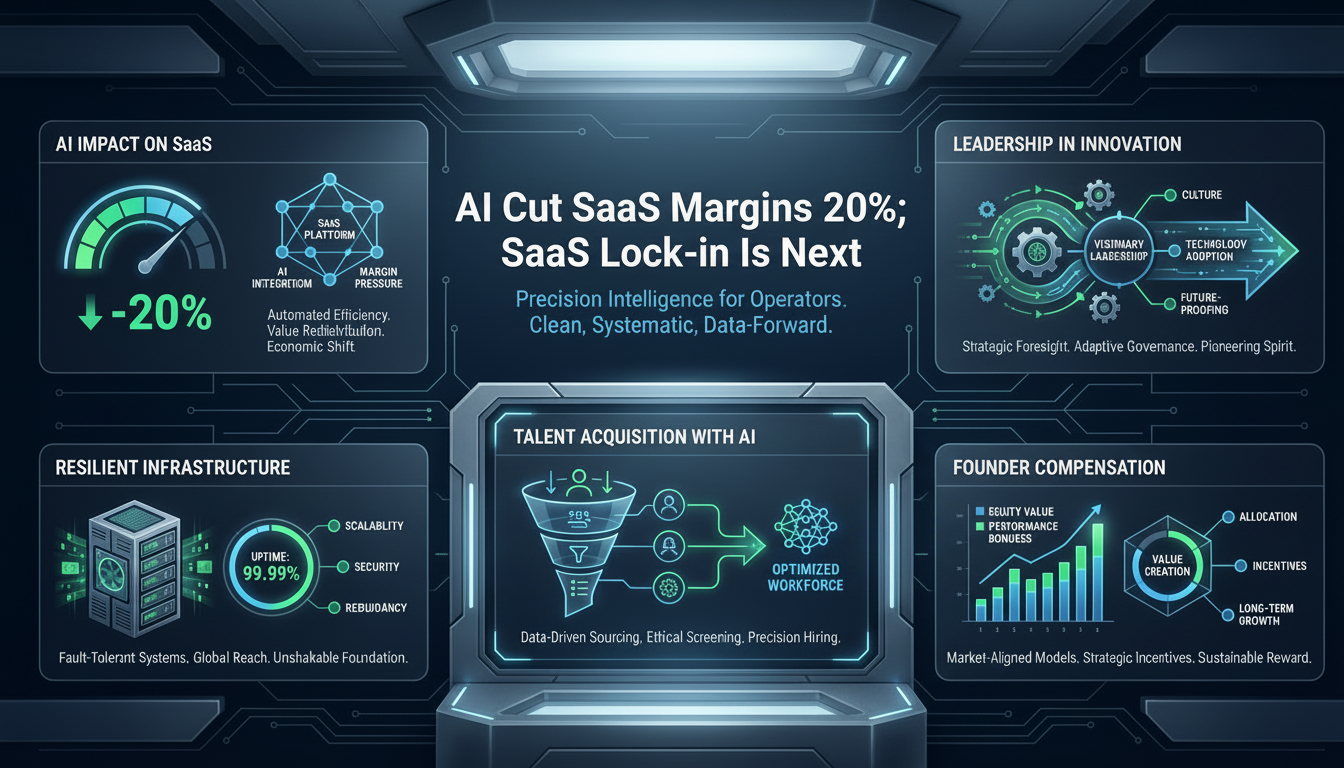
① AI is eating SaaS margins and lowering software barriers to entry, driving a "Saaspocalypse." The Standard & Poor Software Index is down over 20% since February, with enterprise software facing a significant inflection point as AI makes it easier and cheaper to build solutions. (Stefano Puntoni on This Week in Business)
→ The Operator Take: AI-powered coding agents are democratizing software development, forcing legacy SaaS providers to rethink their pricing models and value propositions or face rapid disintermediation.
② Commodity traders wield economic and geopolitical influence on par with major nations, often operating with little oversight. Their revenues frequently surpass the GDP of entire countries, enabling them to act as financiers and even diplomats in global crises, deeply impacting supply chains and political stability. (Jack Farchy on Freakonomics Radio)
→ The Operator Take: Understanding the opaque world of commodity trading is critical for any executive managing global supply chains or assessing geopolitical risks, as these actors can unilaterally shift markets and political outcomes.
③ The "golden age" for starting companies in Silicon Valley, particularly in AI, is creating significant disintermediation risk for early-stage AI companies. While seed investing offers the highest annualized returns, first-generation AI ventures are vulnerable to rapid capability improvements in underlying foundation models. (Tod Sacerdoti on Summation (formerly World of DaaS))
→ The Operator Take: CTOs evaluating AI solutions need to validate vendor moats beyond current model capabilities, focusing on proprietary data, customer relationships, and iteration speed to avoid solutions that can be easily replicated or made obsolete by generalist models.
④ The cover letter is now functionally obsolete due to AI, forcing HR to rely more on real-world signals. AI's ability to generate tailored cover letters instantly renders them unreliable indicators of genuine interest or fit. (Judd Kessler on This Week in Business)
→ The Operator Take: Talent acquisition strategies must pivot away from easily gamed digital signals, prioritizing robust referral networks, real-world project portfolios, and experiential assessments to truly gauge candidate capability and cultural fit.
⑤ Building resilient infrastructure for climate risk is no longer optional but a core design parameter, often with cost-effective green solutions. Integrating climatologists and real-time control systems into infrastructure planning is crucial for quantifying problems and achieving sustainable outcomes, sometimes at a lower cost than traditional "gray" infrastructure. (Greg Stonehouse on C-Suite Perspectives)
→ The Operator Take: Infrastructure and facilities leaders should mandate a proactive shift towards resilience as a core design principle, exploring nature-based solutions that can deliver both environmental benefits and superior economic ROI compared to traditional approaches.
The Stack
🔥 Heating Up
• Agentic AI: Seeing increasing use cases in legal services, but Zach Warren from Thomson Reuters Institute notes that most promising applications still require humans to "babysit and oversee each step" on Clarity.
• Immigration as a driver of innovation: Joel Mokyr, Professor of Economics and History at Northwestern University, argues that current immigration attitudes are "self defeating" and a "great unforced error," given the disproportionate innovation from immigrants on Freakonomics Radio.
• Resilient infrastructure as core design parameter: Greg Stonehouse from HDR emphasizes that designing for resilience is "no longer optional" due to rising climate risks, necessitating proactive integration rather than reactive add-ons on C-Suite Perspectives.
👀 On Watch
• First-Gen AI Company Disintermediation Risk: Tod Sacerdoti of Flex Capital warns that early AI companies building features based on prior model limitations are highly vulnerable as foundation models rapidly improve, potentially eating into their value proposition on Summation (formerly World of DaaS).
• Outcome-Driven Metrics (ODMs): Christine Lee, Expert at Gartner, advocates for ODMs and Protection Level Agreements (PLAs) to frame cybersecurity discussions as cost-benefit analyses, moving beyond ROI of individual tools on Gartner ThinkCast.
• The "Founder Code": Tod Sacerdoti on Summation (formerly World of DaaS) discussed non-obvious rules for founders, including not abandoning a successful company for a new venture without significant reason, highlighting the intense competition and implicit social contracts in tech.
🧊 Cooling Off
• Cover letters as a reliable signal: Judd Kessler, Professor of Business Economics and Public Policy at The Wharton School, states that AI has fundamentally devalued cover letters, making them easy to generate and thus unreliable indicators of candidate interest or fit on This Week in Business.
• SaaS profitability from input-based pricing: Stefano Puntoni, Marketing Professor at The Wharton School, points to AI pushing output-based pricing models, undermining the historical profitability of input-based SaaS subscriptions on This Week in Business.
The Debate
The debate centers on founder compensation: Is it a natural outcome of market forces, or an area where investors are failing their founders?
🐂 The Bull Case: From the perspective of Tod Sacerdoti (General Partner, Flex Capital) on Summation (formerly World of DaaS), seed investing has the highest annualized returns due to early, low-price investments with significant ownership. The system, while competitive, self-corrects through market mechanisms. The "founder code" and intense competition reflect a highly optimized environment where compensation naturally reflects market dynamics and investor ownership strategy.
🐻 The Bear Case: However, a contrarian view from Tod Sacerdoti (General Partner, Flex Capital) later in the same episode suggested a significant flaw: "Investors will never proactively approach founders about raising compensation." He stressed that founder compensation structures are "broken," implying a systemic issue where founders often reach a "breaking point" before compensation is addressed, creating unnecessary friction and potential burnout. This suggests that the current market, while efficient in some ways, neglects a fundamental human element crucial for long-term founder health and company stability.
The Operator's Read: While seed investing metrics are compelling, the neglect of proactive founder compensation by investors is a clear blind spot that creates unnecessary friction and can jeopardize the very growth they seek.
The "Saaspocalypse" is real, but it's clearing ground for a new era of co-created products and resilient infrastructure, valuing real-world impact over digital fluff.
Your Move: Strategic Actions for the Next 7 Days
• Audit your current SaaS contracts and evaluate their pricing models. Prioritize those with output-based pricing or those willing to negotiate, leveraging the "Saaspocalypse" trend to optimize costs and value.
• Review your talent acquisition strategy. Shift resources from cover letter screening to building strong referral networks and implementing skills-based assessments that prioritize real-world connections and demonstrable capabilities.
• Challenge your engineering leadership to identify areas where AI coding agents can lower barriers to entry for new software solutions, potentially shifting from "buy" to "build" where proprietary advantage can be gained.
• Assess your leadership development programs. Are they still training "pathfinders" who dictate vision, or are they cultivating "wayfinders" who excel at co-creation, managing ambiguity, and fostering collective innovation?
📖 Want the full episode breakdowns, guest details, and listen links?
Appendix
HBR IdeaCast: "The New Leadership Structures that Unblock Innovation" · 31 min · Featuring Linda Hill ▶ Listen
Freakonomics Radio: "The Most Powerful People You’ve Never Heard Of (Update)" · 66 min · Featuring Jack Farchy ▶ Listen
Freakonomics Radio: "666. This Is How Progress Happens" · 53 min · Featuring Joel Mokyr ▶ Listen
This Week in Business: "From Hype to Impact: AI Reshapes Enterprise Software" · 13 min · Featuring Stefano Puntoni ▶ Listen
This Week in Business: "The Decline of the Cover Letter in the AI Era" · 12 min · Featuring Judd Kessler ▶ Listen
Clarity: ""AI in Professional Services Report": Converting AI adoption into business victories" · 28 min · Featuring Zach Warren ▶ Listen
Summation (formerly World of DaaS): "Tod Sacerdoti (Flex GP and Pipedream CEO) on seed at scale and SaaS mispricing" · 62 min · Featuring Tod Sacerdoti ▶ Listen
Exchanges: "Oil Market Impacts from Iran" · 13 min · Featuring Daan Struyven ▶ Listen
Gartner ThinkCast: "Mastering the Hype Cycle: How Cybersecurity Leaders Win With AI" · 35 min · Featuring Christine Lee ▶ Listen
C-Suite Perspectives: "Climate Risk Is Rising. Is Our Infrastructure Ready?" · 32 min · Featuring Greg Stonehouse ▶ Listen
How Leaders Lead with David Novak: "#281: Tom Wilson, Chair, President and CEO, Allstate – Be brutal with your time" · 69 min · Featuring Tom Wilson ▶ Listen