The AI power problem isn't about cost, it's about electricians: a critical bottleneck for data center expansion.
📊 11 episodes across 8 podcasts
⏱ 276 minutes of intelligence analyzed
🎙 Featuring: Dr. Sabine Dembkowski, Marco Mattiacci, Freakonomics Radio + Stitcher, Ken Troske, Richard Cox, Natasha Sarin, Brian Singer, Angela Duckworth, Laura Ulrich, Don Scheibenreif, Andrew McAfee, Stefano Puntoni, Pat Gelsinger, Steve Klinsky
The Lead
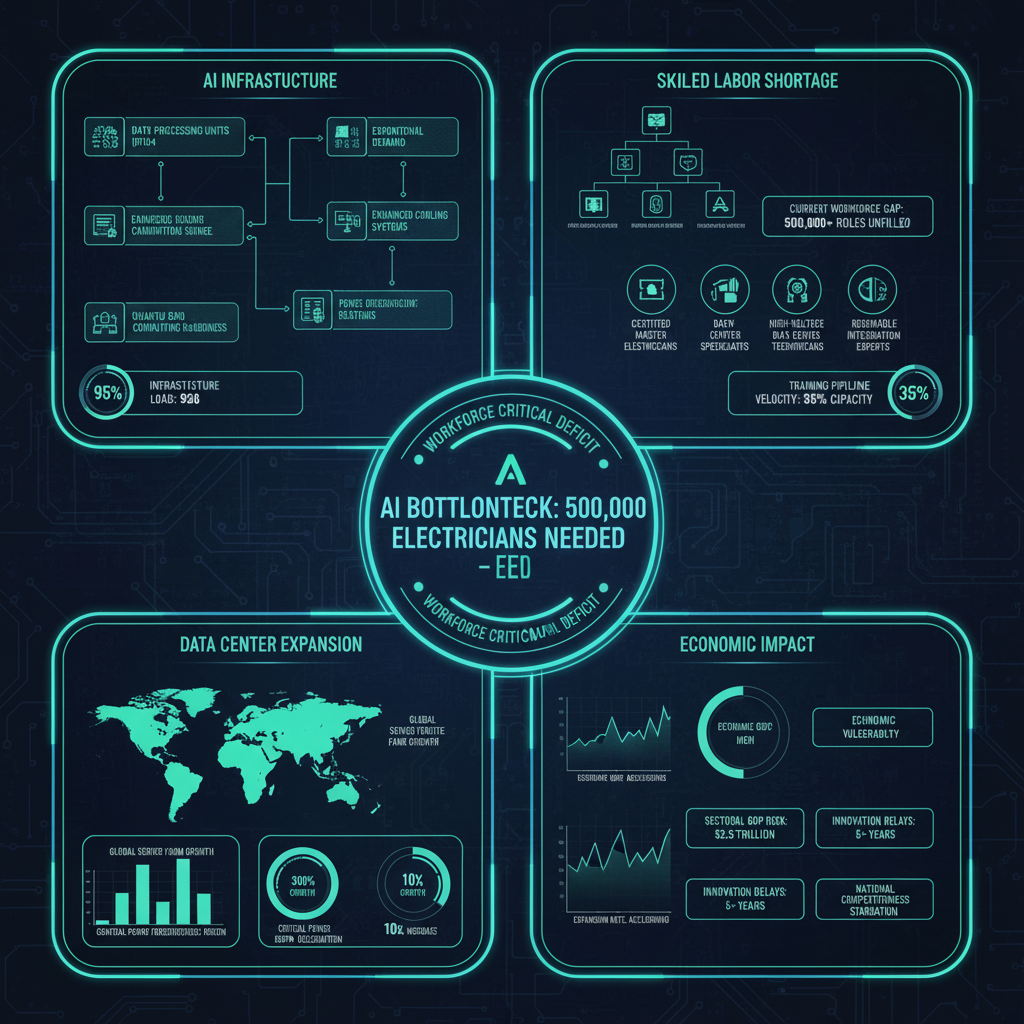
The explosive growth of AI is hitting a pragmatic wall, and it's not the capital expenditure of hyperscalers or even the price of power. The real constraint for AI expansion is a severe shortage of skilled human labor, specifically electricians, needed to build out the necessary grid infrastructure. What started as theoretical discussions about AI's energy demands is now a tactical problem requiring immediate attention from CTOs and infrastructure leaders.
"We think we're going to need to see 500,000 new jobs in the US alone to be able to source the combination of building the generation that's needed to supply power to data centers, that's about 300,000 and then also the grid, the infrastructure that's required for transmission and distribution, that's the other 200,000."
— Brian Singer, Head of GSUSTAIN at Goldman Sachs Research on Exchanges
Goldman Sachs' Brian Singer highlighted a projected 220% global growth in AI and non-AI data center power demand by 2030, equivalent to adding a top 10 power-consuming country. More critically, he pointed out that hyperscalers are increasingly deploying less efficient "behind the meter" natural gas power solutions due to multi-year grid upgrade delays. This signals a stark operational reality: the pace of AI development is now shackled by the pace of physical infrastructure deployment and the availability of specialized labor. The surprising insight here is that while the cost of power is a factor, its impact on a hyperscaler's 2030 EBITDA is minimal (~2.5%) compared to the sheer physical and human effort required to scale. For leaders planning their next data center build or even scaling existing operations, the question is less about kilowatt-hours and more about certified electricians.
The Strategic Question: With a half-million new skilled trade jobs needed for AI infrastructure in the US alone, how are we factoring trade skill development and availability into our long-term AI strategy, alongside traditional tech talent acquisition?
The Rundown
① Boardroom governance for capital projects needs granular KPIs, not just high-level oversight. Marco Mattiacci (Global Top Executive), on The Better Boards Podcast Series, stressed the necessity of moving beyond "first-level KPIs" and defining success with detailed, actionable metrics for technology and R&D roadmaps, without overwhelming boards with data. (Marco Mattiacci on The Better Boards Podcast Series)
→ The Operator Take: Revisit your board reporting for major tech and expansion projects; ensure KPIs are specific, outcome-driven, and tied to deployment realities, not just financial projections, to enable true oversight.
② The bourbon boom is officially over, with 16 million barrels aging in Kentucky and declining demand. Ken Troske (Labor Economist, University of Kentucky), on Freakonomics Radio, noted the current oversupply following falling demand since 2022 due to changing consumer tastes and pricing fatigue. (Ken Troske on Freakonomics Radio)
→ The Operator Take: The bourbon market offers a cautionary tale about overinvestment based on past booms; evaluate long-term supply chain and production strategies against dynamic consumer trends to avoid similar oversupply in your own product lines.
③ A loophole in Dodd-Frank regulations has enabled private credit to become a $3 trillion "black box," raising systemic risk concerns. Natasha Sarin (Economist, Yale), on The Indicator from Planet Money, highlighted the shift of over 50% of traditional bank loans to less regulated private credit firms, drawing parallels to pre-2008 financial risks. (Natasha Sarin on The Indicator from Planet Money)
→ The Operator Take: Understand your exposure to private credit in corporate financing and investment vehicles, as its opacity could introduce unforeseen systemic risks despite its current growth and perceived stability.
④ School cell phone bans are significantly boosting teacher satisfaction and reducing non-academic laptop use. Angela Duckworth (Professor, The Wharton School), on This Week in Business, reported that stricter bell-to-bell policies lead to happier teachers and address the "co-location of academic work and temptation" by digital devices. (Angela Duckworth on This Week in Business)
→ The Operator Take: Re-evaluate company policies around personal devices and digital distractions in the workplace, especially for roles requiring high focus; even small policy changes can significantly impact employee satisfaction and productivity by reducing digital temptations.
⑤ AI is amplifying competitive differentiation, not leveling the playing field, necessitating agile, "learn by doing" development. Andrew McAfee (Research Scientist, MIT), on HBR IdeaCast, emphasized that AI will make distinctions between companies much larger and advocates for clear OKRs and spreading best practices from early AI power users. (Andrew McAfee on HBR IdeaCast)
→ The Operator Take: Move beyond pilot projects in AI and commit to a strategic, agile, and culturally embedded AI adoption plan; this competitive advantage won't wait for perfected solutions, but for continuous learning and rapid deployment.
⑥ Anthropic's Claude is achieving 40 times higher revenue per user than Google's Gemini, proving the viability of niche professional AI strategies. Stefano Puntoni (Professor of Marketing, The Wharton School), on This Week in Business, highlighted Claude's focus on professional markets as a stark contrast to general consumer adoption models like ChatGPT and Gemini. (Stefano Puntoni on This Week in Business)
→ The Operator Take: When planning your AI integration, consider whether a niche, high-value professional use case could unlock significant ROI over broader, more diluted consumer applications, especially if your target audience has specific, high-cost problems AI can solve.
⑦ Intel's decline was linked to non-technical leadership prioritizing short-term financial gains over long-term R&D. Pat Gelsinger (Former CEO, Intel), on Summation, asserted that tech companies require technologists at the helm to maintain strategic vision and avoid issues like the US chip manufacturing decline. (Pat Gelsinger on Summation)
→ The Operator Take: Ensure your leadership team has sufficient technical depth and long-term vision, especially in R&D-heavy sectors; short-term financial focus without technical grounding can lead to significant competitive erosion.
The Stack
🔥 Heating Up
• Gartner: Continues to be a key voice in CX and AI strategy, with discussions on balancing AI efficiency with customer empathy. (Don Scheibenreif on Gartner ThinkCast)
• New Mountain Capital: Highlighted for its "business building" philosophy and a major task force project on GenAI integration across its portfolio. (Steve Klinsky on Exchanges)
• ChatGPT: Still recognized for kickstarting the generative AI revolution and having a massive user base. (Stefano Puntoni on This Week in Business)
👀 On Watch
• Private Credit 401k Inclusion Proposal: A new proposal by the Trump administration to allow private credit in 401k funds. (NPR on The Indicator from Planet Money)
• US Sovereign Wealth Fund to counter China's tech investment: Pat Gelsinger proposed this as a way to provide long-term capital and focus on national priorities. (Pat Gelsinger on Summation)
• US imports more from Taiwan than China: This dramatic shift in trade, largely driven by AI chip demand, is a critical geopolitical signal. (Pat Gelsinger on Summation)
🧊 Cooling Off
• Demand for Bourbon Shrinking: Post-2022, consumer tastes are changing, and price fatigue is setting in, leading to significant oversupply. (Ken Troske on Freakonomics Radio)
• Low hire low fire job market: This trend means employers are not adding many jobs, impacting new college graduates and specific fields like data science. (Darian Woods on The Indicator from Planet Money)
The Bottom Line
The AI revolution is less about the models, and more about the often-overlooked practicalities of power, people, and specific, high-ROI applications.
Your Move
• Quantify Bottlenecks: Assess your current and projected infrastructure needs, specifically identifying where skilled labor (e.g., electricians for data centers) or physical grid capacity could become a constraint for AI initiatives within the next 18-24 months. Plan for talent development or external partnerships accordingly.
• Audit Tech Leadership: Review the technical depth of your senior leadership and board. Ensure there's enough "technologist at the helm" perspective to balance short-term financial gains with long-term strategic R&D and platform investments, especially in AI-driven roadmaps.
• Redefine AI Success Metrics: Move beyond general AI KPIs to specific, actionable, and outcome-driven metrics for current and planned AI deployments. Borrow from the "niche professional market" success of Claude to identify high-value, measurable applications over broad, unmonetized consumer plays.
• Evaluate Workforce Policies: Consider re-evaluating internal policies around device usage and digital distractions. The impact of school cell phone bans on student focus can be a direct analog to employee satisfaction and productivity in knowledge work environments deeply impacted by digital "temptation."
Exchanges: "AI Exchanges: Power Problems?" · 20 min · Featuring Alison Nathan ▶ Listen
CTO's Cheat Sheet: Essential for any leader planning data center expansion or concerned about the physical constraints of AI; focuses on power demand and skilled labor shortages.
Exchanges: "The Business Builder: New Mountain Capital's Steve Klinsky" · 35 min · Featuring Alison Mass ▶ Listen
CTO's Cheat Sheet: Relevant for understanding how private equity integrates AI into portfolio companies and the value of intellectual curiosity in leadership hiring.
Freakonomics Radio: "669. Why Is 95 Percent of the World’s Bourbon Made in Kentucky?" · 46 min · Featuring Freakonomics Radio + Stitcher ▶ Listen
CTO's Cheat Sheet: A fascinating (and surprisingly relevant) case study on market saturation, regulatory impact, and the need for adaptability, offering parallels for tech leaders in rapidly evolving markets.
Gartner ThinkCast: "Human Moments That Matter in an AI‑Driven Customer Experience" · 25 min · Featuring Alexis Wearinga ▶ Listen
CTO's Cheat Sheet: Critical for CX leaders and architects balancing AI efficiency with customer empathy to avoid "over-automating" relationships and risking retention.
HBR IdeaCast: "Strategy Summit 2026: Who’s Going to Succeed with AI?" · 30 min · Featuring Andrew McAfee ▶ Listen
CTO's Cheat Sheet: Essential for leaders formulating AI strategy, particularly for understanding competitive differentiation and adopting agile "learn by doing" approaches rather than traditional waterfall methods.
Summation (formerly World of DaaS): "Fmr Intel CEO Pat Gelsinger on chips, China, and lessons from Andy Grove" · 58 min · Featuring Pat Gelsinger ▶ Listen
CTO's Cheat Sheet: Must-listen for leaders and board members on the critical role of technical leadership in R&D-intensive industries and geopolitical implications in global supply chains.
The Better Boards Podcast Series: "Capital Discipline in High-Performance Enterprises: Aligning Strategy, Technology and Governance Part II | Marco Mattiacci, Global Top Executive" · 17 min · Featuring Dr. Sabine Dembkowski ▶ Listen
CTO's Cheat Sheet: Valuable for any executive reporting to a board, offering practical advice on developing granular yet clear KPIs for technology and R&D oversight.
The Indicator from Planet Money: "Jobs that new college grads are and are not landing" · 9 min · Featuring Adrian Ma ▶ Listen
CTO's Cheat Sheet: Quick read for HR and talent acquisition leads interested in current disparities in the job market for new grads, especially in tech vs. other fields.
The Indicator from Planet Money: "Who's afraid of private credit?" · 9 min · Featuring NPR ▶ Listen
CTO's Cheat Sheet: Important for finance leaders and investors to understand the risks and opacity of the growing private credit market and its interconnectedness with traditional finance.
This Week in Business: "How School Cell Phone Bans Are Changing Student Behavior" · 14 min · Featuring Dan Loney ▶ Listen
CTO's Cheat Sheet: Insightful for HR and operations leaders considering workplace policies on digital distractions, drawing parallels from the impact of school cell phone bans on focus and satisfaction.
This Week in Business: "Inside the Business Models of Today’s Top AI Platforms" · 13 min · Featuring Dan Loney ▶ Listen
CTO's Cheat Sheet: Essential for understanding the differentiated monetization strategies of major AI players (OpenAI, Google, Anthropic) and informing your own build-vs-buy decisions for AI tools.
📖 Want the full episode breakdowns, guest details, and listen links?