
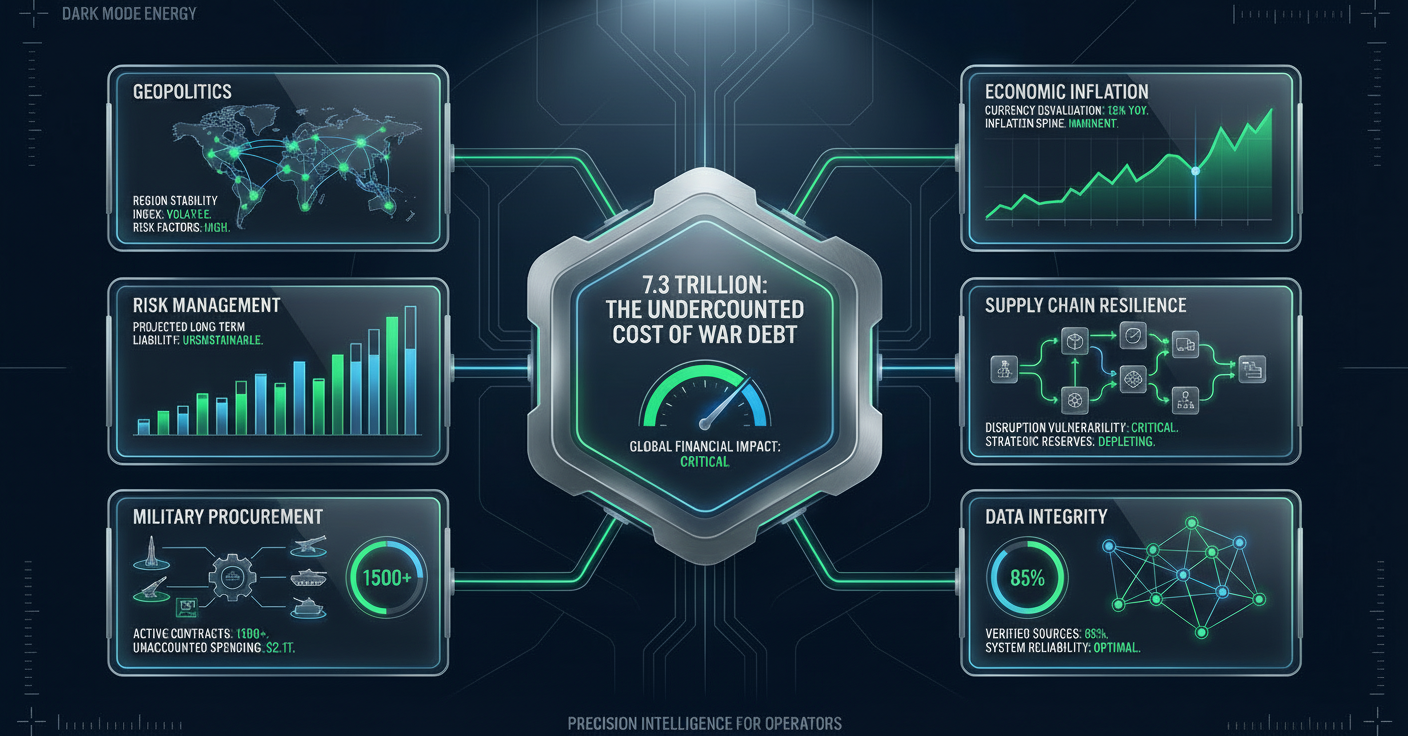
Geopolitical shocks are resetting the board, forcing operators to reprioritize resilience over efficiency and challenging long-held assumptions about hedging, military procurement, and market stability.
📊 11 episodes across 6 podcasts
⏱ 287 minutes of intelligence analyzed
🎙 Featuring: Ricky Mulvey (Host, NPR), Darian Woods (Host, NPR), Mark Cancian (Retired U.S. Marine Colonel, Budgeting for Department of Defense), Linda Bilmez (Public Finance Professor, Harvard Kennedy School)
The Lead
Geopolitical Turmoil Re-writes the Playbook on Risk and Resilience.
Recent escalations in the Middle East are sending ripple effects across global markets and operational strategies, fundamentally challenging conventional wisdom. What was once seen as a theoretical geopolitical risk is now a tangible cost driver, forcing a re-evaluation of everything from supply chain design to military procurement and even basic market hedging. The market reaction, for instance, isn't primarily a growth shock, but a significant inflation shock, as detailed by Kamakshya Trivedi of Goldman Sachs Research.
"The market is pricing in a higher inflation shock in response to the spike in energy prices that you've seen as a result of the conflict...it hasn't really been a growth shock that's been priced."
— Kamakshya Trivedi, Chief Foreign Exchange and Emerging Market Strategist at Goldman Sachs Research on Exchanges
Adding to the surprise, operators expecting traditional hedges like gold or the Swiss franc to perform have found themselves exposed, indicating that past frameworks for geopolitical risk management are failing. This forces a strategic shift: rather than simply optimizing for efficiency, businesses must now prioritize genuine resilience, recognizing that indirect costs, like the true long-term burden of war debt and veteran care, are massively underestimated. For instance, Nita Crawford, Co-founder of Costs of War project at Brown University, highlighted that accrued disability benefits for veterans alone amount to $7.3 trillion.
This evolving landscape impacts everything from the cost of diesel for truckers (NPR, Host on The Indicator from Planet Money) to the price of fertilizer for farmers (NPR, Host on The Indicator from Planet Money). The new operating environment demands a critical look at where and how we build in redundancies, and how deeply we understand the true cost — and potential for unexpected benefits — of disruption.
Strategic Question: Where are our single points of failure, and how are we accounting for the systemic, 'unbudgeted' costs of global instability in our long-term planning and investment decisions?
The Rundown
① The US Military is Massively Overspending on "Exquisite" Weapons. The US military's bias towards high-cost, high-tech weaponry leaves it tactically vulnerable and financially exposed to adversaries employing inexpensive, mass-produced drones. Jerry McGinn, Director of the Center for the Industrial Base at the Center for Strategic and International Studies, noted that adversaries "launch a lot of drones to try to have the US Kind of use their more exquisite weapons to knock them down and deplete our stores" (Jerry McGinn on The Indicator from Planet Money).
→ The Operator Take: Re-evaluate procurement strategies for critical assets; a “good enough”, mass-producible solution might offer greater tactical and economic resilience than a cutting-edge but limited one.
② Geopolitical Conflict is Making "Green" Alternatives More Competitive. Spikes in commodity prices due to global conflicts are creating unexpected economic advantages for sustainable alternatives. For example, plastic made from chicken bones and vegetable waste is becoming more viable as traditional oil-based plastic prices soar, as highlighted by NPR (NPR, Host on The Indicator from Planet Money).
→ The Operator Take: Re-run economic models for sustainable alternatives, as macro-environmental factors might have shifted the ROI significantly, making them more attractive than ever.
③ Regulation is Forcing 200,000 Trucker Exits, Adding Supply Chain Strain. New regulations from the Trump administration are projected to remove 200,000 foreign-born truck drivers over the next five years, despite an existing and growing trucker shortage. Waylon Wong on The Indicator from Planet Money specifically stated, "My indicator is 200,000. That is the number of foreign born truck drivers that could be losing their jobs under new regulations from the Trump administration."
→ The Operator Take: Proactively assess inbound and outbound logistics for potential capacity crunches and cost increases related to the trucking industry; consider investing in automation or localized supply chains.
④ Poland's Post-Soviet Economic Resurgence Offers a Blueprint for Emerging Markets. Poland has become the 20th largest economy globally due to strong institutional policies and successful EU integration, demonstrating that robust economic growth in emerging markets is achievable through foundational reforms and strategic partnerships. Darian Woods (Host, NPR) emphasized, "Poland is now the 20th largest economy in the world. And in terms of its income per person, it's catching up with rich countries, too" (Darian Woods on The Indicator from Planet Money).
→ The Operator Take: Look beyond immediate volatility when evaluating emerging markets; strong institutional frameworks and integration can signal long-term, structural outperformance.
⑤ Human Driver Obsolescence is a Software Problem, Redefining Urban Mobility. The shift to driverless cars is fundamentally a software challenge, not a hardware one, with personal experiences showing how rapidly perceptions change post-adoption. PJ Vogt, Host of Search Engine, mentioned, "First, the idea that I would press a button on my phone, a car would come out of nowhere, driven by nobody. I would get in, watch the steering wheel turn itself. It was a moment where I thought, oh, a lot's about to change" (PJ Vogt on Freakonomics Radio).
→ The Operator Take: For companies impacted by transportation, prepare for the rapid scaling of autonomous vehicle software; the societal and economic shifts will be swift once consumer trust is established.
The Stack
🔥 HEATING UP
• Asymmetric Warfare Economics (Iran's Drone Strategy): Iran's use of cheap drones to rapidly deplete the US inventory of expensive "exquisite" weapons is driving a strategic re-evaluation of military procurement. (Jerry McGinn on The Indicator from Planet Money)
• Stronger US Dollar due to global risk event and energy prices: Heightened geopolitical tensions and rising energy prices are bolstering the US dollar, with Kamakshya Trivedi noting, "As long as pressure on the energy prices remains to the upside, I think the dollar will remain well supported." (Kamakshya Trivedi on Exchanges)
• Federal Reserve's 'Skinny Master Account' for nonbank firms 🆕: This initiative aims to provide limited access to payment rails for fintech and crypto firms, boosting competition but raising concerns among traditional banks. (David Zaring on This Week in Business)
👀 ON WATCH
• Illegal ant trade/smuggling: A booming black market for exotic ants, fueled by social media, is creating ecological risks and a surprising illicit trade. (Mary Child on The Indicator from Planet Money)
• Sustaining Excellence vs. Turnaround Situations 🆕: Roy Williams' experience suggests that maintaining a high-performing team is often more challenging than rebuilding a struggling one. (Roy Williams on How Leaders Lead with David Novak)
• Emotional intelligence and emotional contagion in leadership 🆕: Leaders today require exceptional emotional regulation to navigate uncertainty and prevent team conflict from becoming personal. (Nancy Rothbard on This Week in Business)
🧊 COOLING OFF
• Hedges for portfolios not working: Traditional hedges like gold and the Swiss franc have not performed as expected during recent geopolitical conflicts, leading to painful portfolio outcomes. (Kamakshya Trivedi on Exchanges)
• Exquisite Weapons (military term): The US military's reliance on high-cost, high-tech weaponry is being shown as a vulnerability against mass-produced, inexpensive threats. (Jerry McGinn on The Indicator from Planet Money)
The Debate
The Fed’s “Skinny Master Account” for Fintechs: Innovation vs. Regulatory Arbitrage?
🐂 The Bull Case: David Zaring, Professor of Legal Studies and Business Ethics at The Wharton School, argues that the Federal Reserve's “Skinny Master Account” proposal for nonbank firms makes total sense, especially with internet-native fintechs operating across state lines. He believes that giving fintechs direct access to payment rails boosts competition and innovation, bypassing inefficient state-level licensing or correspondent banking. (David Zaring on This Week in Business)
🐻 The Bear Case: Traditional banks, particularly community lenders, are worried. Zaring points out their concern that “these extremely lightly regulated fintechs... are sort of able to take advantage of Fed services without complying with everything that they ought to be complying with.” They fear regulatory arbitrage, where fintechs gain access to core banking infrastructure without the heavy compliance burden, potentially harming small and medium enterprises. (David Zaring on This Week in Business)
The Operator's Read: The Fed's move signals an intent to modernize payment infrastructure, but regulatory parity is a key concern that could lead to significant legislative or litigation battles defining the future landscape.
The Bottom Line
The signal is clear: resilience, not just efficiency, must be the new operating principle as global instability reprice risk and shake long-held market assumptions.
Your Move
Action Items for Your Team
1. Stress-Test Supply Chains: Identify critical inputs with exposure to geopolitical hotspots and explore alternative sourcing or strategic stockpiling. Consider the “true cost” of disruption, including lost revenue and reputational damage, not just direct material costs.
2. Re-evaluate Hedging & Risk Models: Given the failure of traditional hedges, task your finance and risk teams with scenario planning for non-traditional disruptions and developing new, more robust risk mitigation strategies. This includes challenging assumptions around inflation vs. growth shocks.
3. Assess Automation & AI Opportunities in Resilience: Explore how AI/automation can build resilience, whether it's through dynamic route optimization to counter trucking shortages or identifying alternative material suppliers when primary ones are compromised.
4. Develop & Empower Mid-Level Leaders: Emphasize emotional regulation and delegation in your leadership development programs. Nancy Rothbard of The Wharton School highlighted the necessity for leaders to “stay calm and focused in the face of uncertainty.”
📖 Want the full episode breakdowns, guest details, and listen links?
Appendix
Exchanges: "Emerging Markets: Stirred, But Not Yet Shaken" · 15 min · Featuring Kamakshya Trivedi ▶ Listen
The Indicator from Planet Money: "How much is the Iran war costing us?" · 8 min · Featuring Ricky Mulvey ▶ Listen
The Indicator from Planet Money: "Trump and truckers, Poland prospers, and a booming ant biz" · 9 min · Featuring Darian Woods ▶ Listen
The Indicator from Planet Money: "A trucker, a farmer, and an entrepreneur walk into a global supply shock" · 9 min · Featuring Darian Woods ▶ Listen
Freakonomics Radio: "Are Human Drivers Finally Obsolete?" · 71 min · Featuring PJ Vogt ▶ Listen
Exchanges: "Lloyd Blankfein on His Memoir Streetwise, Risk Management and Leadership" · 31 min · Featuring Lloyd Blankfein ▶ Listen
HBR IdeaCast: "The Shifting Relationship Between Business and the U.S. Government" · 22 min · Featuring Jeffrey Sonnenfeld ▶ Listen
The Indicator from Planet Money: "How Iran is wasting American resources" · 9 min · Featuring Wayland Wong ▶ Listen
How Leaders Lead with David Novak: "#283: Roy Williams, Former Men’s Basketball Head Coach, North Carolina – Get better every single day" · 83 min · Featuring Roy Williams ▶ Listen
This Week in Business: "The Business Impact of Leadership Under Pressure" · 16 min · Featuring Nancy Rothbard ▶ Listen
This Week in Business: "The Fed’s Payment Rails and Fintech Access" · 14 min · Featuring David Zaring ▶ Listen