
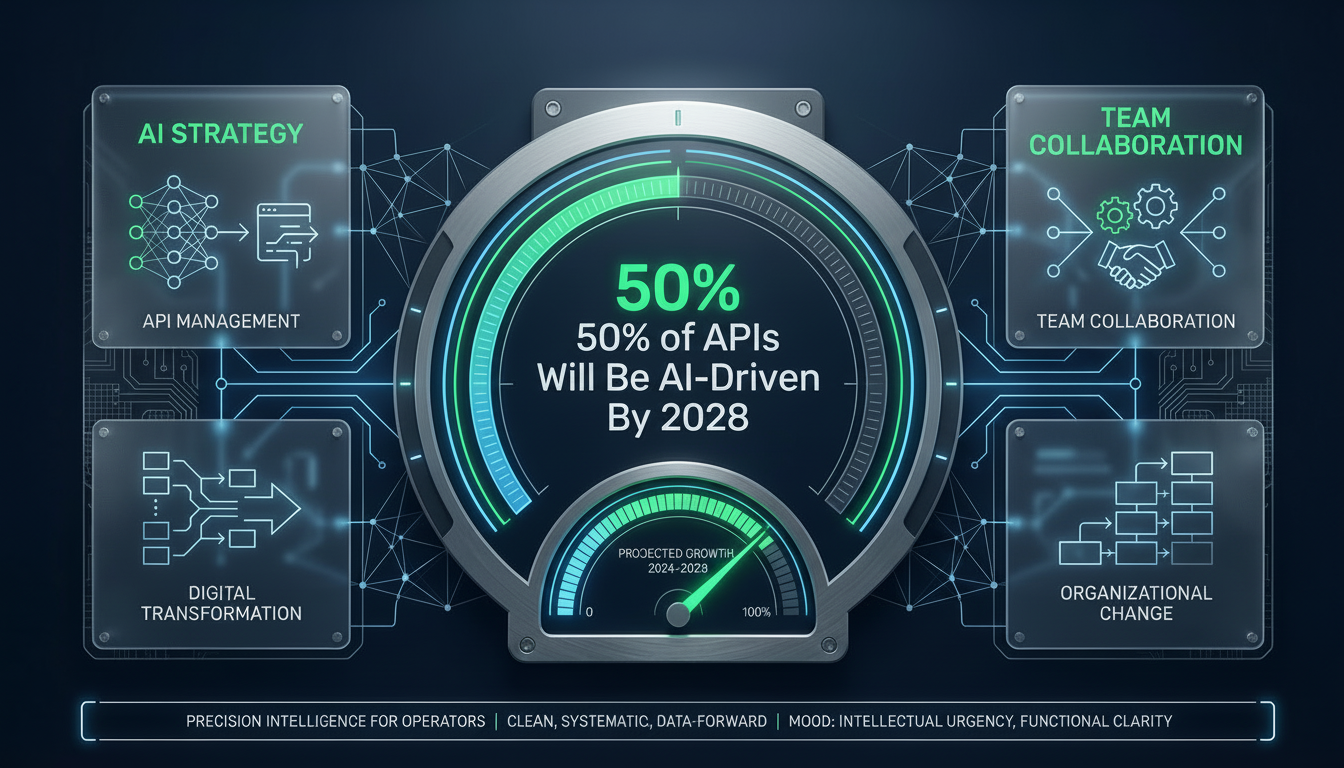
The AI conversation has shifted dramatically; it's no longer about if, but how—and with what guardrails. The real battleground is now implementation, not just aspiration.
📊 11 episodes across 8 podcasts
⏱ 337 minutes of intelligence analyzed
🎙 Featuring: Adrian Aoun, Adrian Ma, Akis Sklavounakis, Alison Beard, Alison Nathan, Amy Bernstein, Ann Lee, Auren Hoffman, David Novak, Darrienne Woods, Elizabeth Connell, Freakonomics Radio + Stitcher, Gabriela Borges, Judge Braswell, Judge Rodriguez, Jeff Hancock, Karen Stokes Lockhart, Kate Niederhoffer, Kati Daffan, Ken Docter, Kula, Leslie Linkowski, Manjunath Bhat, Marianne Roden, Maritza Braswell, Mark Frank, Marti DeLiema, Marty De Lima, Nigel Vaz, Peter Wharton-Hood, Rabia Butler, Scott Schlegel, Sean Carroll, Shameen Pillai, Stephen Dubner, Thomson Reuters Institute Insights podcast, Warwick Sabin, Waylon Wong, Xavier Rodriguez, Zach Warren
The Lead
AI's Operational Reality: You Can't Build the Future Without the API Plumbing and Team Players
The honeymoon phase with AI is officially over. This week, conversations sharply pivoted from aspirational AI to the gritty operational realities of making it work at scale. Forget the grand vision; the current bottleneck isn't the model but the fundamental infrastructure and team dynamics needed to deploy it responsibly. We're seeing a clear signal: organizations that fail to mature their API strategy and cultivate team-first cultures will hit a hard wall in their GenAI ambitions.
"No APIs mean no gen AI. No agentic AI create poorly managed or insecure APIs don't just put your AI initiatives at risk, but also your organization's data and digital assets at risk too."
— Shameen Pillai, Senior Director Analyst at Gartner
Why it matters: Gartner's Shameen Pillai underscores that "No APIs mean no gen AI." This isn't theoretical; it's a direct threat to data security and digital asset integrity. The sheer volume of AI-driven API usage expected by 2028 (over 50% according to Gartner) fundamentally changes the game. If your strategy isn't API-first and GenAI-ready, you’re already behind. This directly impacts everything from developer efficiency (as highlighted by Akis Sklavounakis on Gartner ThinkCast regarding platform engineering) to FinOps awareness and GPU cost management (Manjunath Bhat on Gartner ThinkCast).
"I will pick team players before individually brilliant people. And I've made that absolutely clear. Even great individuals have said, well, if I'M not a team player, then I don't have a place to. I don't belong in this team."
— Peter Wharton-Hood, CEO of LIFE Healthcare Group on How Leaders Lead with David Novak
The Human Element: Beyond technical plumbing, the human side of leadership is taking center stage. Peter Wharton-Hood, CEO of LIFE Healthcare Group, articulated a critical principle on How Leaders Lead with David Novak: "I will pick team players before individually brilliant people." This isn't just a feel-good statement; it's a hard-nosed operational reality in the face of complex AI integration. Individual brilliance can create silos; team players foster the cross-functional collaboration essential for navigating security, compliance, and iterative deployment of AI. The cost of poorly managed AI initiatives is not just financial; it's reputational and can lead to a 'human Ponzi scheme' of disconnected efforts, as Leslie Linkowski put it on The Indicator from Planet Money in a different context, but equally applicable here.
The Strategic Question: Is your organization's AI strategy truly addressing the foundational requirements of API maturity and fostering a culture that prioritizes collaborative deployment over isolated brilliance, or are you charting a course for inevitable "AI Workslop" and security risks?
The Rundown
① AI Workslop is a Strategic Drain, Not a Talent Problem. Organizations mandating AI use without proper frameworks are generating low-quality, AI-produced content that undermines trust and productivity. This "AI Workslop" costs, on average, two hours per instance to deal with and often stems from overburdened employees, not laziness. (Kate Niederhoffer on HBR IdeaCast)
→ The Operator Take: Review internal AI usage policies; emphasize quality assurance and provide clear guidelines and training to avoid the hidden costs of AI-generated junk, which, for a 10,000-employee company, could be $9 million annually (Jeff Hancock on HBR IdeaCast).
② AI is Redefining Healthcare from a Service to a Product. The traditional model of healthcare as a service is being fundamentally reshaped by AI, creating productized solutions that challenge existing regulatory frameworks. Adrian Aoun, Founder of Torch, stated that "Historically, healthcare has been a service, not a product. And AI is kind of changing that." (Adrian Aoun on Summation)
→ The Operator Take: CTOs in healthcare should treat AI as a core product development initiative, not just a back-office tool, and proactively engage with compliance and regulatory teams to navigate this shift.
③ AI Transforms the Software Sector, Shifting Investor Focus to GAAP Earnings. The initial hype around AI in software has settled into a more sober assessment. Improvements in coding algorithms (like Anthropic's CLAUDE code) have brought new competition, leading to a shift in investor sentiment toward value-oriented investors who prioritize GAAP earnings and "growth at a reasonable price," rather than solely non-GAAP metrics. (Gabriela Borges on Exchanges)
→ The Operator Take: Software leaders must adapt monetization strategies, modernize tech stacks, and pursue strategic M&A to build defensible "moats" and attract a new cohort of investors. Consider Peter Wharton-Hood's 🆕'fast follower' strategy for AI, prioritizing cost reductions and easier implementations.
④ The Judiciary Grapples with AI Integration: Speed vs. Trust. The newly formed 🆕Judicial AI Consortium (JAIC) highlights the critical need for clear policies and careful change management to maintain public trust as AI tools enhance case understanding and efficiency in courts. (Maritza Braswell on Clarity)
→ The Operator Take: Even outside the legal sector, this underscores that AI adoption must be accompanied by explicit policy, ethical guidelines, and robust training (only 15% of federal judges have AI training today, a clear gap). "It's not our job to be first. It's our job to get it right," stated Judge Scott Schlegel, a sentiment applicable to any regulated industry deploying AI.
⑤ Scammers Are Harnessing AI, Making Traditional Defenses Obsolete. Digital tools, particularly AI, have supercharged fraudulent activities, with estimates of $31.3 billion to $195.9 billion lost to fraud in the US in 2024. Scammers use AI for highly tailored attacks, including voice cloning and sophisticated text generation, rendering old advice like checking for spelling errors useless. (Marti DeLiema and Freakonomics Radio + Stitcher on Freakonomics Radio)
→ The Operator Take: Update employee security training to reflect advanced AI-powered social engineering tactics. Invest in AI-powered fraud detection systems, recognizing that the battle against scammers is now an AI vs. AI arms race.
The Stack
🔥 HEATING UP
• API Strategy for GenAI and Agentic AI: Gartner emphasizes the non-negotiable role of API maturity, stating that "no APIs mean no GenAI," with over 50% of API usage expected to come from AI by 2028. (Shameen Pillai on Gartner ThinkCast)
• AI as an operating system: AI is fundamentally reshaping how businesses create and deliver value, far beyond being just another technology solution. (Nigel Vaz on HBR IdeaCast)
• AI's impact on healthcare transformation: Healthcare is shifting from a service to a product due to AI, challenging traditional regulatory models. (Adrian Aoun on Summation)
• GLP-1s and their impact on health and behavior: GLP-1s primarily function by increasing frontal lobe authority, which helps reduce addictive behaviors like gambling and drinking. (Adrian Aoun on Summation)
🆕 ON WATCH
• 🆕Judicial AI Consortium (JAIC): A newly formed group for judges, by judges, addressing the rapid evolution of AI in the court system and stressing ethical AI use. (Maritza Braswell on Clarity)
• 🆕Global Tariff Compliance for Manufacturers: International manufacturers face dynamic global tariffs, requiring real-time data and integrated global trade management systems, with genuine (but risky) applications of AI in compliance. (Marianne Roden on Clarity)
• 🆕Picking your boss: A new leadership recommendation suggesting that employees should strive to be in demand enough to actively pick their bosses and career paths. (Peter Wharton-Hood on How Leaders Lead with David Novak)
• 🆕Resisting technology change for strategic advantage: A contrarian view that deliberately delaying cutting-edge technology adoption (such as AI) can be a strategic "fast follower" approach to leverage future cost reductions. (Peter Wharton-Hood on How Leaders Lead with David Novak)
🥶 COOLING OFF
• Linear thought process/Waterfall approach: This traditional strategy methodology is highlighted as the single biggest threat to successful AI transformation due to its inability to adapt to the iterative nature of AI deployment. (Nigel Vaz on HBR IdeaCast)
• Flawed Consumer Fraud Education: Traditional scam prevention advice (e.g., checking for spelling errors) is now obsolete due to AI advancements in voice cloning and sophisticated text generation. (Freakonomics Radio + Stitcher on Freakonomics Radio)
The Bottom Line
Operational reality is now dictating AI strategy: if your APIs aren't mature and your teams aren't truly collaborative, your AI aspirations will remain just that—aspirations.
Your Move
① Audit API Maturity: Assess your organization against Gartner's five-dimension API maturity model to identify gaps hindering GenAI deployment. Prioritize initiatives to bolster API security and management, recognizing that over 50% of API usage will be AI-driven by 2028. (Gartner ThinkCast)
② Implement an "AI Workslop" Taskforce: Establish clear guidelines and quality gates for AI-generated content. Train teams to recognize and remediate low-quality AI output to prevent the significant productivity and morale drain highlighted by HBR IdeaCast.
③ Re-evaluate Trust & Safety Protocols for AI-powered Scams: Update internal and external fraud prevention training and tools, assuming a sophisticated, AI-powered adversary. Traditional defenses are obsolete against AI voice cloning and text generation. (Freakonomics Radio)
📖 Want the full episode breakdowns, guest details, and listen links?
Appendix
Gartner ThinkCast: "No APIs, No AI: Organizing Software Engineering for Today's AI Reality" · 18 min · Featuring Karen Stokes Lockhart
For CTOs: Critical insights on API maturity models and team topologies essential for scaling GenAI, directly impacting developer productivity and future AI initiatives. ▶ Listen
The Indicator from Planet Money: "Should colleges accept money from bad people?" · 8 min · Featuring Sean Carroll
For CEOs: A thought-provoking dive into the ethical complexities of "tainted money" that applies beyond academia to any organization considering funding from controversial sources, impacting reputational risk. ▶ Listen
HBR IdeaCast: "Strategy Summit 2026: Why AI Transformation Needs a Human Touch" · 31 min · Featuring Amy Bernstein
For CxOs: Strategic insights on moving beyond linear thinking in AI strategy, with a focus on ethical implementation, data governance, and viewing AI as an operating system for the business. ▶ Listen
Freakonomics Radio: "667. Here’s Why You Are Constantly Fighting Off Scammers" · 47 min · Featuring Freakonomics Radio + Stitcher
For Security Leaders: Essential listening for understanding how AI is industrializing scams, rendering traditional prevention methods obsolete, and the need for updated defense strategies. ▶ Listen
HBR IdeaCast: "The Hidden Causes of AI Workslop—and How to Fix Them" · 29 min · Featuring Alison Beard
For Operations Leaders: Deep dive into the emerging problem of "AI Workslop," its hidden costs, and practical approaches to fix low-quality AI-generated content within organizations. ▶ Listen
Exchanges: "Can Software Survive AI?" · 15 min · Featuring Alison Nathan
For Software Executives: An analyst's perspective on AI's disruptive impact on the software sector, changing investor sentiment, and strategies for maintaining defensible "moats" and monetization. ▶ Listen
Summation (formerly World of DaaS): "Adrian Aoun on healthcare as a product, Apple's AI problem, and why you should have kids now" · 54 min · Featuring Adrian Aoun
For Product Chiefs: Insights on AI productization in healthcare, Apple's strategic AI missteps, and a unique perspective on angel investing and longevity research. ▶ Listen
Clarity: "How a new judicial consortium plans to address the impact of AI in courts" · 34 min · Featuring Rabia Butler
For Legal & Compliance: An insider's look at how the judiciary is proactively establishing best practices for AI use in courts, with crucial lessons on policy, ethics, and maintaining public trust. ▶ Listen
The Indicator from Planet Money: "Can anything save the news biz?" · 9 min · Featuring Adrian Ma
For Business Development Leaders: Explores innovative business models and revenue strategies for reviving local news, showcasing how public benefit corporations can balance profit with public service. ▶ Listen
How Leaders Lead with David Novak: "#282: Peter Wharton-Hood, CEO, LIFE Healthcare Group – Pick team players over individual performers" · 68 min · Featuring David Novak
For HR & Talent Leaders: A deep dive into Peter Wharton-Hood's team-first leadership philosophy, emphasizing cultural fit over individual brilliance, and strategic insights on technology adoption. ▶ Listen
Clarity: "How can international manufacturers keep up with ever-changing global tariffs and remain in compliance?" · 24 min · Featuring Rabia Butler
For Supply Chain & Finance: Critical for understanding the complexities of global tariff compliance, the impact of SCOTUS rulings, and the genuine (but risky) applications of AI in trade management. ▶ Listen