
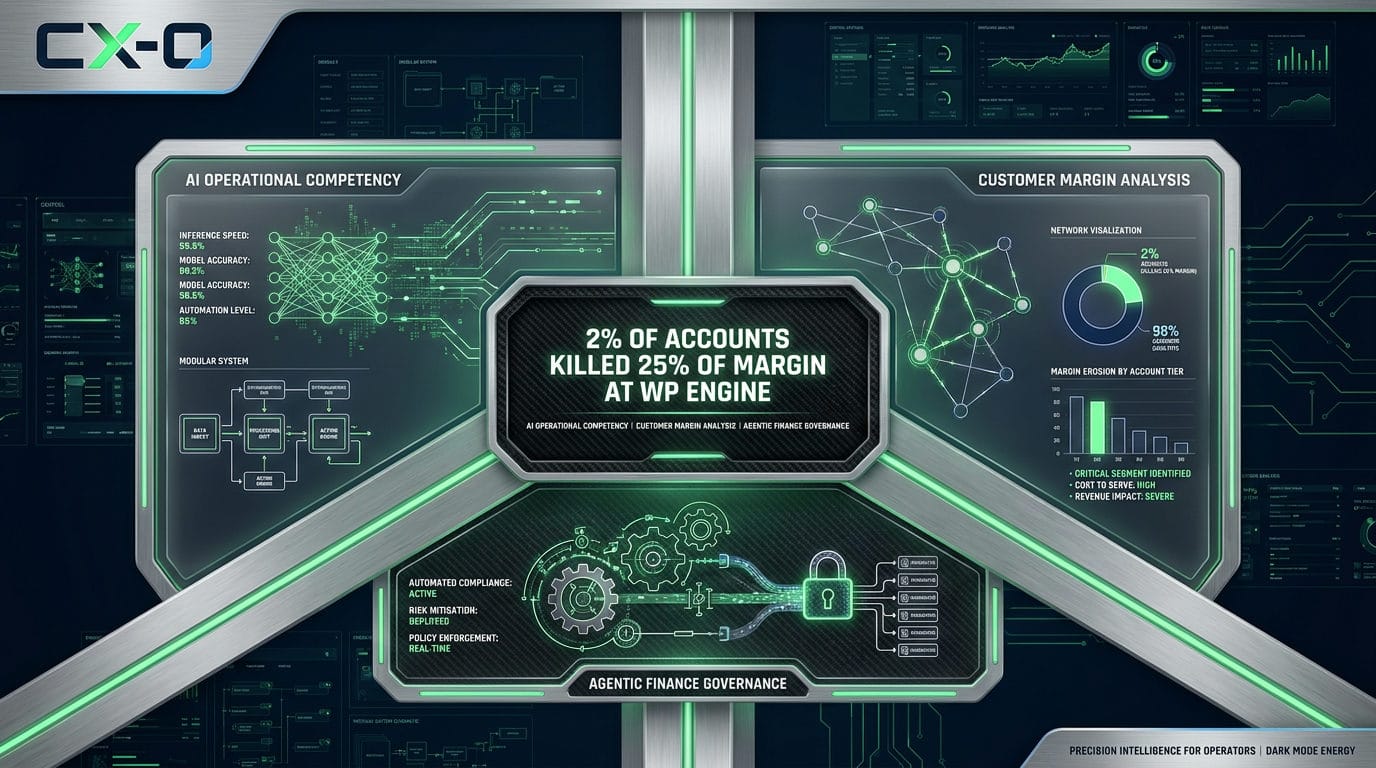
The greatest trap for a scaling organization right now is mistaking "AI efficiency" for "operational competency."
📊 10 episodes across 8 podcasts
⏱ 8 hours 6 minutes of intelligence analyzed
🎙 Featuring: Evan Campbell (Chinook Ranch Consulting), Patrick Bangert (Occidental Petroleum), Michael Krigsman (CXOTalk), Samuel Monti (SolarWinds), Dhawal Parvatikar, Jason Cohen (WP Engine), Vin Vashishta (V-Squared), Paula Goldman (Salesforce), Nick Gospodinov (Mandel AI), Omer Ismail (OnePay), Matt Ausman (Zebra Technologies)
|
The Big Shift
The end of "Pilot Purgatory" through Proof of Competency.
The AI hype cycle has hit an infrastructure wall. Fascination with "what is possible" is yielding to the reality of "what can we actually support?" Patrick Bangert (Chief AI Officer, Occidental Petroleum) recommends replacing the Proof of Concept with a Proof of Competency.
Why it matters: Most AI pilots fail not because the math is wrong, but because the organization lacks the muscle to adopt the output. Bangert argues that the "secret sauce" isn't high tech; it’s the boring, unsexy work of data cleansing and frontline change management. At Oxy, they’ve decoupled the decision-making from the communication: Machine Learning handles the complex CO₂ injection optimization, while LLMs are strictly confined to the communication layer.
The Strategy: Stop running "free" pilots. Projects are dead on arrival unless a business owner formally signs off on the ROI estimate and the funding before the first line of code is written. In the shift from asking "can we build it?" to "should we build it?", domain expertise is the only barrier keeping "AI slop" from degrading the core business.
"So POC in my terminology stands for proof of competency, not proof of concept... Adoption is the mechanism by which the revenue KPI is actually achieved."
— Patrick Bangert, Chief AI Officer, Occidental Petroleum, on CXOTalk
The Bottom Line: If you cut your domain experts in anticipation of AI efficiency, you will end up rehiring them at a premium to fix the mess your models made.
The Rundown
① The "Profit Whale" Chart: Finding Your Margin Vampires.
Rank your customers by gross-profit dollars and plot them cumulatively. On Run the Numbers, Jason Cohen (WP Engine) noted that a tiny tail—just 150 accounts out of 7,700—can drag a company's gross margin from 80% down to 55%.
→ The Operator's Take: Investigate the tail before firing it. These "unprofitable" customers often surface product bugs or self-service gaps that unlock margin across your entire base once fixed.
② Stop Tying OKRs to Bonuses Immediately.
The moment an employee believes an OKR impacts their payout, "you'll never see another ambitious objective set... forever." On CFO 4.0, Evan Campbell (Chinook Ranch Consulting) argued that OKRs drive strategic change, while KPIs monitor business-as-usual.
→ The Operator's Take: Treat OKRs purely as a strategy realization framework. If a KPI falls out of its "control range," it graduates to an OKR until it's fixed.
③ Agentic Finance: The Rise of Bounded Subaccounts.
"Penny" agents that can actually move money introduce a trust gap. On Summation, Omer Ismail (OnePay) suggested creating dedicated bank subaccounts with hard spending limits specifically for AI agents.
→ The Operator's Take: Agentic commerce requires "pocketed liquidity." Agents should operate with $200–$300 limits rather than holding "full account access."
④ The Unstructured-to-Structured Procurement Gap.
Critical lead-time changes and supplier backorders sit trapped in emails and "tribal knowledge" long before hitting the ERP. On Supply Chain Now, Nick Gospodinov (Mandel AI) discussed using agents to extract this context, providing buyers with sourcing options before a crisis hits.
→ The Operator's Take: Point AI at the "coordination layer." Turning unstructured inboxes into a "system of action" surfaces ROI within the first 24 hours.
⑤ The "Human Goes First" Rule for Product Innovation.
On CXOTalk, Salesforce’s Paula Goldman pointed to IKEA’s "couch in a box" as proof that AI often defaults to clichés. When IKEA used AI for design, it kept producing standard sofas. Generating a breakthrough required humans to challenge the brief before the tool was ever touched.
→ The Operator's Take: In judgment-heavy roles, evaluate use cases by whether AI should perform the work rather than whether it can.
Signal Board
🔥 HEATING UP
• Net Revenue Retention (NRR): On CFO Thought Leader, SolarWinds CFO Samuel Monti identified this as the defining KPI for recurring revenue health.
• Open-Weight Models: On CXOTalk, Patrick Bangert noted that industrial leaders like Oxy are shifting LLM workloads to open-weight models to eliminate token-based variable costs.
👀 ON WATCH
• 🆕 Zebra Technologies Governance: Employees built 4,600 agents in months. On Technovation, Matt Ausman explained that current policy prohibits sharing them to maintain individual accountability.
• 🆕 OnePay Teen Accounts: On Summation, Omer Ismail detailed plans to use secured-credit infrastructure to build credit history for users before they turn 18.
❄️ COOLING OFF
• Siloed Metric Optimization: On CFO 4.0, Evan Campbell warned that locally optimized goals (like procurement savings) can destroy product innovation and force business divestiture.
• Routine Management Reporting: On the GrowCFO Show, Dhawal Parvatikar shared an experiment where stopping 14 recurring reports prompted questions from only 2 people, proving most routine reporting is unread "slop."
The Debate
Is "Human-in-the-Loop" a Scalable Governance Model?
The "Yes" Case: Nick Gospodinov (Mandel AI) and Rick McDonald argue that humans must remain the final decision-makers in chaotic supply chain environments. AI agents should gather sourcing options and present the "top three" to a buyer, but never autonomously commit company capital without a human checkpoint.
The "No" Case: Paula Goldman (Salesforce) argues that "human-in-the-loop" is becoming a fallacy. If an agent processes 50,000 data points, a human cannot realistically verify every step without defeating the purpose of automation. Governance must shift to "Human at the Helm"—setting deterministic guardrails, anomaly detection, and escalation triggers rather than manual reviews.
The Operator's Read: The evidence favors Goldman’s view. Manual verification creates an unscalable bottleneck. Operations teams will need to build "audit trails for agents" instead of "tasks for humans."
The Bottom Line
Strategy is logistics; business is won by operations. If your AI strategy doesn't start with data cleansing and end with frontline adoption, it’s just expensive theater.
Quick Appendix
CFO 4.0: "OKRs Explained: How to Turn Strategy into Action" · 52 min · Featuring Evan Campbell ▶ Listen
Listen if you need to: Fix the "sandbagging" culture created by linking goals to bonuses.
CFO Thought Leader: "1228: The New Economics of SolarWinds" · 59 min · Featuring Samuel Monti ▶ Listen · Apple Podcasts
Listen if you need to: Understand how to transition $500M+ businesses to recurring revenue models.
CXOTalk: "Why Most AI Pilots Fail (And How to Fix It)" · 46 min · Featuring Patrick Bangert ▶ Listen · Apple Podcasts
Listen if you need to: Stop "pilot purgatory" and build a proof-of-competency framework.
CXOTalk: "AI Agents: Why You Need to Be at the Helm" · 53 min · Featuring Paula Goldman ▶ Listen · Apple Podcasts
Listen if you need to: Transition from "human-in-the-loop" to "human-at-the-helm" governance.
GrowCFO Show: "How AI Is Changing FP&A" · 39 min · Featuring Dhawal Parvatikar ▶ Listen · Apple Podcasts
Listen if you need to: Audit your management reporting for "dead" reports no one reads.
Run the Numbers: "The Profit Whale" · 63 min · Featuring Jason Cohen ▶ Listen · Apple Podcasts
Listen if you need to: Identify the 2% of customers causing 80% of your support headaches.
Summation: "OnePay CEO Omer Ismail" · 54 min · Featuring Omer Ismail ▶ Listen · Apple Podcasts
Listen if you need to: See how agentic commerce will interact with actual bank accounts.
Supply Chain Now: "Driving Growth Through Smarter AI Investments" · 42 min · Featuring Vin Vashishta ▶ Listen · Apple Podcasts
Listen if you need to: Rebuild marketplaces for an agent-first reality.
Supply Chain Now: "The Future of Self-Coordinating Supply Chains" · 49 min · Featuring Nick Gospodinov ▶ Listen · Apple Podcasts
Listen if you need to: Capture "tribal knowledge" currently trapped in employee inboxes.
Technovation: "Matt Ausman on AI Agents and the Future of IT" · 29 min · Featuring Matt Ausman ▶ Listen · Apple Podcasts
Listen if you need to: Scale internal agent creation without losing data accountability.
