
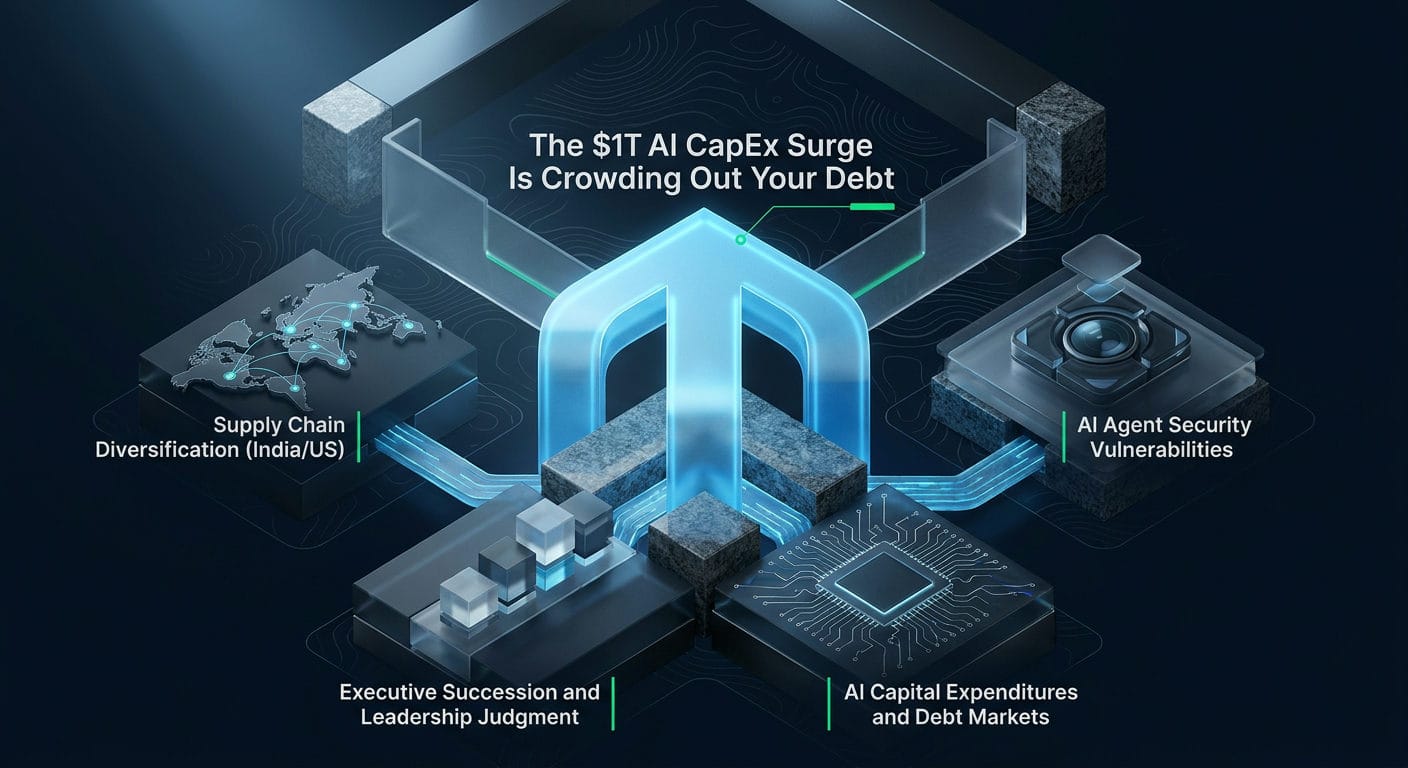
The board’s focus on AI’s operational promise is currently blinding them to its distortion of global capital markets.
📊 10 episodes across 8 podcasts
⏱ 509 minutes of intelligence analyzed
🎙 Featuring: Laura Geniere, Brian Winter, Laura Jáner, Adam Grant, Spencer Cox, Simon Bowen, Jim Vasilopoulos, Jan Rutherford, Fareed Zakaria, Scott Galloway, John Donvan, Meredith Whittaker, Neil Chilson, Jeff Berman, Christina Wing, Alison Beard, Adi Ignatius, Pamela Fletcher, Evan Epstein, Philippe Laffont, David Novak, Anna Lembke, Anke Richter
|
The AI Capital Crowding Effect
While management teams focus on how AI agents might automate the front office, a more immediate threat is emerging on the balance sheet. A surge in capital expenditure from hyperscalers—projected to exceed $1 trillion next year—combined with heavy government borrowing, is altering the cost of capital for everyone else.
Anke Richter, credit strategist at ISP Group, argues that we are entering a period of "normalization" where the cheap money of the post-2008 era is officially dead. The AI infrastructure arms race creates a "crowding out" effect that consumes investor attention and liquidity. For non-AI firms, debt capacity is shrinking and equity is becoming more expensive simply because you are competing for the same dollar as a data-center build-out.
"I believe a lot of companies think about the impact of AI on the operational business but do not really look at what it means for their financing side and I think that might be a little bit of a blind spot."
— Anke Richter, Credit strategist at ISP Group on The Better Boards Podcast Series
Why it matters: If your five-year plan assumes a return to 2019-era funding costs, your terminal value is likely overstated. Boards must push management to reassess capital structure, sharpen investor relations to compete for "stolen" attention, and stress-test the business against a sustained higher-rate environment.
Board Question: How does our projected ROI on non-AI projects hold up if our cost of capital remains 200 basis points higher than our historical average for the next three years?
IDEAS IN BRIEF
① The Transition from Expertise to Judgment.
As AI drives the unit cost of routine, repeatable thinking toward zero, human value is shifting toward accountability and "source code"—the wisdom and character behind a leader’s decisions. (Simon Bowen on The Leadership Podcast)
→ The Implication: Succession planning must move beyond task-based training to the explicit codification of a leader’s distinctive "thinking model" to prevent organizational collapse when that leader exits.
② Supply Chain Diversification as Strategic Insurance.
Global allies, including Canada and India, are increasingly diversifying their trade and defense ties away from the U.S. to mitigate the risk of American policy volatility. (Fareed Zakaria on The Prof G Pod)
→ Strategic Shift: Every new iPhone sold in America is now made in India, a scale of supply-chain migration that was unthinkable three years ago but is now a baseline requirement for resilience.
③ The Security Paradox of AI Agents.
🆕 Consumer AI agents require broad OS-level permissions that can bypass application-layer encryption, potentially exposing an entire network of contacts through a single user's installation. (Meredith Whittaker on Masters of Scale)
→ The Risk: Whittaker warns that "we are eating the seed corn of our cybersecurity" by prioritizing agent convenience over the structural perils of LLM prompt injection, which remains unsolved in 11% of tested cases.
④ Separating Age from Succession Logic.
Performance declines in senior leaders are often misattributed to age, when the actual root cause is frequently boredom or misaligned incentives. (Christina Wing on HBR IdeaCast)
→ The Fix: Boards should implement transparent pay bands and separate "age" from "career transition" conversations to ensure high-value wisdom isn't prematurely offboarded due to social taboos.
⑤ Real-World Abundance as Addiction Antidote.
🆕 The "addiction economy" thrives on digital micro-control, which paradoxically increases anxiety and perfectionism among young adults. (Anna Lembke on The Prof G Pod)
→ The Implication: High-performance cultures should prioritize "embodied activities" and real-world friction, as digital affirmation increasingly fuels a dopaminergic narcissism that erodes long-term resilience.
Signal Board
🔥 HEATING UP
• India-Based Manufacturing: Rapid scaling of iPhone production signals India's emergence as the primary alternative to Chinese supply chains. (Fareed Zakaria on The Prof G Pod)
• Visual Decision Models: Using geometric shapes to make complex organizational patterns and cultural metrics measurable for boards. (Simon Bowen on The Leadership Podcast)
👁️ ON WATCH
• 🆕 Philippe Laffont: The Coatue founder's thesis on space-based data centers as a solution to terrestrial land and energy constraints. (Philippe Laffont on How Leaders Lead)
• Prompt Injection: 🆕 An architectural flaw in LLM agents that allows malicious actors to hijack systems via browser content. (Meredith Whittaker on Masters of Scale)
❄️ COOLING OFF
• Post-2008 Funding Models: Cheap corporate debt is ending; boards must prepare for a "normalization" to pre-financial-crisis levels. (Anke Richter on The Better Boards Podcast Series)
• Gerrymandering Security: Shifting voter blocs in the U.S. could turn safe districts into liabilities for incumbents during high-volatility cycles. (Fareed Zakaria on The Prof G Pod)
THE TENSION
Topic framing: The debate over whether AI agents represent a net positive for individual agency or a surrender of privacy.
🔵 Perspective One: Neil Chilson argues that AI agents can actually enhance privacy by automating the labor-intensive work of opting out of data brokers and reading dense privacy policies that humans ignore. (Neil Chilson on Masters of Scale)
🔴 Perspective Two: Meredith Whittaker contends that the underlying architecture of LLMs makes them structurally unsafe, citing an 11% success rate for prompt injection attacks even in controlled frontier-lab environments. (Meredith Whittaker on Masters of Scale)
The Strategist's Read: The tension lies in the trade-off between personal productivity and systemic vulnerability; while agents offer immediate utility, they introduce a "non-patchable" attack surface that current cybersecurity frameworks are unprepared to govern.
The Bottom Line
The AI revolution has become a capital markets event that requires a recalibration of your debt strategy and executive judgment.
Episode Guide
Boardroom Governance: "Pamela Fletcher: Electrification, AI, and the Boardroom" · 47 min · Featuring Pamela Fletcher (Former CEO, Sion Power) Listen for: Why battery supply chains are now a national security priority for directors. ▶ Listen · Apple Podcasts
HBR IdeaCast: "The Topics We Avoid at Work—and How to Start Talking About Them" · 31 min · Featuring Christina Wing (Senior Lecturer, Harvard Business School) Listen for: Practical frameworks to distinguish between necessary privacy and toxic workplace secrecy. ▶ Listen · Apple Podcasts
How Leaders Lead: "#316: Philippe Laffont, Founder, Coatue Management" · 85 min · Featuring Philippe Laffont (Founder, Coatue Management) Listen for: The "big ideas" framework for analyzing multi-year technology waves. ▶ Listen · Apple Podcasts
Masters of Scale: "Open to Debate: should we trust AI agents with our information?" · 67 min · Featuring Meredith Whittaker (President, Signal) and Neil Chilson (Abundance Institute) Listen for: The most substantive debate to date on the architectural risks of LLM-based agent systems. ▶ Listen · Apple Podcasts
ReThinking: "How to escape your echo chamber with Utah Governor Spencer Cox" · 45 min · Featuring Spencer Cox (Governor of Utah) Listen for: Evidence-based strategies for depolarization that work in both state houses and boardrooms. ▶ Listen · Apple Podcasts
The Better Boards Podcast Series: "Beyond Operations: AI, Debt, and The Balance Sheet" · 27 min · Featuring Anke Richter (Credit strategist, ISP Group) Listen for: How the $1T AI CapEx surge is raising borrowing costs for non-tech firms. ▶ Listen · Apple Podcasts
The Leadership Podcast: "TLP 536: The Problem Beneath the Problem" · 51 min · Featuring Simon Bowen (Founder, Models Method) Listen for: How to codify "source code" leadership to ensure wisdom survives executive succession. ▶ Listen · Apple Podcasts
The Prof G Pod: "A Stanford Psychiatrist on Escaping the Addiction Economy" · 64 min · Featuring Anna Lembke (Professor of Psychiatry, Stanford) Listen for: How digital over-optimization is hollowing out young adult resilience. ▶ Listen · Apple Podcasts
The Prof G Pod: "Brazil’s Election Comeback and What America Can Learn" · 38 min · Featuring Brian Winter (Editor-in-Chief, Americas Quarterly) Listen for: How a 10-million-member WhatsApp network disrupted traditional political polling. ▶ Listen · Apple Podcasts
The Prof G Pod: "Fareed Zakaria on the Midterms and What Comes Next" · 54 min · Featuring Fareed Zakaria (Host, Fareed Zakaria GPS) Listen for: A global perspective on supply chain diversification and the waning of the populist wave. ▶ Listen · Apple Podcasts
