
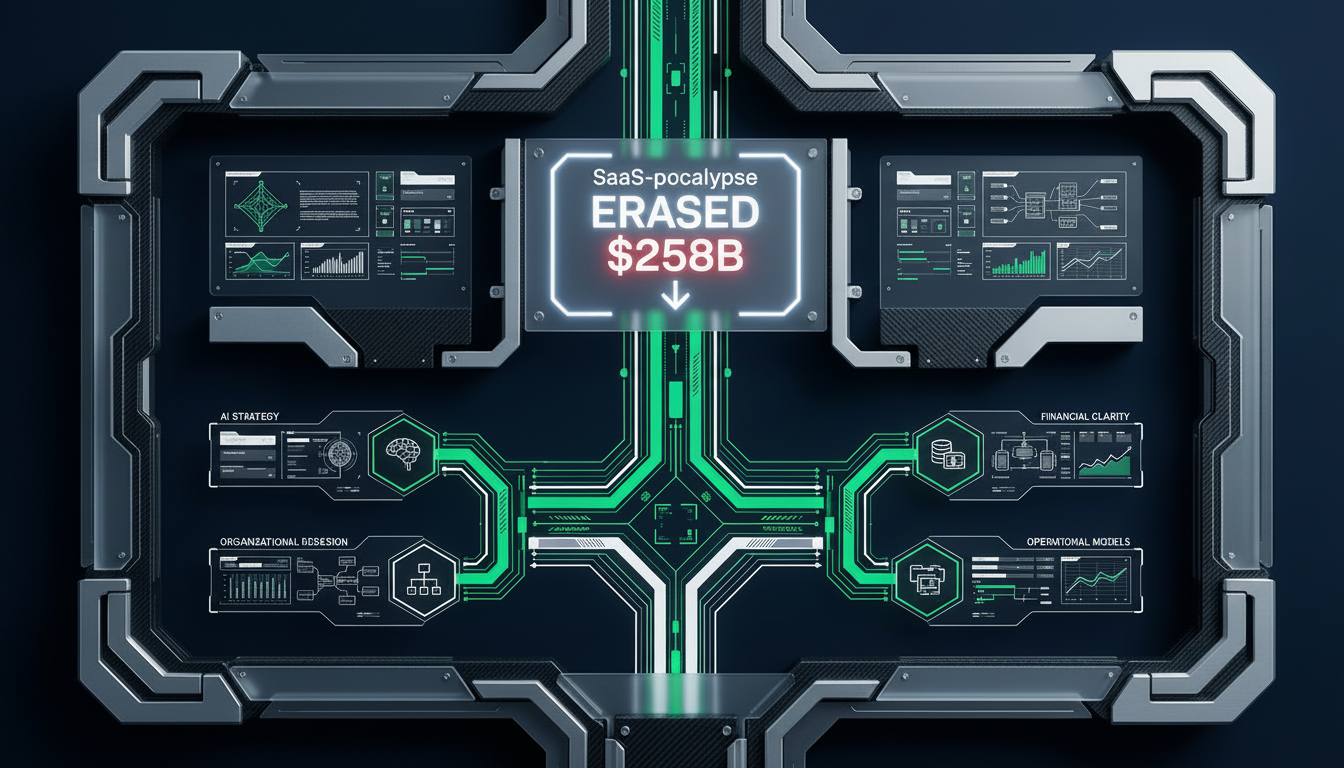
The "SaaS-pocalypse" wasn't a blip; it was a fundamental shift forcing operators to rethink organizational design, financial clarity, and AI strategy.
📊 7 episodes across 4 podcasts
⏱ 279 minutes of intelligence analyzed
🎙 Featuring: Andrew Bender (CFO, BNI Global), The Future of Finance is Listening (Host, CFO THOUGHT LEADER), Steve Coughran (Host, Coltivar Group, LLC), Peter High (Host, Metis Strategy), Eric Ries (Founder of the Long-Term Stock Exchange, Author), Kellie Romack (Chief Digital Information Officer, ServiceNow), Michael Perica (CFO, Rimini Street), CJ Gustafson (Host, Run the Numbers), Mike Wilcox (CFO, Blockchain.com), Mike Riegel (CFO, Blockchain.com), Sandhya Venkatachalam (Co-Founder and General Partner, Axiom Partners)
The Big Shift
It's Not Just About AI; It's About Reinventing the Firm for the AI Economy
For too long, the default answer to scaling software or increasing efficiency has been "buy another SaaS." But the tide is turning, and the shifts are more profound than simply adopting AI tools. We're seeing a fundamental challenge to the very structure and operational models of companies.
The "SaaS-pocalypse," where corporate valuations shifted by hundreds of billions due to AI's disruptive arrival, was a seismic event. Michael Perica (CFO, Rimini Street) highlighted this, noting a single day erased$258 billionof market cap across the SaaS landscape. This wasn't just a market correction; it highlighted how quickly monolithic software models can become obsolete when agentic AI can automate entire workflows. Sandhya Venkatachalam (Co-Founder, Axiom Partners) crystallizes this, stating, "AI is moving from tool to worker, and instead of helping humans with tasks, software is starting to do the job itself." The implications are massive for resource allocation, strategic planning, and the skill sets required to compete.
"That kicked off what we call the SaaS apocalypse, where it was a one day across the SaaS enterprise software landscape in valuations, it took out $258 billion of market cap."
— The Future of Finance is Listening, Host of CFO THOUGHT LEADER
The response isn't just about integrating AI; it's about re-evaluating the entire corporate operating system. Eric Ries (Founder, Long-Term Stock Exchange) provocatively frames corporate corruption not as a failure of individual character, but as a "failure of design." He points out that misaligned incentives and poorly designed metrics — like customer service teams incentivized by "average hold time" — actively degrade value. The solution isn't just AI, but organizational models that are inherently robust and aligned with long-term purpose.
This means finance and operations leaders must move beyond incremental efficiency gains and ask hard questions about how their organizations are built. It's about designing for the AI era from the ground up, not just bolting on AI solutions. Firms that understand this are leveraging AI to transform everything from IT service desks (ServiceNow resolving 90% of requests on first touch by AI, as noted by Kellie Romack) to internal legal diligence (Axiom Partners using an "AI lawyer," per Sandhya Venkatachalam). Ignoring these design-level forces will lead to a continued erosion of value, regardless of how many new AI tools you adopt.
The Rundown
① Operational CFOs are the New Strategic Imperative. Early stints in non-finance roles are proving critical for CFOs to "think bigger" and align financial strategy with frontline operations. Andrew Bender (CFO, BNI Global) credits his time in investment banking and operational strategy with preparing him for the CFO role, noting, "If the finance team feels like it's off on its own island, and sometimes it can, then it's pretty clear that your operators may not be aligned with your finance team."
→ The Operator's Take: Push your finance leaders out of their comfort zones and into the operational trenches. The best CFOs understand how the business actually makes money, not just how it records it.
② Know Your Core Numbers Beyond the P&L. Revenue and profit are vanity metrics if you don't grasp the underlying financial hydraulics. Steve Coughran (Host, Coltivar Group, LLC) highlights three critical metrics: cash flow, return on invested capital, and the cash conversion cycle, emphasizing that "if you're guessing when it comes to the financial side of your business, I'm telling you, you're headed down a slippery slope."
→ The Operator's Take: Mandate quarterly reviews that deeply dissect these three metrics, not just the usual income statement and balance sheet. Your board and your future self will thank you.
③ Corporate Structure Drives Results (or Corruption). Organizational design, not individual morality, is the primary determinant of corporate behavior. Eric Ries (Founder, Long-Term Stock Exchange) argues that "corruption is not a failure of character, but a failure of design," and that metrics, if misaligned, can actively make customer experiences worse.
→ The Operator's Take: Audit your incentive structures and metrics. If customer satisfaction is declining despite investment, assume your internal design is the problem, not your people.
④ AI for Internal Value is Real, Not Hyped. Tangible ROI from AI is happening now, not in some distant future. Kellie Romack (Chief Digital Information Officer, ServiceNow) shared that ServiceNow generated "$355 million in internal value" from AI last year, partly by having AI resolve 90% of IT service requests on the first touch.
→ The Operator's Take: Stop chasing abstract AI pilots. Identify a single, high-volume internal process with clear metrics and deploy AI there for immediate, measurable impact.
⑤ Modular Infrastructure is the New Moat. In rapidly evolving markets like crypto and AI, agility trumps monolithic scale. Mike Wilcox (CFO, Blockchain.com) explains how their "modular infrastructure that gives us agility and flexibility" allows them to serve both retail and institutional clients with shared tech stacks.
→ The Operator's Take: Re-evaluate your foundational tech investments. Are you building flexibility for future unknowns, or committing to rigid systems that will soon become technical debt?
⑥ AI is Not Just a Tool; It's a Digital Worker. AI agent capabilities are accelerating beyond mere assistance. Sandhya Venkatachalam (Co-Founder, Axiom Partners) showcased their internal "AI lawyer" that handles legal diligence "with the same accuracy, but in a fraction of the time."
→ The Operator's Take: Instead of asking "How can AI help my team?", start asking "Which roles or tasks can be entirely owned by AI agents?", and resource accordingly. The shift is from augmentation to automation.
Signal Board
🔥 Heating Up
• Agentic AI technologies offering new enterprise modernization routes: This signal is gaining traction as AI moves from concept to tangible solutions, allowing companies to tackle specific business processes and choke points effectively. (Michael Perica on CFO THOUGHT LEADER)
• CFO-CIO Collaboration on AI Strategy: The need for finance and IT leaders to partner on enterprise-wide AI transformation is becoming critical for strategic deployment and quick wins. (Michael Perica on CFO THOUGHT LEADER)
• Investing in 'AI for the real world': There's increasing recognition that AI can unlock new markets by addressing labor gaps and unstructured data in industries that "almost skipped the digital era." (Sandhya Venkatachalam on Technovation with Peter High (CIO, CTO, CDO, CXO Interviews))
👀 On Watch
• Insanely useful and usable products: This phrase reflects a growing focus on AI applications that solve specific problems for a broad global audience, making technology accessible and impactful. (Sandhya Venkatachalam on Technovation with Peter High (CIO, CTO, CDO, CXO Interviews))
• Axiom Partners 🆕: A venture capital firm actively deploying internal AI agents for operations, representing a new model for VC and a significant move towards an AI-native operating structure. (Sandhya Venkatachalam on Technovation with Peter High (CIO, CTO, CDO, CXO Interviews))
• exchange vs. brokerage model in crypto 🆕: This distinction highlights the growing sophistication in financial models within the crypto space, moving beyond simple exchanges to more nuanced brokerage models. (Mike Wilcox on Run the Numbers)
❄️ Cooling Off
• Shareholder primacy: Increasingly viewed as a framework that leads to short-term thinking and compromises long-term value, with examples of companies thriving by defying this convention. (Eric Ries on Technovation with Peter High (CIO, CTO, CDO, CXO Interviews))
• AI-generated dashboards are often unhelpful due to lack of nuance: A contrarian view suggesting that while AI can process data, its output often lacks the operational context needed for true decision-making. (Steve Coughran on Strategy Meets Finance)
The Bottom Line
The pace of change demands operators who can see beyond the hype, embrace deep organizational redesign, and relentlessly focus on what moves the needle, because yesterday's "best practices" are today's liabilities.
Your Move
1. Align Finance & Ops: Task your CFO (or financial leader) with spending a full day shadowing an operational team lead. Challenge them to find one shared KPI that directly impacts both operational efficiency and financial outcomes. Report back at your next leadership meeting.
2. Redesign an Incentive: Pick one metric—like customer service hold time—and audit its incentive structure. If it's leading to perverse outcomes, redesign it this week to align with actual customer value, not just internal efficiency targets.
3. Identify an AI Worker Role: Pinpoint a high-volume, rules-based internal task (e.g., initial legal diligence, IT ticket triage, sales report generation). Research current "AI worker" solutions that could fully automate it, rather than just assist a human. Prioritize a clear ROI.
4. Audit Your Tech Stack for Modularity: Review a key part of your technology infrastructure. How flexible is it? Can components be swapped out for more agile solutions without disrupting the entire system? Start planning for more modularity in new investments.
📖 Want the full episode breakdowns, guest details, and listen links?
Quick Appendix
CFO THOUGHT LEADER: "1169: Thinking Bigger on the Road to the CFO Role | Andrew Bender, CFO, BNI Global" · 46 min · Featuring Andrew Bender ▶ Listen
Focus for COOs: Listen for how a CFO prioritizes operational understanding and leverages AI for member retention, offering a blueprint for aligning finance with customer experience.
CFO THOUGHT LEADER: "1170: Why the ‘SaaS-pocalypse’ Changed the CFO Conversation | Michael Perica, CFO, Remini Street" · 47 min · Featuring Michael Perica ▶ Listen
Focus for COOs: Essential listening for understanding the strategic implications of the "SaaS-pocalypse" and how CFOs are partnering with CIOs to target AI investments.
Run the Numbers: "Blockchain.com CFO on How Crypto Exchanges Actually Make Money" · 45 min · Featuring Mike Wilcox ▶ Listen
Focus for COOs: A deep dive into how modular infrastructure and diversified business models provide agility in volatile markets, valuable for any company scaling rapidly.
Strategy Meets Finance: "If You've Been Watching the News, You Better Know Your Numbers | Ep 220" · 18 min · Featuring Steve Coughran ▶ Listen
Focus for COOs: This episode provides a quick, no-nonsense primer on the mission-critical financial metrics every operator needs to master beyond just the P&L.
Technovation with Peter High (CIO, CTO, CDO, CXO Interviews): "Kellie Romack on how ServiceNow Generated $355M in AI Value" · 28 min · Featuring Kellie Romack ▶ Listen
Focus for COOs: A practical case study on internal AI value generation, detailing how ServiceNow achieved massive ROI and workforce transformation in their IT service desk.
Technovation with Peter High (CIO, CTO, CDO, CXO Interviews): "Software to Digital Workers: Sandhya Venkatachalam on the AI Economy" · 39 min · Featuring Sandhya Venkatachalam ▶ Listen
Focus for COOs: Critical for understanding how AI is moving from a tool to a "digital worker" and the implications for venture capital and broader industry restructuring.
Technovation with Peter High (CIO, CTO, CDO, CXO Interviews): "Why Good Companies Go Bad: Eric Ries on Corporate Corruption" · 56 min · Featuring Eric Ries ▶ Listen
Focus for COOs: An essential listen for anyone thinking about organizational design and culture, offering a compelling argument for how systems, not just people, drive company ethics and performance.