
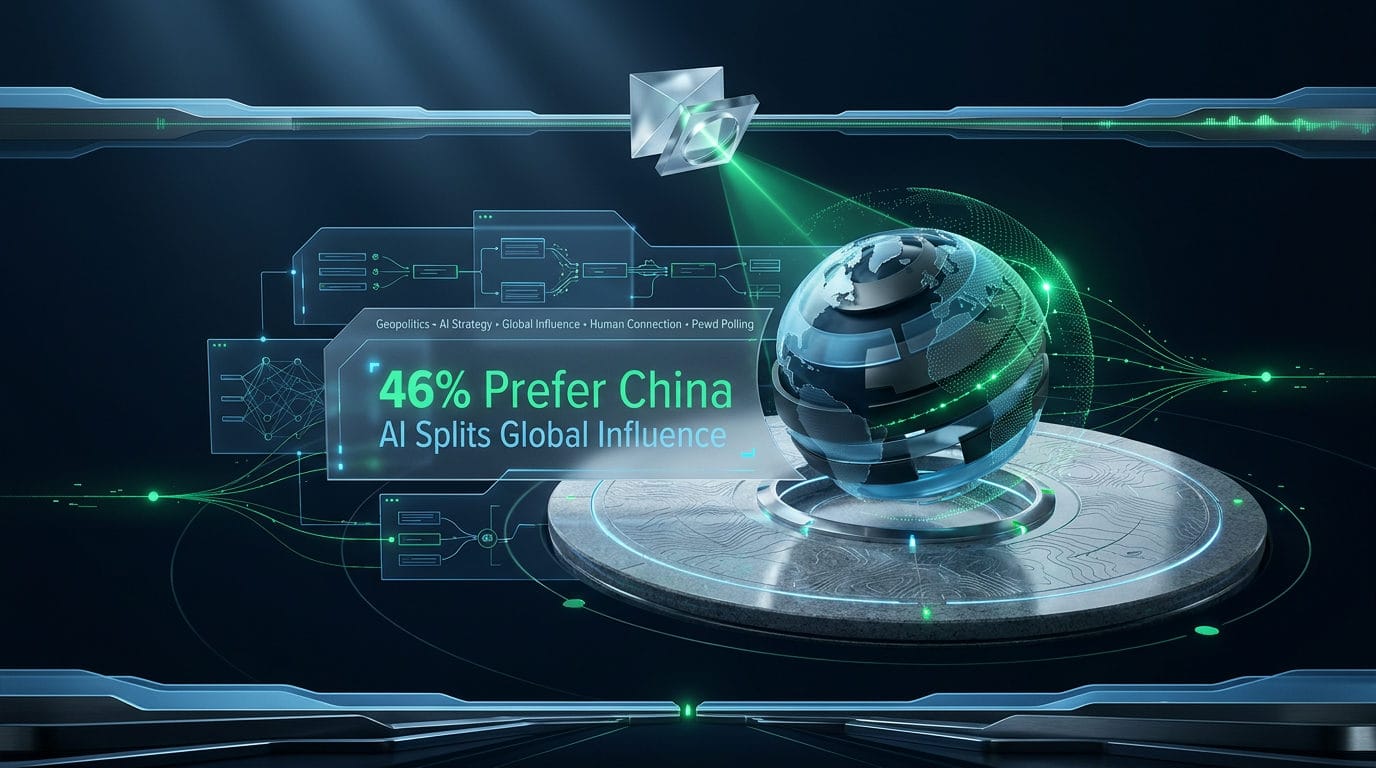
The strategic implications of new polling data and technological shifts are forcing a reassessment of global influence and the future role of human interaction.
📊 11 episodes across 7 podcasts
⏱ 558 minutes of intelligence analyzed
🎙 Featuring: Alice Han, James Kynge, Molly Graham, Don Faul
{{SPONSOR:sponsor_top}}
THE BIG SHIFT: Global Influence, AI, and the Unexpected Premium on Human Connection
As the global landscape redraws itself, we are seeing a critical convergence of geopolitical shifts, the relentless march of AI, and a surprising re-evaluation of human interaction. New data suggests a significant pivot in global perception: the world is increasingly viewing China more favorably than the U.S., a development with profound implications for long-term strategic alliances and market access. This shift is not merely a superficial trend; it's underpinned by China's strategic efforts in technology and infrastructure.
"The latest Pewd Polling shows that 46% of people worldwide have a more favorable view of China versus the US."
— Alice Han, Host, Vox Media Podcast Network on The Prof G Pod with Scott Galloway
This rebalancing of global influence coincides with an accelerating AI race where the U.S. and China are taking fundamentally different approaches. While the U.S. narrative often emphasizes AI's risks, China adopts a pragmatic, entertainment-focused, and increasingly open-source strategy, particularly appealing to the Global South. Selina Xu, Head of China Research at Eric Schmidt’s Office, highlighted that 84% of Chinese respondents are more excited than worried about AI, a stark contrast to only 10% in the U.S. This difference in societal embrace will impact the pace of AI integration and innovation within these respective spheres of influence.
Paradoxically, as AI's capabilities expand, the value of authentic human connection and in-person interaction is expected to command a premium. Donnie Boivin, CEO of Success Champion Networking, noted that the rise of AI explicitly increases the value and prominence of human interactions, suggesting that "human connection becomes a premium as digital automation expands." This creates a tension: while AI reshapes global economies and geopolitics, the need for deep, meaningful human engagement is being rediscovered. Leaders must strategically navigate this dual reality by understanding shifting global perceptions while simultaneously nurturing the human capital crucial for resilience and innovation.
IDEAS IN BRIEF
① China's Unconventional AI Dominance Strategy.
Xi Jinping's vision for open-source AI models targeted at developing nations, exemplified by WAICO, aims to bind countries to China technologically and politically. (Alice Han and James Kynge on The Prof G Pod with Scott Galloway)
→ Strategic implication: This "Belt and Road" for AI could reshape global technological alliances, giving China significant influence over emerging markets' digital infrastructure and data flows.
② Leadership Framework for Care and Accountability.
Aiko Bethea and Brené Brown introduced the "Anchored, Aligned, and Accountable" framework, underscoring that true accountability emerges from believing people are doing their best, rather than merely assuming positive intent. (Aiko Bethea on Dare to Lead with Brené Brown)
→ The takeaway: Leaders must build systems that foster honest conversations about power and identity while also requiring self-awareness and emotional regulation for effective team performance.
③ Redefining Productivity Beyond "Values".
Chris Bailey, author of "Intentional," initially dismissed "values" as soft but deep research led him to acknowledge their profound impact on human motivation, leading to a reframing of how to tackle procrastination. (Chris Bailey on Coaching for Leaders)
→ The Insight: Understanding the emotional roots of task aversion, particularly the six characteristics (boring, unpleasant, frustrating, far off, unstructured, meaningless), is key to structuring work for completion and personal satisfaction.
④ The "Anti-Social Century" and Its Political Cost.
Derek Thompson on The Prof G Pod with Scott Galloway discussed how declining real-world socialization, especially among young men, leads to increased political chaos as entertainment and a preference for digital gambling over physical risks. (Derek Thompson on The Prof G Pod with Scott Galloway)
→ The Impact: Leaders should recognize that widespread social isolation is not just a personal problem but a significant societal challenge that degrades civic engagement and amplifies political instability, demanding proactive infrastructure and policy solutions.
⑤ Military Leadership Principles Translate to Tech.
Don Faul (CEO, CrossFit), a former Marine Corps officer, shared how his military experience, emphasizing humility, service, and decentralized decision-making, proved directly applicable and foundational for leadership roles at Google and Facebook. (Don Faul on Worklife with Adam Grant)
→ The Implication: Core leadership tenets of building high-performing teams—connecting with people, showing care, and inspiring a path forward—transcend industry and cultural contexts, proving more valuable than domain expertise.
SIGNAL BOARD
🔥 HEATING UP
• Increased global favorability towards China over the US: Pew polling data shows a significant shift, with 46% globally favoring China, a reversal from 2023. (Alice Han on The Prof G Pod with Scott Galloway)
• China's Open-Source AI Strategy: China is pushing open-source AI models globally, positioning itself as a leader for developing nations and counterbalancing Western AI dominance. (Kyle Chan on The Prof G Pod with Scott Galloway)
• Neurodiversity as a strength in leadership: Academic research suggests autistic individuals have lower bias and systemic thinking, while ADHD is linked to divergent thinking, offering a competitive advantage for organizations. (Ludmila Praslova on Coaching for Leaders)
• In-person interaction prominence due to AI: As AI automates transactional tasks, the value and demand for genuine human connection and in-person `vibe coding` increases, making it a future premium. (Donnie Boivin on The Leadership Podcast)
🆕 ON WATCH
• WAICO Intergovernmental AI Organization: A new intergovernmental body being established by China to set global AI governance standards, mirroring the geopolitical influence of the Belt and Road initiative. (Alice Han on The Prof G Pod with Scott Galloway)
• RedNote for Chinese Food Discovery: A social media platform providing authentic and rapidly updated insights into regional Chinese food trends, often surpassing Western search engines in relevance. (Amy Lyons on The Prof G Pod with Scott Galloway)
• Cognitive coverage for AI-human interaction: A new metric for understanding how humans learn from AI, akin to test coverage in software development, is emerging as critical for effective human-AI collaboration. (Satya Nadella on Masters of Scale)
• Sovereign AI through national company innovation: The concept that countries can achieve AI independence by fostering innovation within their own companies, rather than relying on protectionist measures. (Satya Nadella on Masters of Scale)
❄️ COOLING OFF
• Traditional networking methods for sales: "Give-first" networking and collecting business cards are proving ineffective for high-value sales, requiring a shift to strategic relationship building and measuring with metrics. (Donnie Boivin on The Leadership Podcast)
• The "ideal leader myth" and "pipeline myth": Critical leadership myths that hinder the development of diversified leadership paths, as organizations cling to outdated notions of what leadership looks like. (Ludmila Praslova on Coaching for Leaders)
• Perceived value of excessive solitude: Research suggests people overestimate the happiness derived from isolation; those "forced" to socialize more than they initially desired consistently report higher well-being. (Derek Thompson on The Prof G Pod with Scott Galloway)
• Philanthropy for social entrepreneurs (traditional model): The traditional approach often results in "boring" appeals and excessive fundraising burdens, leading to inefficiencies and frustration for heroic changemakers. (Chris Anderson on Worklife with Adam Grant)
THE TENSION
While no explicit disagreements were detected, a nuanced tension emerges around the global perception of AI, particularly between Western apprehension and Eastern pragmatism.
🔵 Western Apprehension vs. Eastern Pragmatism: In Western contexts, particularly the U.S., there is significant anxiety and fear surrounding AI development, often driven by narratives of job displacement and existential risks. Selina Xu, Head of China Research at Eric Schmidt’s Office, highlighted that "in the US 10% said that they were more excited rather than worried" about AI, suggesting a strong undercurrent of concern. This often shapes regulatory discussions towards caution and control.
🔴 China's Pragmatic Embrace of AI: In contrast, China views AI more pragmatically, focusing on its entertainment value and practical applications rather than philosophical debates about general intelligence. According to Selina Xu, "In China people are very pragmatic. They don't see AI as this in general, this machine God." This allows for a more rapid integration and experimentation, even leading to highly efficient, open-source AI models despite chip constraints.
The Strategist's Read: This divergence will likely lead to distinct innovation trajectories and a de facto splitting of global AI ecosystems, with the Western approach potentially lagging in adoption while benefiting from more cautious ethical frameworks, and the Eastern approach pushing the boundaries of integration and real-world utility, potentially setting new global standards.
THE BOTTOM LINE
The accelerating convergence of global geopolitical shifts, AI's rapid evolution, and a renewed appreciation for human connection demands a strategic re-evaluation of trust, influence, and the future of value creation.
📖 Want the full episode breakdowns, guest details, and listen links?
Read the Episode Guide →
APPENDIX
The Prof G Pod with Scott Galloway: "China Decode: China's Bid for AI Dominance, and Chinese Food Trends (ft. @BlondieinChina)" · 50 min · Featuring Alice Han▶ Listen · Apple Podcasts
For the geopolitical strategist: This episode provides crucial insights into China's long-term AI strategy, its geopolitical implications, and how cultural soft power is being leveraged to reshape global perception.
Dare to Lead with Brené Brown: "The Framework for Leading With Both Care and Accountability" · 64 min · Featuring Aiko Bethea▶ Listen
For the human capital leader: Essential listening for understanding how to foster psychological safety alongside rigorous accountability, especially through courageous conversations about power and identity.
Coaching for Leaders: "793: How to Finish What You Start, with Chris Bailey" · 38 min · Featuring Chris Bailey▶ Listen · Apple Podcasts
For the operations and productivity expert: A deep dive into the psychology of procrastination and practical strategies for leaders and teams to consistently complete high-value projects.
The Leadership Podcast: "TLP521: Why Traditional Networking Is Broken" · 40 min · Featuring Donnie Boivin▶ Listen · Apple Podcasts
For the sales and partnership executive: Unpacks the flaws in traditional networking and outlines modern approaches for building authentic, mutually beneficial relationships in an AI-driven world.
Worklife with Adam Grant: "What pressure can teach you about leadership with Don Faul" · 45 min · Featuring Don Faul▶ Listen · Apple Podcasts
For the aspiring or rising CEO: A compelling case study on how foundational leadership principles from high-pressure environments like the military transfer to complex corporate leadership, emphasizing resilience and high standards.
Masters of Scale: "Possible: Satya Nadella on making human and token capital compound" · 60 min · Featuring Satya Nadella▶ Listen · Apple Podcasts
For the technology and innovation leader: Required listening for understanding Microsoft's strategy for AI as the "future of the firm," including concepts like token capital and sovereign AI.
The Prof G Pod with Scott Galloway: "Inside the Anti-Social Century — with Derek Thompson" · 69 min · Featuring Derek Thompson▶ Listen · Apple Podcasts
For the culture and talent strategist: Offers a critical perspective on the societal impact of declining social interaction and its implications for civic engagement, mental well-being, and leadership connection.
Coaching for Leaders: "792: Create Leadership Paths That Work for Everyone, with Ludmila Praslova" · 40 min · Featuring Ludmila Praslova▶ Listen · Apple Podcasts
For the diversity and inclusion executive: Illuminates how fostering neurodiversity and dismantling "ideal leader" myths can expand talent pools and improve organizational outcomes for everyone.
Coaching Real Leaders: "How Do I Lead Someone Who Doesn’t Seem to Fit the Team Culture?" · 65 min · Featuring Muriel Wilkins▶ Listen · Apple Podcasts
For the frontline manager: Provides practical coaching guidance on integrating high-performing but culturally distinct team members through clear expectations and process-oriented communication.
The Prof G Pod with Scott Galloway: "China Decode: The World Now Views China More Favorably Than the U.S. (ft. Selina Xu)" · 46 min · Featuring Alice Han▶ Listen · Apple Podcasts
For the global market entry strategist: Essential for grasping the evolving geopolitical landscape, including surprising shifts in global public opinion and China's strategic AI advancements.
Worklife with Adam Grant: "Why you should give away your most valuable assets with TED Chairman Chris Anderson" · 41 min · Featuring Chris Anderson▶ Listen · Apple Podcasts
For the non-profit or mission-driven enterprise leader: Explores the counter-intuitive power of giving away intellectual property and brand assets for exponential growth and deeper impact, as demonstrated by TED's evolution.
