
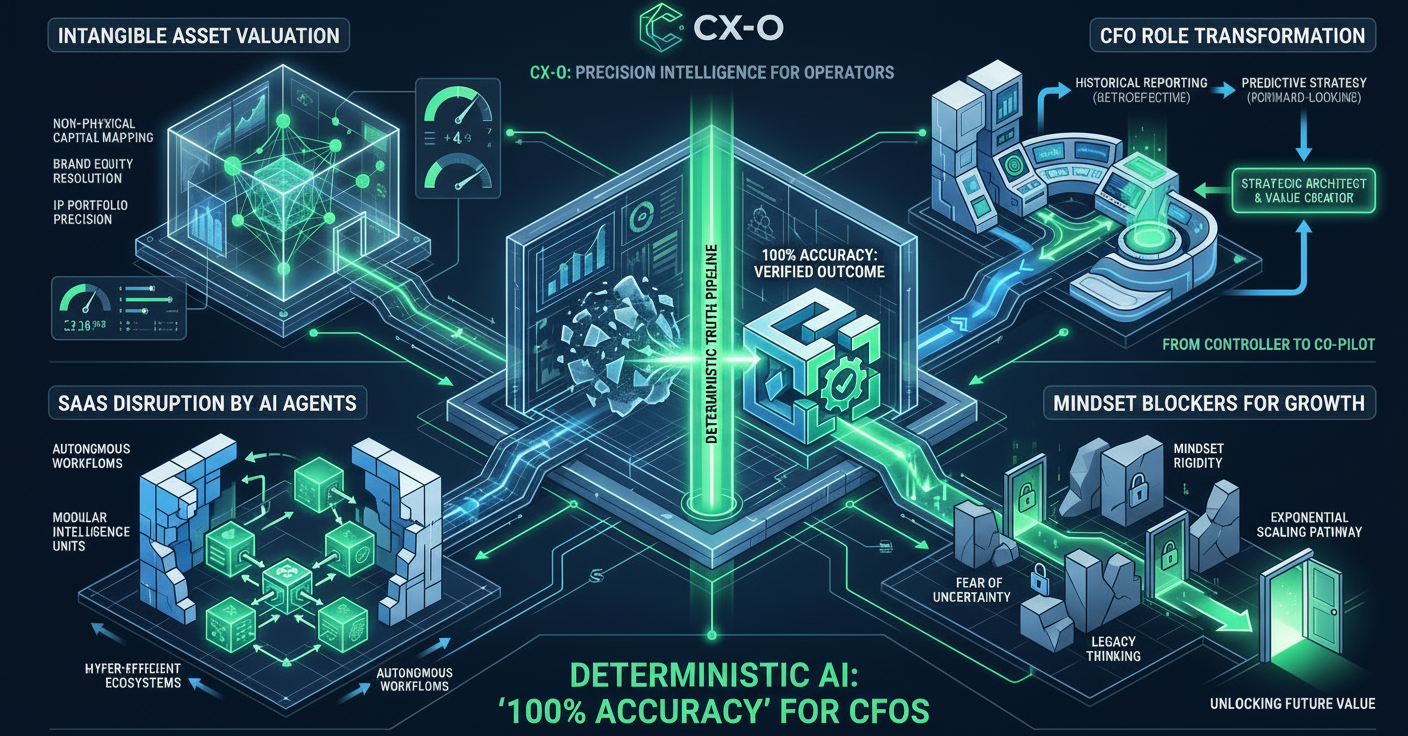
The age of the “deterministic CFO” is here, and they're leveraging AI and redefining value in a capital-intensive, intangible-rich world.
📊 10 episodes across 8 podcasts
⏱ 415 minutes of intelligence analyzed
🎙 Featuring: Peter High (Metis Strategy), Stephen Witt (Author of The Thinking Machine), Jensen Huang (NVIDIA), Geoffrey Hinton (University of Toronto)
The Big Shift
AI's New Frontier: From Probabilistic Guesses to Deterministic Certainty in Finance
The conversation around Artificial Intelligence has largely been dominated by its probabilistic nature—the ability to predict, forecast, and learn from vast datasets, often with a margin of error. However, a significant pivot is underway, particularly within the finance sector: the emergence of Deterministic AI 🆕. This isn't just an incremental improvement; it's a fundamental redefinition that shifts AI from a helpful tool to a non-negotiable requirement for accuracy and accountability.
For organizations dealing with financial reporting, where "perfection is the only allowable outcome" (Patrick Villanova, Chief Financial Officer at BlackLine), probabilistic AI, with its inherent margin of error, simply won't cut it. Patrick Villanova (Chief Financial Officer, BlackLine) highlighted on CFO Weekly that the finance industry's highly regulated environment demands 100% accuracy, which only deterministic AI, operating within established guardrails, can reliably provide. This marks a critical evolution, transforming AI from a "fifth opinion" in forecasting to a foundational element ensuring audit-ready data.
The implications are profound. Finance professionals are seeing a seismic shift in their roles. No longer "entry-level processors," they are becoming "reviewers and analysts"—a higher-value function. This requires a cultural shift and continuous training, as emphasized by Villanova. The ability of deterministic AI to automate processes like cash application (with over 80% hands-off automation as noted by Villanova) frees up human capital for more strategic endeavors. This isn't just about efficiency; it's about enabling finance teams to focus on wealth creation rather than merely wealth management, a point also echoed by Matteo Turi (Chief Operating Financial Officer, Letoon Holding Ltd) on the GrowCFO Show. The demand for unerring accuracy in finance is pushing AI development towards systems that don't just predict, but prove.
"In our world, you can really boil it down to two things. You give AI a ton of data and you ask it for an answer. And that is maybe what some companies are doing outside of our space that do not have the infrastructure, don't have the platform, do not have the workflows, do not have the data moat, haven't done it before and don't understand the stakes."
— Patrick Villanova, Chief Financial Officer at BlackLine on CFO Weekly
This shift to deterministic AI is also reshaping how companies view their intangible assets. As Turi highlighted, 90% of the S&P 500's value is now intangible, primarily intellectual property. AI, specifically deterministic AI, becomes the "grid" (Turi's term) that monetizes these assets, enabling a CFO to become a "valuation architect." Without this precise, auditable AI, businesses risk becoming "more disorganized" as AI amplifies existing chaos rather than streamlining it. This is why the focus on deterministic, rather than probabilistic, AI in finance is not just a trend but a foundational change for modern enterprise operations.
The Rundown
① Mindset is the #1 Blocker for Business Growth.
Host Steve Coughran (Coltivar Group, LLC) argued on Strategy Meets Finance that the primary obstacle for 99% of businesses isn't a lack of cash, strategy, or training, but owners' self-limiting "stories" or mindsets. He presented examples of businesses with clear financial upside that resisted change due to internal narratives and fear, advocating for reframing these stories to empower business outcomes.
→ The Operator's Take: An "Operator" can have the perfect strategy, but if the leader's (or their team's) internal narrative creates resistance to change, execution will falter. This is a cultural battle as much as a strategic one.
② Board Recruitment is a "Sales Campaign," Not Just an Application Process.
Fiona Hathorn (CEO, Women on Boards UK) emphasized on CFO 4.0 - The Future of Finance that board vacancies are rarely advertised transparently, making personal networks and a "sales campaign" crucial. She stated, "[Most boards don't transparently advertise their board vacancies. They rely on their networks, the chairs network, the non exec networks, the employee networks.]" Effectively communicating one's unique "board value add" through strategic networking and a tailored CV is far more effective than relying on formal applications.
→ The Operator's Take: For rising executives, a board seat is a strategic career move. Treat it like a top-tier sales motion, requiring bespoke messaging and proactive relationship building, not just applying to job boards.
③ The Traditional SaaS Model Faces Disruption from AI Agents.
Duncan Davidson (Co-founder and General Partner, Bullpen Capital) predicted on Technovation with Peter High (CIO, CTO, CDO, CXO Interviews) that the Software as a Service (SaaS) model will be disrupted, with AI agents and service-based solutions replacing per-seat, per-month subscriptions. This shift is already being anticipated by the stock markets, with expert Peter High noting, "[There's a lot being written about and being enacted that certainly shows some of the risk to the SaaS model, traditional SaaS model, at least through the emergence of artificial intelligence.]"
→ The Operator's Take: Re-evaluate your software vendor relationships. The rise of AI agents means per-seat licensing could be a legacy model, shifting budget allocation from licenses to transactional AI services. Your Software as a Service (SaaS) model will be disrupted by AI agents 🆕 is coming.
④ Nonprofit Finance Principles Can Sharpen Decision-Making for Any CFO.
Darien Wright (CFO and COO at National Geographic Society, NAMI) discussed on The Growth-Minded CFO how the unique challenges of nonprofit finance, particularly around revenue cadence reliant on contributions, foster rigorous financial discipline and data-driven forecasting. He highlighted the importance of liquidity management and rebalancing capital structures in an environment with less predictable revenue streams.
→ The Operator's Take: If you think your business is tough, try running a nonprofit. Applying the “liquidity, liquidity, liquidity” mindset and scenario planning from unpredictable revenue streams will steel any CFO for uncertainty.
⑤ Marketplaces are Unbundling and Competing on Mindshare, Not Just Discovery.
CJ Gustafson (Host, Run the Numbers) detailed on Run the Numbers how generalist marketplaces like Craigslist evolved into specialized vertical platforms by adding specific value layers like authentication or unique supply. He noted that "Supply, while necessary to differentiate at the start, is actually in eroding moat. What wins is mindshare, the buyer's habit, the muscle memory of which app you open first."
→ The Operator's Take: If your business operates in or touches a marketplace, understand that value is shifting from broad discovery to deep specialization and user habit. What's your unique value layer beyond just connecting buyers and sellers?
Signal Board

🔥 HEATING UP
• Deterministic AI for perfect outcomes in finance: CFOs are demanding 100% accuracy from AI in financial reporting, moving beyond probabilistic models. (Patrick Villanova on CFO Weekly)
• Board Recruitment Process: The demand for diversity of thought is changing recruitment criteria, emphasizing tailored personal branding over traditional applications. (Fiona Hathorn on CFO 4.0 - The Future of Finance)
• Equity Value Growth in Private Companies: Privately held companies like C Spire are prioritizing this metric as highly as public companies, focusing on strategic capital allocation and intrinsic value modeling. (Derek Doyle on CFO THOUGHT LEADER)
• Agentic AI in Finance: Acting as a "fifth opinion" in forecasting and automating tasks like cash application with high efficiency. (Patrick Villanova on CFO Weekly)
👀 ON WATCH
• Marketplace Take Rates and Their Impact 🆕: High take rates can incentivize disintermediation or competition; understanding the true costs of platform labor intensity is crucial. (CJ Gustafson on Run the Numbers)
• Software as a Service (SaaS) model will be disrupted by AI agents 🆕: The traditional per-seat, per-month SaaS subscription model is predicted to be replaced by AI agents and service-based solutions. (Duncan Davidson on Technovation with Peter High (CIO, CTO, CDO, CXO Interviews))
• 10x drop in factor of production opens new industries 🆕: Historically, such drops create massive market opportunities, and AI is poised to deliver this in various sectors. (Duncan Davidson on Technovation with Peter High (CIO, CTO, CDO, CXO Interviews))
• Learn disciplines, be flexible, keep learning for career longevity 🆕: Essential advice for finance professionals navigating technological shifts and career transitions. (Darien Wright on The Growth-Minded CFO)
📉 COOLING OFF
• Billionaires tax in California could lead to Silicon Valley's decline 🆕: A contrarian view suggesting punitive tax policies could erode the innovation hub's competitive edge. (Duncan Davidson on Technovation with Peter High (CIO, CTO, CDO, CXO Interviews))
• Avoiding FOMO in AI investments: A clear warning against investing in AI purely out of "fear of missing out" rather than a sound strategic basis. (Drew Pinto on Technovation with Peter High (CIO, CTO, CDO, CXO Interviews))
• Hodinkee 🆕: Highlighted as a cautionary tale of a marketplace taking on inventory and struggling. (CJ Gustafson on Run the Numbers)
Your Move
Next Steps for the Accountable Operator
① Audit AI initiatives: For any AI project in finance, immediately categorize it as probabilistic or deterministic. If it's probabilistic, outline a clear path to deterministic outcomes or re-evaluate its use case for financial reporting. You need 100% accuracy, not "most likely."
② Review your SaaS stack for AI disruption: Analyze your contracts and usage for core SaaS products. Identify vendors whose per-seat licensing model could be vulnerable to AI agent-based task automation. Start planning budget shifts from subscriptions to service- or transaction-based AI solutions.
③ Assess organizational "mindset blockers": Facilitate a candid dialogue within your leadership team about internal "stories" or fears that might be hindering strategic initiatives. Use the framework of "reframing narratives" to identify and mitigate resistance to necessary change.
④ Sharpen your board value proposition: If you're a CFO or C-suite leader, explicitly define your unique "board value add." Actively network with chairs and existing non-executive directors by clearly articulating your specific contributions, treating board entry as a highly targeted sales campaign.
⑤ Monetize intangible assets: Work with your finance and legal teams to identify and quantify your company's intellectual property. Explore how AI can be leveraged to monetize these intangible assets, following the "High Valuation Triangle" framework for wealth creation.
The Bottom Line
The "soft" skills of leadership—mindset and empathy—are the new hard skills for operators navigating an AI-driven, capital-intensive landscape where the very definition of enterprise value is being rewritten.
📖 Want the full episode breakdowns, guest details, and listen links?
Quick Appendix
Technovation with Peter High (CIO, CTO, CDO, CXO Interviews): "The Thinking Machine: How Jensen Huang Won the GPU War for NVIDIA" · 55 min · Featuring Peter High ▶ Listen
CFO 4.0 - The Future of Finance: "261. CFO 4.0 Revisited: Making the shift from CFO to Board with Fiona Hathorn, CEO of Women on Boards UK" · 45 min · Featuring Fiona Hathorn (CEO, Women on Boards UK) ▶ Listen
CFO Weekly: "Agentic AI and the Future of the Deterministic CFO with Patrick Villanova, CFO at BlackLine" · 36 min · Featuring Patrick Villanova (Chief Financial Officer, BlackLine) ▶ Listen
CFO THOUGHT LEADER: "1166: Building Equity Value in a Capital-Intensive World | Derek Doyle, CFO, C Spire" · 53 min · Featuring Derek Doyle (CFO, C Spire) ▶ Listen
Strategy Meets Finance: "The #1 Thing Holding 99% of Businesses Back | Ep 218" · 20 min · Featuring Steve Coughran (Host, Coltivar Group, LLC) ▶ Listen
Technovation with Peter High (CIO, CTO, CDO, CXO Interviews): "How Marriott’s Chief Revenue & Technology Officer Is Turning IT into a Growth Engine" · 35 min · Featuring Drew Pinto (Executive Vice President and Chief Revenue and Technology Officer, Marriott International) ▶ Listen
GrowCFO Show: "#273 How CFOs Can Increase Company Valuation, Matteo Turi, Chief Operating Financial Officer, Letoon Holding Ltd" · 37 min · Featuring Matteo Turi (Chief Operating Financial Officer, Letoon Holding Ltd) ▶ Listen
The Growth-Minded CFO: "How Nonprofit Finance Sharpens Decision-Making for Any CFO, with Darien Wright" · 34 min · Featuring Darien Wright (CFO and COO at National Geographic Society, NAMI) ▶ Listen
Technovation with Peter High (CIO, CTO, CDO, CXO Interviews): "Bubble or Breakthrough? How CIOs Should Think About the AI Tech Boom" · 49 min · Featuring Duncan Davidson (Co-founder and General Partner, Bullpen Capital) ▶ Listen
Run the Numbers: "The Economics of Marketplaces: Take Rates, Middlemen, and Power" · 51 min · Featuring CJ Gustafson (Host, Run the Numbers) ▶ Listen