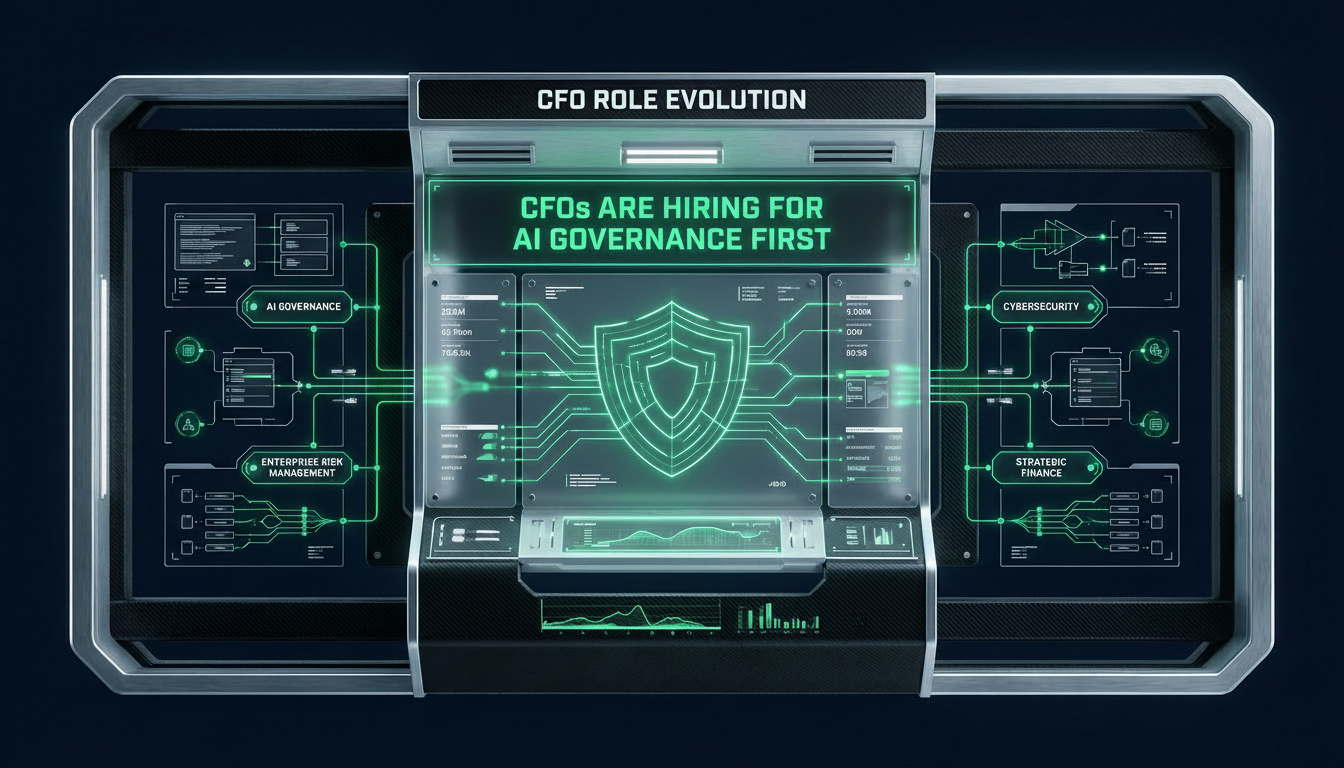
The CFO’s job just got a whole lot heavier: from AI governance to cyber defense, they’re the new front line.
{{tagline}}
📊 11 episodes across 8 podcasts
⏱ 394 minutes of intelligence analyzed
🎙 Featuring: Tony MacDonald, The Future of Finance is Listening, Jessica McClain, Megan Weis, Hannah Munro, Claire Bodanis, Craig Cuyar, Peter High, Lauren Pearl, Dav Masaon, Alex Louisy, CJ Gustafson, Aman Varejee, CJ, Aman, Marc Mehlman, Akin Adekeye, Jack Sweeney, Kevin Appleby, Howard Francioni, Kevin Craine, Dr. Mark van Rijmenam, Alex Gutman
The Big Shift: CFOs are the new CISO (and AI Ethicist)
We’ve been tracking the expanding mandate of the CFO for a while, but this week’s discussions make it clear: the role isn't just strategic anymore; it's the operational linchpin for both information security and AI governance. It’s no longer an IT issue, it’s a critical enterprise risk that directly impacts the bottom line and requires a CFO-level perspective.
Howard Francioni, Lead Auditor at Akton Boundrie Group, bluntly states that information security is now a "CFO responsibility" (GrowCFO Show). He highlights vulnerabilities like poor password hygiene and insecure endpoints, emphasizing that the financial and reputational damage from breaches like Jaguar Land Rover's production halts extend far beyond IT. This isn't about setting up firewalls; it’s about integrating cyber risk into the core risk register, understanding the supply chain vulnerabilities, and ensuring immutable backups against ransomware.
But it doesn't stop there. The same CFO is simultaneously being asked to pilot the organization through the complexities of AI adoption. Akin Adekeye, General Counsel and Chief Legal Officer at Compound, argues that AI becomes a "board issue the moment it affects enterprise risk, capital allocation, strategic competitiveness" (CFO THOUGHT LEADER). He notes the prevalence of Shadow AI and the need for robust governance with board oversight, executive ownership, and operational controls—a domain where the CFO's financial and operational understanding is uniquely suited to balance innovation and risk. Marc Mehlman, CFO of Ascensus, even revealed that one of the first roles his company hired for AI was around AI governance, creating a playbook to ensure responsible deployment.
"The biggest AI risk for many companies is not necessarily... we're using it poorly. It's, we're not using it at all. Like you cannot at this stage in 2026, not be in the AI game."
— Akin Adekeye, General Counsel and Chief Legal Legal Officer at Compound on CFO THOUGHT LEADER
This dual imperative means CFOs aren't just managing money; they're managing the digital integrity and future trajectory of the entire enterprise. It’s a complete transformation from cost-controller to enterprise risk guardian and strategic growth catalyst—all while keeping an eye on the cyber-criminals and the algorithmic biases.
Why it matters: The financial impact of cyber breaches and AI missteps can be catastrophic. The CFO, with their bird's-eye view of enterprise risk and capital allocation, is now undeniably the critical executive to champion these intertwined domains. Expect new budget lines, new talent requirements, and more board meeting focused on these critical topics.
The Rundown
① Operational Understanding Trumps Pure Financial Reporting for CFOs.
Marc Mehlman, CFO of Ascensus, argues that "The numbers at the end of the day are just a result of a bunch of business decisions" (CFO THOUGHT LEADER), stressing that CFOs must understand the operational genesis behind the figures, not just report them. This broad operational experience, often gained through lateral career moves, is critical for effective decision-making and pattern recognition.
→ The Operator's Take: Don't promote your most detail-oriented accountant to CFO if they lack operational curiosity. The modern CFO needs to be fluent in the business processes that generate the numbers, not just the numbers themselves. Force rotational programs into operational roles for your high-potential finance leaders.
② The US and UK CFO recruitment markets are converging due to economic shifts.
Dav Masaon, Co-Founder of Zanda, notes that the traditionally bullish US market is adopting more extensive due diligence, mirroring Europe's approach (The Growth-Minded CFO). This shift impacts hiring timelines and salary parity, with a New York Controller potentially earning as much as a European CFO.
→ The Operator's Take: For competitive hires, especially CFOs, expect longer processes and be prepared to articulate the value proposition beyond immediate compensation. Understand that economic tightening means less "bullish" decision-making even in previously fast-moving markets, requiring a more compelling narrative for candidates.
③ Annual Reports are Shifting from Compliance to Core Storytelling.
Claire Bodanis, Founder and Director of Falcon Windsor, emphasizes that annual reports should tell a compelling story, not just fulfill regulatory requirements, viewing them as a "channel for a corporate story" rather than an end-of-year scramble (CFO 4.0 - The Future of Finance). The FRC even explicitly requires companies to tell their story.
→ The Operator's Take: Treat your annual report as a critical employer branding and investor relations tool, not just a finance team deliverable. Involve marketing and communications deeply to ensure it conveys a consistent, compelling narrative that can boost employee pride and external perception.
④ AI Implementation's Biggest Hurdle is Organizational Inertia, Not Technology.
Tony MacDonald, CFO of Sama, highlights that the primary challenge in AI adoption is "organizational inertia" and managing expectations for ROI (CFO THOUGHT LEADER). Many AI projects fail not due to technical issues, but because companies struggle with the change management required to integrate new AI tools effectively.
→ The Operator's Take: Prioritize change management and realistic ROI forecasting in your AI strategy. Don't just pilot technology; pilot new workflows and build a strong communication plan around how AI will enhance, not replace, human roles to overcome internal resistance.
⑤ Lifelong Learning is Now Non-Negotiable for Finance Leaders.
Jessica McClain, CFO at Girl Scouts Nation's Capital, asserts that "It's vital that a CFO is a lifelong learner" (CFO Weekly), as AI handles transactional work and the human elements of empathy, influence, and relationship building become paramount. This requires continuous adaptation to constant transformation.
→ The Operator's Take: Mandate continuous professional development for your finance team beyond technical skills. Focus on leadership, emotional intelligence, and strategic thinking. Consider establishing internal mentorship programs that encourage "sideways learning" across departments.
Signal Board
🔥 Heating Up
• CFOs becoming CEOs: More CFOs are transitioning into CEO roles due to the heightened importance of financial discipline in today's economic climate. (Dav Masaon on The Growth-Minded CFO)
• Integrated Communications Planning: Annual reports are becoming a year-round communication channel for corporate stories, moving beyond an end-of-year scramble. (Claire Bodanis on CFO 4.0 - The Future of Finance)
• AI Governance: AI is rapidly transitioning from an IT project to a critical board-level governance issue, affecting enterprise risk, capital allocation, and strategic competitiveness. (Akin Adekeye on CFO THOUGHT LEADER)
👀 On Watch
• International Non-Financial Reporting Standards (INFRS): The IFRS Foundation is developing these standards to bring rigor to sustainability reporting, similar to financial reporting. (Claire Bodanis on CFO 4.0 - The Future of Finance)
• Digital Twin for Learning: Dr. Mark van Rijmenam's book integrates a digital twin via WhatsApp for interactive, real-time coaching, signaling new immersive learning experiences. (Dr. Mark van Rijmenam on Digital Transformation Podcast)
• Outcome-Driven IT Delivery: Companies like Gilbane are transforming IT from project-based to value stream-based, aligning technology directly with client-defined outcomes. (Alex Gutman on Technovation with Peter High (CIO, CTO, CDO, CXO Interviews))
🧊 Cooling Off
• Traditional US fast-paced hiring: The US market is adopting more extensive due diligence, mirroring European practices, especially for significant hires like CFOs, due to current economic conditions. (Dav Masaon on The Growth-Minded CFO)
• AI as a Financial Bubble: The current AI boom does not fit the historical definition of a financial bubble based on valuation multiples and capital intensity, contrasting with past bubbles like the dot-com era. (Aman Varejee on Run the Numbers)
• Internet/AI Security-by-Design: Both the Internet and AI are being built without security-by-design, repeating past mistakes with significant future implications rather than proactively addressing threats. (Howard Francioni on GrowCFO Show)
The Debate
Are financial bubbles inherently destructive or ultimately beneficial for innovation?
The "Yes" Case (Ultimately Beneficial): Aman Varejee, Financial Historian, Investor, and Early Member of the PayPal Mafia, argues that despite their busts, historical bubbles like the dot-com and UK railway booms led to significant technological advancements and economic growth. He points out that "In a five year period, the amount of money going into UK railways was around 25% of GDP" (Run the Numbers), showcasing the immense capital allocation that drove infrastructure and innovation, even if speculative excesses eventually collapsed. This perspective views bubbles as chaotic, yet necessary, accelerators for progress.
The "No" Case (Purely Destructive/Problematic): While not explicitly stated as destructive, the consistent patterns of cognitive biases and speculative manias driving bubbles, as detailed by Aman Varejee, underscore their inherent risk and irrationality. The very definition of a bubble—a 3x price increase followed by a symmetrical downturn—implies significant value destruction for those caught on the wrong side. The role of "easy money" and government policies in fueling these bubbles, as highlighted in the discussion, suggests systemic flaws rather than efficient market mechanisms. CJ noted during the discussion that "Funnily enough, at the top of every bubble there are a lot of people who are self aware or who understand what they're going through," implying a self-inflicted collective delusion that can be avoided.
The Operator's Read: While bubbles can inadvertently accelerate innovation through massive capital deployment, the human and economic cost of their inevitable busts makes them a dangerous and ultimately inefficient growth engine. Discipline over speculative impulse is always the better bet.
The Bottom Line
The CFO is the ultimate operational architect, balancing aggressive growth steering with rigorous defense against cyber threats and algorithmic risks, requiring a deeply operational lens on both finance and technology.
Your Move
① Audit your AI initiatives for Shadow AI: Work with IT and legal to identify unsanctioned AI tools or projects, then establish clear governance, ownership, and operational controls to mitigate risk and maximize value. (Akin Adekeye on CFO THOUGHT LEADER)
② Integrate cyber risk into your core risk register: Move information security beyond IT. Quantify the financial and reputational impacts of potential breaches and ensure C-suite visibility and budget allocation for critical defenses like immutable backups. (Howard Francioni on GrowCFO Show)
③ Implement "sideways learning" for your finance team: Create opportunities for high-potential finance leaders to rotate into operational roles or lead cross-functional projects, ensuring they understand the "genesis of the numbers" rather than just reporting them. (Marc Mehlman on CFO THOUGHT LEADER)
④ Re-evaluate your annual report as a strategic asset: Partner with marketing and investor relations to transform your annual report from a compliance document into a compelling corporate narrative that builds employee pride and external trust. (Claire Bodanis on CFO 4.0 - The Future of Finance)
📖 Want the full episode breakdowns, guest details, and listen links?
Quick Appendix
CFO THOUGHT LEADER: "1172: Finance Isn’t the Brake—It’s the Steering Wheel for Growth | Tony MacDonald, CFO, Sama" · 51 min · Featuring Tony MacDonald▶ Listen
For Ops Leaders: How to align finance with sales growth, even in a sales-driven culture.
CFO Weekly: "Greatest Hits: Building Learning Cultures in Finance with Jessica McClain, CFO at American Staffing Association" · 28 min · Featuring Jessica McClain▶ Listen
For Talent Leaders: Insights on fostering continuous learning and emotional intelligence in finance teams.
CFO 4.0 - The Future of Finance: "264. CFO 4.0 Revisited: A CFOs Guide to Writing Annual Reports That Your Investors Actually want to Read with Claire Bodanis" · 50 min · Featuring Hannah Munro▶ Listen
For Comms & IR Teams: Strategies for crafting compelling annual reports that also fulfill regulatory needs.
Technovation with Peter High (CIO, CTO, CDO, CXO Interviews): "Scaling Technology at Omnicom: Craig Cuyar on Post-Acquisition Transformation" · 25 min · Featuring Craig Cuyar▶ Listen
For CIOs/CTOs: Navigating post-acquisition tech integration and balancing internal capabilities with outsourcing.
The Growth-Minded CFO: "Revisiting: What Makes a Great CFO? Expert CFO Recruiter, Dav Masaon, Tell Us" · 39 min · Featuring Lauren Pearl▶ Listen
For Founders/Hiring Managers: Key considerations for hiring a CFO, including market differences and stage-fit.
Run the Numbers: "The Anatomy of Financial Bubbles | Lessons From 200 Years of Market Panic" · 56 min · Featuring CJ Gustafson▶ Listen
For Strategists: A historical perspective on financial bubbles and their often misunderstood impact on innovation.
CFO THOUGHT LEADER: "1171: How CFOs Rise by Learning Sideways First | Marc Mehlman, CFO, Ascensus" · 46 min · Featuring Marc Mehlman▶ Listen
For High-Potential Leaders: The value of diverse operational experience for aspiring CFOs.
CFO THOUGHT LEADER: "Special Episode: AI Governance & the Board: What CFOs Need to Know" · 28 min · Featuring Akin Adekeye▶ Listen
For Boards/Executives: Understanding AI as a critical board-level governance and risk issue.
GrowCFO Show: "#276 Why Information Security Is Now a CFO Responsibility, Howard Francioni, Lead Auditor, Akton Boundrie Group" · 33 min · Featuring Kevin Appleby▶ Listen
For Risk & Compliance: Why information security is a strategic CFO responsibility, not just an IT concern.
Digital Transformation Podcast: "Navigate Exponential Change" · 19 min · Featuring Kevin Craine▶ Listen
For Transformation Leaders: A futurist’s framework for navigating rapid technological change and leadership mindset.
Technovation with Peter High (CIO, CTO, CDO, CXO Interviews): "From Projects to Value Streams: Gilbane’s CTO on Outcome-Driven IT" · 19 min · Featuring Alex Gutman▶ Listen
For IT Leaders: How to shift IT delivery from project-centric to outcome-driven value streams, leveraging AI.