
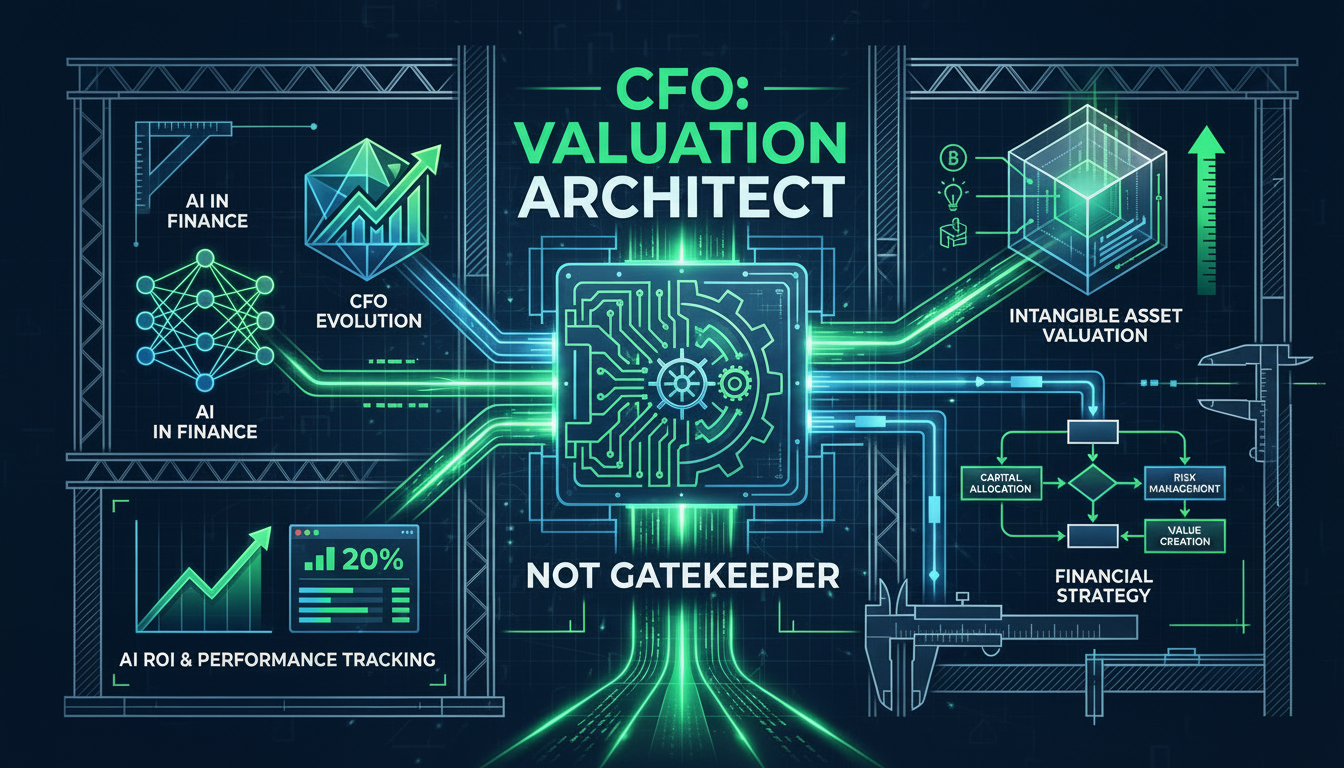
The AI boom faces a reality check, demanding CFOs become "valuation architects" who measure tangible impact beyond the hype.
📊 11 episodes across 9 podcasts
⏱ 425 minutes of intelligence analyzed
🎙 Featuring: Hannah Munro, Fiona Hathorn, Patrick Villanova, Megan Weis
The Big Shift: From AI Hype to Measurable Value Creation
There's a palpable shift underway from the generalized excitement over AI to a hard-nosed demand for measurable, strategic value. This period's discussions reveal a clear message: the era of pilot projects and vague promises is ending. Leaders are now intensely focused on how AI actually drives financial results, demanding that CFOs evolve into "valuation architects" who can quantify the impact of intangible assets, including AI. This isn't just about deploying new tech; it's about fundamentally rethinking how value is created and measured in an AI-powered world.
The driver: The rapid rise of intangible assets means traditional financial metrics are no longer sufficient. Matteo Turi, Chief Operating Financial Officer at Letoon Holding Ltd, starkly highlighted this, stating, "90% of the value of the S&P 500 is intangible, which is vertically intellectual property. Now if you go back to 1975, 50 years ago, the intangible value of the S&P 500 was just 17%." This transformation means finance leaders must actively understand how AI contributes to IP, operational efficiency, and ultimately, equity value. Private companies like C Spire are already prioritizing "equity value" as their North Star, even without direct shareholder pressure (Derek Doyle, CFO of C Spire).
The challenge: Operationalizing AI at scale, especially in regulated environments, demands extreme precision and a human-in-the-loop approach. Patrick Villanova, CFO at BlackLine, emphasized the necessity of deterministic AI in finance, where "perfection is the only allowable outcome." He views AI as a "fifth opinion" in forecasting, but one that must operate within established guardrails, building trust through accuracy. The risk of missteps is high; Sathish Muthukrishnan, Chief Information, Data & Digital Officer at Ally Financial, warned, "One misstep is going to take me years behind and I'm never going to be able to recover from it."
The implication: CFOs must transition from simply managing finances to actively designing a company's valuation strategy around these new realities. Turi declared, "The CFO needs to become what I call it the valuation architect." This involves not just tracking P&L, but understanding how AI investments translate into EBIT and IRR, how data privacy builds trust, and how efficient capital allocation leads to equity value growth. The critical takeaway: AI is an amplifier. As Turi succinctly put it, "The more messed is your business, the more disorganized it is, the more messy it will become with AI." Success hinges on strategic clarity and a structured approach to value creation.
The Rundown
① Effort ≠ Results; Strategy Does. Many leaders confuse long hours with productive outcomes, leading to burnout and financial losses if not tied to a clear strategy and measurable KPIs. (Steve Coughran on Strategy Meets Finance)
→ The Operator's Take: Don't just track activity; tie every major initiative to specific unit economics and strategic levers. If you can't measure the value, it's busywork.
② Customer-Centric Finance: Integrating for Impact. CFOs are moving beyond traditional gatekeeping to integrate customer data into product development and resource allocation, using metrics like customer-weighted ROI. (Mohamed “Mo” Omaizat on The CFO Playbook)
→ The Operator's Take: Finance needs a seat at the product table, actively connecting customer behavior to P&L impacts. If you're not speaking the customer's language, you're missing a key value lever.
③ Unspoken Rules of Board Recruitment. Most board positions aren't openly advertised but filled through personal networks, requiring candidates to clearly articulate their "board value add" and actively campaign for roles. (Fiona Hathorn on CFO 4.0 - The Future of Finance)
→ The Operator's Take: Stop waiting for board applications to appear; start building your network and clearly defining your specific governance and strategic contribution for a board role now.
④ The Rise of the Secondary Market for Liquidity. The secondary market for venture capital has surged to $150 billion, surpassing the IPO market as a primary source of liquidity, driven by companies staying private longer. (Mike Jung on Run the Numbers)
→ The Operator's Take: Leverage structured liquidity solutions for founders and employees to maintain motivation and manage personal financial risk, especially as IPO windows become less predictable.
⑤ Nonprofit Finance as a Training Ground for CFOs. The blended CFO/COO role, common in nonprofits, fosters strong decision-making under uncertainty, capital structure rebalancing, and an empathetic leadership style applicable to any organization. (Darien Wright on The Growth-Minded CFO)
→ The Operator's Take: Embrace roles that combine financial and operational leadership; the ability to make decisions with imperfect information and manage complex capital structures is a universal executive skill.
⑥ AI Agents Redefine Enterprise Software. The traditional SaaS model faces disruption as AI agents automate tasks, shifting value from per-seat subscriptions to service-based solutions and elevating human functionality. (Duncan Davidson on Technovation with Peter High (CIO, CTO, CDO, CXO Interviews))
→ The Operator's Take: Re-evaluate your SaaS stack not just on features, but on its embedded AI and how it enables human teams to achieve a "10x" impact rather than simply replacing tasks.
Signal Board
🔥 Heating Up
• Agentic AI in Finance: Shifting from probabilistic to deterministic AI that demands 100% accuracy for financial reporting, effectively acting as a "fifth opinion" in forecasting and automating tasks like cash application with 80%+ hands-off rates. (Patrick Villanova on CFO Weekly)
• High Valuation Triangle: A powerful framework developed by Matteo Turi to highlight the monetization of IP, strong leadership, and global market strategy as keys to building investable businesses, particularly for CFOs as "valuation architects." (Matteo Turi on GrowCFO Show)
• Equity Value Growth in Private Companies: Privately held companies explicitly adopting "equity value" as their core strategic metric to drive decisions, mirroring public company shareholder value. (Derek Doyle on CFO THOUGHT LEADER)
👀 On Watch
• Determinism in AI 🆕: The critical need for AI to guarantee 100% accuracy in highly regulated fields like finance, contrasting with probabilistic AI models, and influencing how AI is integrated into existing platforms. (Patrick Villanova on CFO Weekly)
• Marketplace Take Rates and Their Impact 🆕: The complex interplay of purchase frequency, ticket size, and platform labor intensity that influences sustainable take rates, with high rates potentially leading to disintermediation. (CJ Gustafson on Run the Numbers)
• SaaS model disruption by AI agents 🆕: Prediction that traditional SaaS models will be challenged by AI agents and service-based solutions, requiring a shift in how value is perceived and bundled. (Duncan Davidson on Technovation with Peter High (CIO, CTO, CDO, CXO Interviews))
• CFO as Valuation Architect 🆕: The evolving role of the CFO to actively design and build company valuation, moving beyond wealth management to wealth creation, especially through intangible assets. (Matteo Turi on GrowCFO Show)
🧊 Cooling Off
• Overwork as a Productivity Metric: The outdated belief that long hours equate to effective business outcomes, often masking systemic inefficiencies and leading to employee burnout and failed systems. (Steve Coughran on Strategy Meets Finance)
• Finance as a Gatekeeper: The traditional view of finance as a restrictive, policing function is being replaced by a more collaborative, customer-centric approach that fosters trust and integrates with operational decisions. (Mohamed “Mo” Omaizat on The CFO Playbook)
• Probabilistic AI in Financial Reporting: AI models that deliver outcomes with less than 100% certainty are unacceptable for critical financial reporting tasks, emphasizing the need for deterministic AI with strict guardrails. (Patrick Villanova on CFO Weekly)
The Debate
The sustainability of investment in the current AI boom: Bubble or Breakthrough?
The "Breakthrough" Case: Duncan Davidson, Co-founder and General Partner at Bullpen Capital, argues that the current AI surge is a legitimate "tech boom" given its widespread "core-use" adoption. He distinguishes it from bubbles like Bitcoin, stating, "If the technology really is used for its core use and AI is being used like crazy, then you know, you're in a tech poem and you should go all in in poker sense." He emphasizes that leaders must participate strategically and learn from history where every major technology since the Industrial Revolution came in on a tech boom. (Duncan Davidson on Technovation with Peter High (CIO, CTO, CDO, CXO Interviews))
The "Bubble" Case: Mike Jung, Co-founder and Managing Partner at Founder Circle Capital, while acknowledging the growth, casts a more skeptical eye on the long-term sustainability, especially in the context of venture capital. He points out the historical pattern of "AI Investment Super Cycles" and questions their long-term sustainability, particularly as the market shifts away from consumer-focused investments. He implies that while AI is impactful, the current investment frenzy may outpace realistic value creation. (Mike Jung on Run the Numbers)
The Operator's Read: The weight of evidence leans towards a breakthrough with significant capital deployment, but operators must focus on quantifying AI's impact on their specific business models to avoid getting caught in generalized excitement.
The Bottom Line
The imperative for operators is clear: stop admiring AI's potential and start rigorously measuring its concrete impact on value creation and equity, because vague promises are losing currency.
Your Move
① Quantify Intangibles: Work with your CFO to develop a framework for measuring the value contribution of intangible assets, particularly IP, to your company's overall valuation. Matteo Turi (Chief Operating Financial Officer, Letoon Holding Ltd) highlighted that 90% of the S&P 500's value is now intangible, necessitating a shift in financial strategy.
② Audit AI Readiness: Assess your current operational processes for disorganization and identify areas that need standardization and simplification. Matteo Turi warned, "The more messed is your business, the more disorganized it is, the more messy it will become with AI." Focus on process hygiene before AI implementation.
③ Redefine SaaS ROI: Partner with your IT/CIO to re-evaluate your SaaS investments through the lens of AI agents and service-based models. Duncan Davidson (Co-founder and General Partner, Bullpen Capital) predicts the traditional SaaS model will 'die' as AI takes over tasks, implying that ROI calculations must evolve.
④ Map Board Networks: Identify key individuals and organizations in your target board compensation space. Fiona Hathorn (CEO, Women on Boards UK) stressed that most board vacancies are filled through networks, not open advertisements, so proactive networking is critical for securing a board position.
📖 Want the full episode breakdowns, guest details, and listen links?
Quick Appendix
CFO 4.0 - The Future of Finance: "261. CFO 4.0 Revisited: Making the shift from CFO to Board with Fiona Hathorn, CEO of Women on Boards UK" · 45 min · Featuring Hannah Munro (Managing Director, Host, itas) ▶ Listen
CFO THOUGHT LEADER: "1166: Building Equity Value in a Capital-Intensive World | Derek Doyle, CFO, C Spire" · 53 min · Featuring Derek Doyle (CFO, C Spire) ▶ Listen
CFO Weekly: "Agentic AI and the Future of the Deterministic CFO with Patrick Villanova, CFO at BlackLine" · 36 min · Featuring Patrick Villanova (Chief Financial Officer, BlackLine) ▶ Listen
GrowCFO Show: "#273 How CFOs Can Increase Company Valuation, Matteo Turi, Chief Operating Financial Officer, Letoon Holding Ltd" · 37 min · Featuring Matteo Turi (Chief Operating Financial Officer, Letoon Holding Ltd) ▶ Listen
Run the Numbers: "The $150B Secondary Market and the Future of Venture Liquidity | Mike Jung" · 58 min · Featuring Mike Jung (Co-founder and Managing Partner, Founder Circle Capital) ▶ Listen
Run the Numbers: "The Economics of Marketplaces: Take Rates, Middlemen, and Power" · 51 min · Featuring CJ Gustafson (Host, Run the Numbers) ▶ Listen
Strategy Meets Finance: "Why Working Hard Isn’t Fixing Your Business | Ep 217" · 7 min · Featuring Steve Coughran (Host & Founder, Coltivar) ▶ Listen
Technovation with Peter High (CIO, CTO, CDO, CXO Interviews): "Bubble or Breakthrough? How CIOs Should Think About the AI Tech Boom" · 49 min · Featuring Duncan Davidson (Co-founder and General Partner, Bullpen Capital) ▶ Listen
Technovation with Peter High (CIO, CTO, CDO, CXO Interviews): "Defining, Measuring, and Communicating the Value of AI" · 21 min · Featuring Nick Colisto (CIO, Avery Dennison) ▶ Listen
The CFO Playbook: "From Metrics to Meaning: Building a Customer-Centric Finance Org" · 34 min · Featuring Mohamed “Mo” Omaizat (CFO and Managing Director, Taxfix) ▶ Listen
The Growth-Minded CFO: "How Nonprofit Finance Sharpens Decision-Making for Any CFO, with Darien Wright" · 34 min · Featuring Darien Wright (CFO and COO at National Geographic Society, NAMI) ▶ Listen