The AI productivity dividend is real, but so are the human displacement costs and the emerging battle over who controls the last mile of autonomous tech.
📊 11 episodes across 9 podcasts
⏱ 372 minutes of intelligence analyzed
🎙 Featuring: Abdiaziz, Julia Mejia, Matt Walsh, Timothy B. Lee
Shifting Gears: The Human Cost of Autonomous Innovation
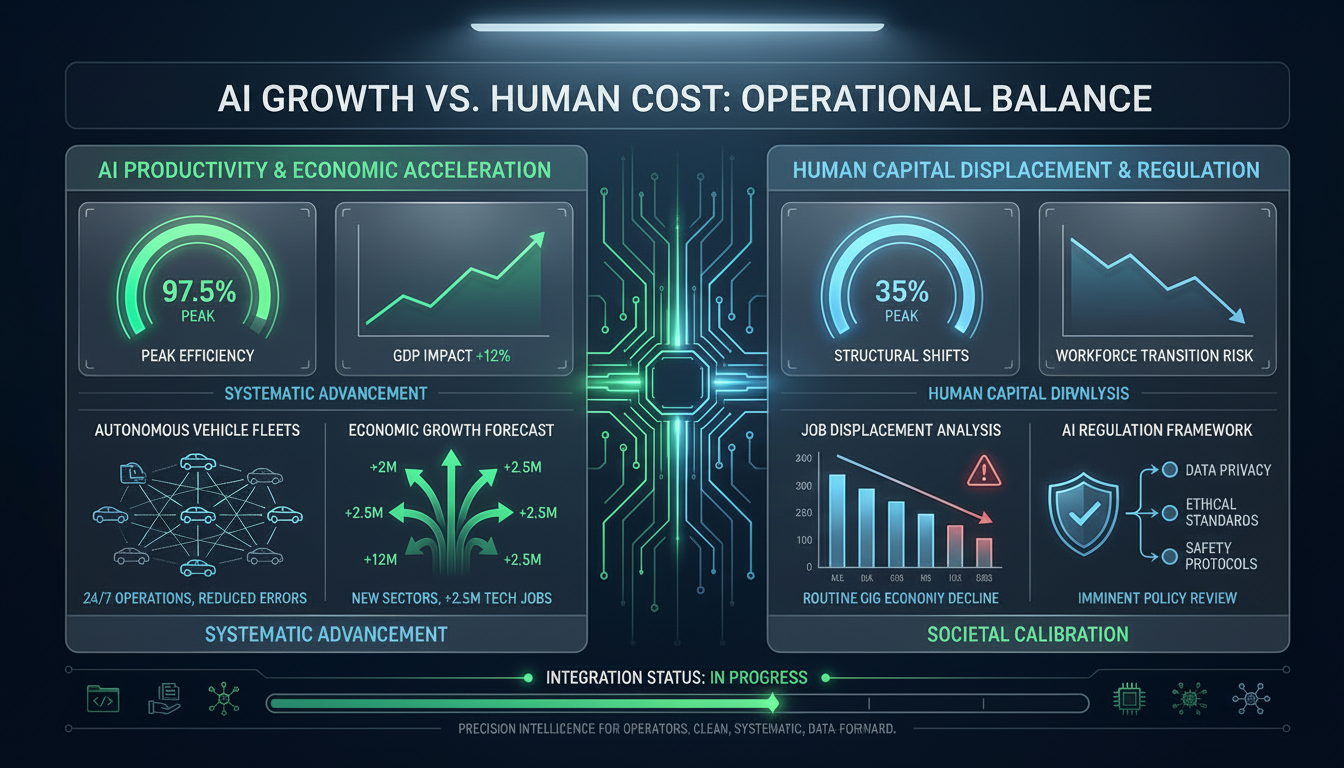
The promise of AI-driven productivity is undeniable, with the Fed even raising its long-term growth rate projection largely due to perceived AI efficiency. However, the human and societal friction points are rapidly escalating, particularly in the realm of autonomous vehicles. What looks like an efficiency gain from 30,000 feet often translates into a direct threat to livelihoods and established community structures on the ground.
This week, the conversation around autonomous vehicles (AVs) highlighted a stark reality: the technology is no longer theoretical, and neither is its impact on jobs and urban politics. In Boston, the proposed entry of companies like Waymo faced significant organized opposition, not just from labor unions, but from city officials prioritizing job protection. As Abdiaziz, a taxi driver, Uber/Lyft driver, and union recruiter, starkly put it on Freakonomics Radio:
"When Uber came, their aim was to kill taxi business. Now Waymo is to kill the drivers."
— Abdiaziz, Taxi Driver, Uber/Lyft Driver, Union Recruiter on Freakonomics Radio
This isn't just about taxi drivers. It's about a broader societal reckoning with technological unemployment, especially for low-wage workers. City Councilors like Julia Mejia voiced concerns over human jobs, explicitly stating, "If we're competing with machines, it will ultimately have an impact on our drivers." This public pushback illustrates that the deployment of advanced AI isn't purely a technical or economic decision; it's a deeply political one. While Waymo representatives cite safety benefits, emphasizing their five times lower injury-causing crash rates compared to human drivers, the argument for efficiency often falls flat against the moral imperative of job security in "union towns" like Boston.
What's surprising is that while unions and city councils often align against these technologies, the disability community is emerging as a powerful ally for AVs, viewing them as a path to independence (Carl Richardson on Freakonomics Radio). This creates a complex, multi-faceted debate that CTOs and operations leaders must navigate, understanding that local political and social dynamics can be as significant as technical readiness.
The Strategic Question: As we deploy efficiency-driving AI across our operations, have we adequately mapped not just the technical and financial ROI, but also the societal and political friction points that could derail even the most promising initiatives?
The Rundown
① AI is fueling a record jump in US growth projections. The Federal Reserve's long-term real growth rate projection for the US was raised by an unprecedented 20 basis points, largely attributed to the perceived productivity of AI. (Jeremy Siegel on This Week in Business)
→ The Operator Take: The macro-economic signal for AI's impact is strengthening; this translates to increasing pressure on leadership to demonstrate concrete productivity gains from their AI investments, moving beyond pilot programs to scaled deployment.
② OpenAI's Sora shutdown signals volatility in AI production tools. OpenAI abruptly shut down its advanced AI video app Sora just six months after its public release, raising questions about the stability of new AI production platforms and a reported $1 billion investment from Disney now in limbo. (Waylon Wong on The Indicator from Planet Money)
→ The Operator Take: Proceed with caution on early-stage, mission-critical AI tools; dependency on nascent AI platforms carries high integration risk and the potential for significant sunk costs if underlying models or products are quickly deprecated.
③ Math-focused AI is advancing rapidly, paving the way for bug-free software. Harmonic's Aristotle model, using formal verification in Lean code, has achieved gold medal performance in complex math problems, contributing to a tenfold increase in formally verified Erdos problems in mere months. (Vlad Tenev and Tudor Achim on Summation)
→ The Operator Take: Formal verification, accelerated by AI, is moving from niche academic application to a scalable method to eliminate software bugs; strategic investment in these techniques could drastically reduce technical debt and increase system reliability across critical infrastructure.
④ Private credit stability is stronger than headlines suggest despite AI risk. Despite media narratives conflating risks across credit markets, 98.5% of private credit-backed companies are servicing their debts, with institutional investors seeing attractive new opportunities as spreads widen. (Alex Blostein and Vivek Bantwal on Exchanges)
→ The Operator Take: Don't let broad market sentiment dictate your private credit strategy; sophisticated due diligence on individual portfolio companies, especially those resilient to AI disruption, can uncover significant illiquidity premiums for those willing to hold through perceived volatility.
⑤ Disagreement is critical for organizational health, but how you disagree matters. Many leaders inadvertently suppress constructive disagreement by hiring "cultural fits" and approaching opposing views with a mindset of "fixing" others, rather than fostering an environment where conversations can continue productively. Julia Minson noted, "A really sort of high level, upstream way that we suppress disagreement is by hiring people that we agree with." (Julia Minson on HBR IdeaCast)
→ The Operator Take: Proactively audit your leadership hiring practices and meeting structures to ensure genuine receptiveness to dissent, as suppressing disagreement now leads to bigger risks and blind spots later.
The Stack
🔥 Heating Up:
• AI impact on US GDP growth: The Federal Fed raised its long-term real growth rate projection by 20 basis points, largely due to AI's perceived productivity boost. (Jeremy Siegel on This Week in Business)
• Formal verification for software and math: AI models like Harmonic's Aristotle are rapidly advancing mathematical superintelligence, accelerating the verification of complex proofs and hinting at a future of near bug-free software. (Vlad Tenev and Tudor Achim on Summation)
• Iran's Sanctions-Proof Banking System: Despite decades of sanctions, Iran has built a sophisticated domestic payment network and integrated with systems like Russia's MIR, creating a parallel financial architecture independent of Western control. (Philip Nichols on This Week in Business)
👀 On Watch:
• Smartphones, Online Music Streaming, and Traffic Fatalities: Increased traffic deaths on major music album release days are primarily linked to distracted driving from smartphone use, particularly among younger, solo drivers. (Vishal Patel on Freakonomics Radio)
• Private Credit Retail Outflows: Evergreen retail funds in private credit are expected to see net outflows through 2026 and likely 2027, driven by liquidity concerns. (Alex Blostein on Exchanges)
• Leader as 'the weather': Leaders' demeanor profoundly influences team dynamics; controlling one's "weather" is critical for consistent and positive team performance. (Shea Ralph on How Leaders Lead with David Novak)
🧊 Cooling Off:
• Sora (AI video app) 🆕: OpenAI abruptly shut down its groundbreaking AI video app Sora, just months after its public release, impacting investments and raising questions about product longevity. (Waylon Wong on The Indicator from Planet Money)
• Equal voting rights in IPOs: The percentage of new listings going public with an equal voting structure hit a record low of two-thirds in 2025, down 11 percentage points from the previous year. (Jeff Mahoney on The Voice of Corporate Governance)
• AI labor apocalypse is wrong: Macro-level data on unemployment claims remain stable, challenging the widespread narrative of an impending AI-driven job crisis, despite anecdotal job cuts. (Jeremy Siegel on This Week in Business)
The Bottom Line
While AI is undeniably accelerating growth at a macro level, its friction points are increasingly hyper-local, demanding that operational leadership balance efficiency with an acute awareness of human impact and geopolitical realities.
Your Move: Strategic Imperatives for the Coming Week
1. Map AI Integration Friction Points: Identify current or planned AI deployments that might encounter significant local resistance, particularly those impacting low-wage roles or established community structures, and develop preemptive stakeholder engagement plans. Start with your operations teams and union liaisons.
2. Stress-Test AI Vendor Stability: Review vendor roadmaps and financial health for any critical AI tools in your stack. Develop contingency plans for rapid deprecation or unexpected shutdowns, especially for single-source dependencies, given the volatility observed in the market this week.
3. Evaluate Formal Verification for Critical Systems: For high-stakes software or mathematical models, explore how AI-accelerated formal verification techniques could be integrated into your development lifecycle to mitigate bugs and enhance reliability, reducing long-term technical debt.
4. Audit Disagreement Receptiveness: Implement or refine mechanisms to encourage constructive dissent within your leadership teams. Directly assess if your hiring practices or meeting cultures inadvertently suppress valuable opposing viewpoints before they become critical blind spots.
📖 Want the full episode breakdowns, guest details, and listen links?
Appendix
HBR IdeaCast: "Learn to Disagree More Effectively" · 31 min · Featuring Julia Minson▶ Listen
Freakonomics Radio: "In a Driverless World, Who Loses and Who Wins?" · 66 min · Featuring Abdiaziz▶ Listen
Exchanges: "Private Credit Concerns in Context" · 31 min · Featuring Alex Blostein▶ Listen
Summation (formerly World of DaaS): "Vlad Tenev and Tudor Achim on mathematical superintelligence, why math is harder than code for LLMs, and the end of buggy software" · 49 min · Featuring Auren Hoffman▶ Listen
This Week in Business: "Inside Iran’s Payment Network and Global Sanctions Strategy" · 13 min · Featuring Philip Nichols▶ Listen
This Week in Business: "How Geopolitics and AI Are Influencing Today’s Financial Markets" · 13 min · Featuring Jeremy Siegel▶ Listen
Freakonomics Radio: "668. Do Taylor Swift and Bad Bunny Have Blood on Their Hands?" · 54 min · Featuring Bapu Jena▶ Listen
The Indicator from Planet Money: "The US loses tech hires, sayonora to Sora, and Afroman's win" · 9 min · Featuring Waylon Wong▶ Listen
How Leaders Lead with David Novak: "#284: Shea Ralph, Head Coach of Women’s Basketball, Vanderbilt – Ground your team in values, not results" · 66 min · Featuring Shea Ralph▶ Listen
The Voice of Corporate Governance: "CII’s Monthly Governance and Capital Market Regulation Update (Feb. 3 - March 3)" · 27 min · Featuring Jeff Mahoney▶ Listen
Gartner ThinkCast: "How AI Really Thinks — and Why It Hallucinates" · 13 min · Featuring Chris Howard▶ Listen