
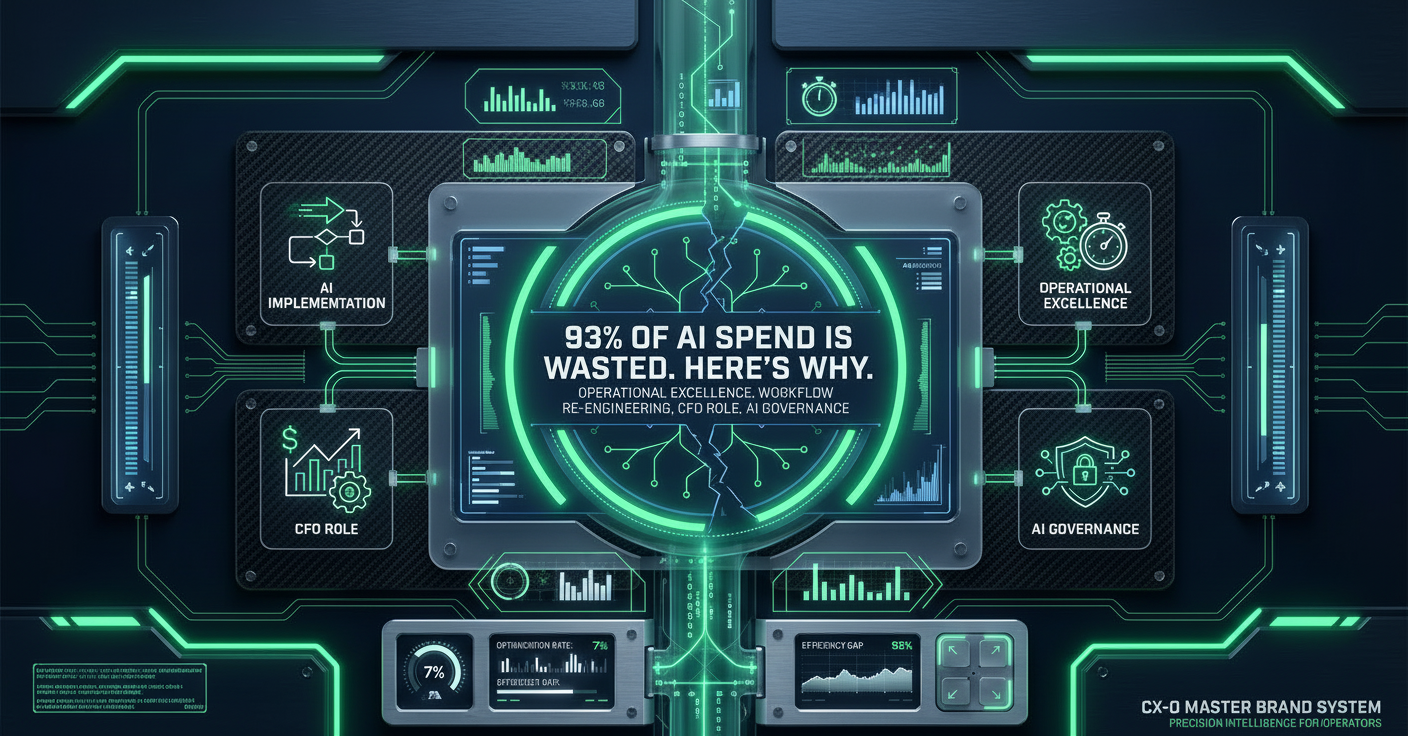
Navigating the AI revolution isn't about throwing tech at every problem; it's about disciplined process re-engineering and ruthless focus on outcomes.
📊 9 episodes across 5 podcasts
⏱ 394 minutes of intelligence analyzed
🎙 Featuring: Michael Krigsman, Bill Briggs, Tom DiDesidero, Rich Schmidt, Bill Zarella, Pradeep Mannakkara, Ben Mayrides, Kunal Agarwal, Shobhit Varshney, Shobhit Kapoor, Aidan Viggiano, Dr. Ram Charan, Jon McNeill
The Big Shift
It’s Not About AI, It’s About the Operating System
The conversation around AI is shifting from a tech-first approach to a fundamental re-evaluation of how organizations actually operate. Many leaders are still mistakenly focusing on AI as a technology solution, rather than a catalyst for operational excellence. Deloitte CTO, Bill Briggs, highlighted this imbalance, stating that "93% of all AI spend is going toward the tech and the tooling and only 7% is on everything else, which is the culture, the change, the learning, how do we communicate the vision, how do we be thoughtful about trying to redesign or reimagine how we work." This misallocation weaponizes inefficiency, embedding AI into broken processes, leading to cost overruns and failed initiatives.
The real signal this week is that the most successful AI implementations are starting with first-principles thinking, questioning every requirement, and re-engineering workflows from the ground up BEFORE automation enters the picture. Jon McNeill, who scaled Tesla from $2B to $20B, emphasized that "The biggest breakthroughs didn't come from genius... but really the big breakthroughs came from this repeatable operating system" rather than just individual brilliance. Similarly, Citi's Global Head of AI, Shobhit Varshney, outlined their strategy to “re-engineer workflows before applying AI,” ensuring that existing inefficiencies aren't simply automated. This is a crucial distinction: AI isn't a band-aid; it's a lever to amplify an already optimized system.
This means your job is less about finding the "right" AI tool and more about building the "right" operational foundation. Whether it's Tesla's "The Algorithm" or Citi's workflow re-engineering, the pattern is clear: exceptional growth and effective AI adoption are byproducts of meticulously designed operating systems that prioritize value, question assumptions, simplify processes, and only then, automate. It’s an axiom: start with the outcome, value first.
"93% of all AI spend is going toward the tech and the tooling and only 7% is on everything else, which is the culture, the change, the learning, how do we communicate the vision, how do we be thoughtful about trying to redesign or reimagine how we work."
— Bill Briggs, CTO of Deloitte on CXOTalk
The Rundown
① Operational CFOs are the new strategic architects.
CFOs are stepping out of the "historian" role and into active "navigator" positions, deeply involved in all facets of the business. Tom DiDesidero, CFO at SmartRecruiters, noted that "the most successful companies have highly operational CFOs," who actively make tough decisions around team structure and execution. This means getting into the weeds of product, GTM, and engineering to architect data, people, and processes. (Tom DiDesidero on The CFO Playbook)
→ The Operator's Take: Shift your finance team's focus from mere reporting to active involvement in strategic decision-making across departments, pushing for cross-functional leadership and data-driven insights.
② AI governance requires a phased, not a "lock down first," approach.
Cvent deliberately encouraged its employees to create 6,000 internal AI agents to build widespread AI fluency before implementing stricter moderation and metrics. This contrasts with a typical "lock down first" security approach. Ben Mayrides, CISO at Cvent, explained that existing IAM and observability controls are inadequate for autonomous agents. (Ben Mayrides on CXOTalk)
→ The Operator's Take: Foster AI adoption and experimentation internally, starting with training and basic guardrails, before rolling out rigid controls. Use frameworks like AWARE to scale governance intelligently rather than stifling innovation.
③ Talent density and "learning density" are your highest ROI investments.
Instead of job-hopping for titles, operators like Rich Schmidt, CFO of Inmar Intelligence, achieved CFO status by staying within one company for decades, mastering operational problem-solving. Kunal Agarwal, CFO of Gorgias, advocated for optimizing for "learning density" in career progression. (Rich Schmidt on CFO THOUGHT LEADER)
→ The Operator's Take: Create internal career paths that reward deep operational expertise and continuous learning within your organization to build institutional knowledge and reduce churn.
④ The true cost of AI is more than just token usage.
Kunal Agarwal, CFO of Gorgias, highlighted that "our infrastructure costs are single biggest expense driver of our company year over year... That's the single biggest increase." Modern AI agent costs extend significantly beyond just LLM token usage, encompassing security, architectural, and infrastructure expenses. (Kunal Agarwal on Run the Numbers)
→ The Operator's Take: When evaluating AI investments, bake in the full stack of infrastructure, security, and architectural costs, not just the per-token LLM charges. The long-term TCO is often underestimated.
⑤ Hypergrowth is an "algorithm," not just genius.
Jon McNeill, former President of Tesla, revealed that Tesla's growth from $2B to $20B in 30 months was due to a repeatable, five-step operating system ("The Algorithm"), emphasizing questioning requirements, deleting unnecessary steps, simplifying processes, accelerating cycle time, and automating last. (Jon McNeill on Technovation with Peter High (CIO, CTO, CDO, CXO Interviews))
→ The Operator's Take: Implement a rigorous process for stripping complexity and accelerating speed in your organization. Regularly challenge every "requirement" to see if it's legally, safely, or physically necessary. If not, eliminate it.
⑥ AI is bringing voice communication "back" for enterprises.
Aidan Viggiano, CFO of Twilio, discussed how AI is causing a "comeback" for voice communication products, enabling more natural interactions with AI agents. Twilio's AI agent now handles 98% of inbound inquiries, freeing up human staff for more complex tasks. (Aidan Viggiano on CFO THOUGHT LEADER)
→ The Operator's Take: Re-evaluate your customer support and internal communications for voice-first AI applications. The efficiency gains and improved customer experience enabled by conversational AI agents are significant.
Signal Board
🔥 Heating Up
• CIO role transformation: Shifting from managing IT infrastructure to orchestrating an organization with human and AI workforces, acting almost as a VC portfolio manager. (Bill Briggs on CXOTalk)
• Operational CFO role: Increasingly involved in decision-making beyond finance, driving growth and operational efficiency through strategic insights and hands-on leadership. (Tom DiDesidero on The CFO Playbook)
• AI-driven workflow transformation: Organizations like Inmar Intelligence are aggressively scaling AI workflows, increasing them from 200 to over 2,800 custom workflows in one year. (Rich Schmidt on CFO THOUGHT LEADER)
• First-principles thinking: Being applied to challenge established norms and drive innovation, questioning every requirement to simplify processes and accelerate cycle times. (Jon McNeill on Technovation with Peter High (CIO, CTO, CDO, CXO Interviews))
👀 On Watch 🆕
• AWARE framework: A new model for comprehensive AI governance, focusing on identity, context, guardrails, risk scoring, and ecosystem observability for autonomous agents. (Ben Mayrides on CXOTalk)
• Learning Density: A career philosophy recommending optimizing for maximum learning per unit of time, rather than just chasing titles or compensation. (Kunal Agarwal on Run the Numbers)
• AI pricing based on outcomes: A model emerging for AI agents where billing is tied directly to resolved interactions or achieved business outcomes, not just token usage. (Kunal Agarwal on Run the Numbers)
• China's 90% Model: A strategic approach by China to dominate global manufacturing by aiming for 90% of world demand capacity, selling at low prices, gaining market share, and leveraging currency devaluation and subsidies. (Dr. Ram Charan on Technovation with Peter High (CIO, CTO, CDO, CXO Interviews))
❄️ Cooling Off
• AI experimentation without a value-first approach: The practice of launching free AI pilots with vendors without a clear business case or outcome in mind, often leading to misallocated spend. (Shobhit Varshney on Technovation with Peter High (CIO, CTO, CDO, CXO Interviews))
• Traditional IAM controls for AI agents: Existing Identity and Access Management systems are proving inadequate for governing the identity, scope, and observability of autonomous AI agents. (Ben Mayrides on CXOTalk)
• Applying AI to inefficient processes: Deploying AI on overly complex or broken business processes, which "weaponizes inefficiency" and invariably leads to higher costs and poorer outcomes. (Bill Briggs on CXOTalk)
• "Asset-light" strategies in manufacturing: Criticized for ceding manufacturing capability and creating vulnerabilities in the face of geopolitical strategies like China's 90% Model. (Dr. Ram Charan on Technovation with Peter High (CIO, CTO, CDO, CXO Interviews))
The Debate
The role of AI in driving efficiency in human capital: elimination vs. augmentation.
The "Elimination" Case: Aidan Viggiano, CFO of Twilio, provided a clear mandate: "We kind of have to continue to be [flat on headcount]... I need you to drive efficiency within your organization, leveraging this tools and AI and all of that." She sees AI as a tool to maintain current headcount while growing the business, directly offsetting the need for new hires by increasing productivity. The goal is to eliminate lower-value tasks and prevent staff increases. (Aidan Viggiano on CFO THOUGHT LEADER)
The "Augmentation" Case: Shobhit Varshney, Global Head of AI at Citi, countered by emphasizing that "doing the right AI is focusing on value creation. And value creation comes by empowering your team members and employees with being the best of themselves." His perspective is that AI should enhance human capabilities, freeing up time for higher-value work, rather than directly cutting roles. Citi's goal is to unlock "100,000 hours worth of productivity every week" to empower employees. (Shobhit Varshney on Technovation with Peter High (CIO, CTO, CDO, CXO Interviews))
The Operator's Read: The weight of evidence leans towards augmentation first, but with an underlying expectation of flat or reduced headcount over time. The "empowerment" argument is a necessary step to secure buy-in and unlock initial value, but the CFO's ultimate accountability for cost efficiency ensures that headcount will be implicitly managed down as AI-driven productivity gains accrue.
The Bottom Line
Stop chasing the shiny AI object; optimize your operating system first, then weaponize efficiency with technology.
Your Move
• Challenge Assumptions: Institute a "Question Every Requirement" policy for all process changes. Ask: Is it mandated by law, safety, or physics? If not, why is it there? Jon McNeill (CEO and Co-founder, DVx Ventures) demonstrated this as core to Tesla's hypergrowth.
• Audit AI Spend: Conduct an immediate audit of your AI spending. Is 93% going to tech and tooling and only 7% to change management, culture, and training? Rebalance your budget to prioritize the people and process side of AI adoption, as suggested by Bill Briggs (CTO, Deloitte).
• Reimagine Workflows: Before deploying any new AI tool, mandate a workflow re-engineering exercise. Apply AI to a streamlined process, not an inefficient one, to avoid "weaponizing inefficiency," a critical insight from Shobhit Varshney (Global Head of AI, Citi).
📖 Want the full episode breakdowns, guest details, and listen links?
Quick Appendix
CFO THOUGHT LEADER: "1173: The CFO at the Crossroads of Code, Capital, and Clarity | Rich Schmidt, CFO, Inmar Intelligence" · 56 min · Featuring Rich Schmidt
Who Should Listen: Finance leaders looking for unconventional career paths and insights into large-scale AI adoption in enterprise, especially data ingestion and workflow automation.
CFO THOUGHT LEADER: "1174: How a Hard Reset Reignited Momentum | Aidan Viggiano, CFO Twilio" · 44 min · Featuring Aidan Viggiano
Who Should Listen: CFOs navigating significant workforce reductions, balancing growth with profitability, and cautiously integrating AI while maintaining governance.
CXOTalk: "Deloitte CTO: Advice to CIOs on Enterprise AI | CXOTalk #912" · 53 min · Featuring Bill Briggs
Who Should Listen: CIOs and C-suite executives keen on understanding the common pitfalls of enterprise AI spending, the importance of culture, and effective AI governance strategies.
CXOTalk: "Governing AI Agents at Scale: Identity, Scope, and Observability (with Glean and Cvent) | CXOTalk #914" · 30 min · Featuring Pradeep Mannakkara
Who Should Listen: CISOs and IT leaders grappling with AI agent governance, security, and the limitations of traditional IAM in an increasingly autonomous AI environment.
Run the Numbers: "AI Pricing and the Hidden Growth Lever Most CFOs Ignore" · 55 min · Featuring Kunal Agarwal
Who Should Listen: CFOs and finance leaders interested in AI pricing models, managing AI's true variable costs, and optimizing career growth for "learning density."
Technovation with Peter High (CIO, CTO, CDO, CXO Interviews): "The 90% Model: Dr. Ram Charan on China’s Manufacturing War" · 42 min · Featuring Dr. Ram Charan
Who Should Listen: CEOs and strategic leaders needing to understand geopolitical economic competition, particularly China's manufacturing strategy, and its implications for global business.
Technovation with Peter High (CIO, CTO, CDO, CXO Interviews): "Why Citi Re-Engines Workflows Before Applying AI" · 28 min · Featuring Shobhit Varshney
Who Should Listen: Technology and operations leaders focused on responsible AI adoption, workflow re-engineering, and cultivating an AI-first culture within a large enterprise.
Technovation with Peter High (CIO, CTO, CDO, CXO Interviews): "From $2B to $20B: Jon McNeill on Tesla’s Hypergrowth Algorithm" · 48 min · Featuring Jon McNeill
Who Should Listen: Leaders seeking actionable frameworks for hypergrowth and operational excellence, especially those looking to reduce complexity and increase speed.
The CFO Playbook: "Why Operational CFOs Win: Strategy, Speed, and Leading Through Change with SmartRecruiters' Tom DiDesidero" · 38 min · Featuring Tom DiDesidero
Who Should Listen: CFOs focused on operational strategy, differentiating companies through focused AI investment, and navigating M&A integrations from a finance perspective.