
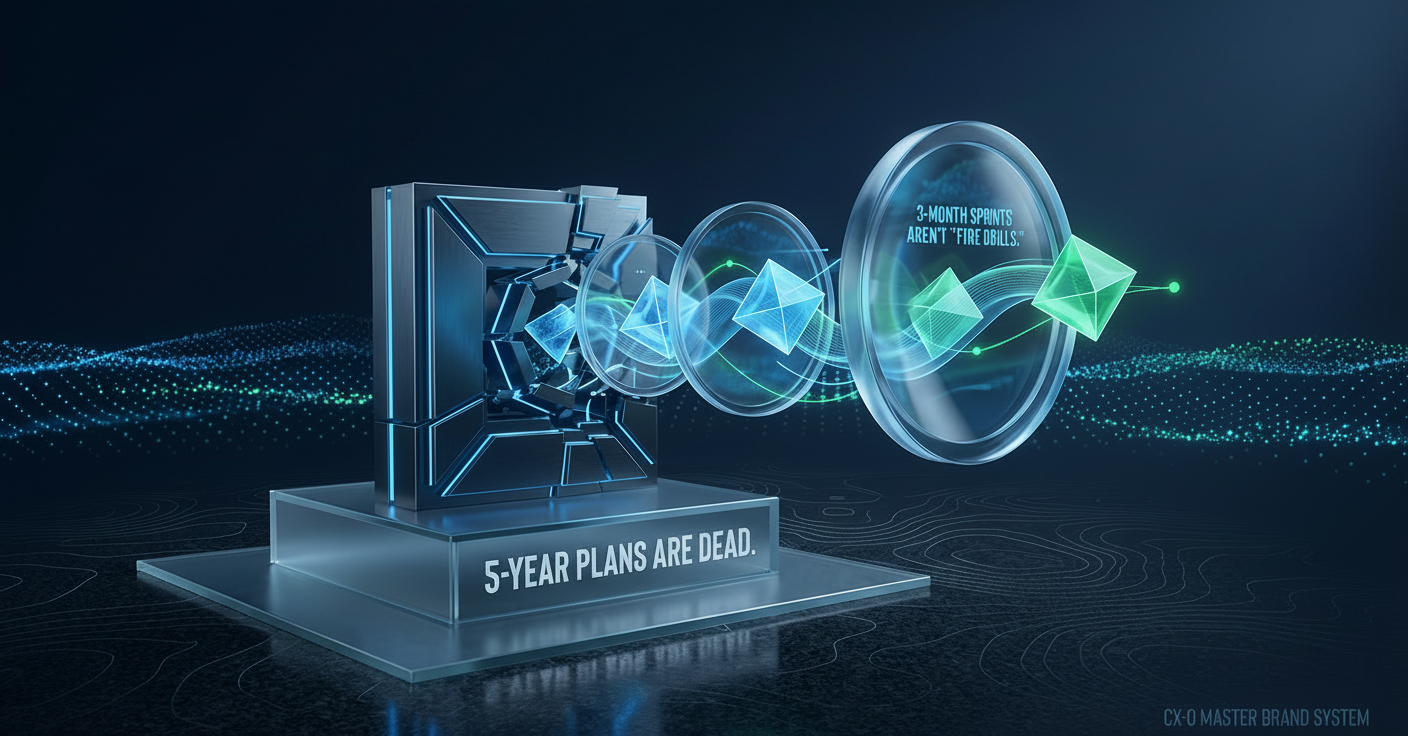
The strategic planning horizon has collapsed, forcing leaders to anchor in organizational health, not five-year forecasts.
📊 11 episodes across 8 podcasts
⏱ 443 minutes of intelligence analyzed
🎙 Featuring: Adam Grant (Host, TED), Esther Perel (Psychotherapist, ReThinking), Kim Scott (Host, Author, Radical Candor: Communication at Work), Nir Eyal (Author of Hooked, Indistractable, Beyond Belief, Author)
THE BIG SHIFT
Strategic Agility Demands a Human Anchor as Planning Horizons Shrink
The operating environment for businesses has fundamentally shifted. The once-standard 5-10 year strategic plan is now effectively obsolete, replaced by agile cycles spanning just 3-6 months. This accelerated pace, fueled by rapid technological evolution and information flow, isn't a sign of chaos but rather a mandate for responsible, sprint-based planning. As Patrick Lencioni, Host of At The Table with Patrick Lencioni, emphatically states, "The danger of fire drill leadership is still very problematic, but three to six months is not a fire drill anymore. That's actually responsible planning."
This compression of the planning horizon means that traditional long-range forecasts are losing relevance. In their place, organizational health and deeply embedded values become the critical anchors for stability and resilience. Cody Thompson noted on At The Table with Patrick Lencioni that "If you don't have the foundation of that organizational health, it can feel pretty stressful... building a little bit of a moat with organizational health, I think might be the answer." This pivot emphasizes that in a world where first-mover advantage can disappear in weeks, internal coherence and clear purpose are what enable rapid adaptation without losing strategic direction.
The implications are profound: leaders must cultivate an organization that can pivot quickly, not by abandoning strategy, but by grounding it in a robust internal culture. This demands a renewed focus on the human elements of leadership—fostering relational skills, understanding underlying motivations, and even leveraging neurodiversity. The ability to embrace paradoxes, integrate diverse perspectives, and cultivate relationships becomes far more critical than rigid, long-term plans in navigating this dynamically shortening future.
"If you just do rules, if you just do structure and security and safety and, and dependability and predictability and all of that, you will fossilize and die. If you just do change and innovation and dysregulation and risk taking, et cetera, you may go chaotic."
— Esther Perel, Psychotherapist and Author on Worklife with Adam Grant
The Board's Question:
How are we re-evaluating our strategic planning cycle to align with this compression, and what specific investments are we making in organizational health and relational capital to maintain stability amidst rapid shifts?
IDEAS IN BRIEF
① Relationships are the new currency for entrepreneurship, not just capital. Suneera Madhani, Founder of CEO School / Stax, shared her billion-dollar exit story, emphasizing that "you really are the company you keep" and that collecting relationships was pivotal, even more so than initial capital or technical skills. (Suneera Madhani on CEO School with Suneera Madhani)
→ The Implication: Founders should prioritize cultivating a network of critical, constructive peers and mentors as actively as they pursue investment, recognizing relationships as foundational capital for high-growth ventures.
② "Unofficial Resumes" dictate workplace dynamics more than official credentials. Esther Perel, Psychotherapist, and Adam Grant, Host at TED, discussed how personal relational histories and socialization profoundly influence professional interactions and organizational dynamics, often creating unrecognized "baggage" in organizational culture. (Esther Perel & Adam Grant on Worklife with Adam Grant)
→ The Implication: Leaders must become adept at uncovering and addressing these unspoken relational histories within their teams to foster healthier, more productive collaboration and prevent hidden tensions from derailing projects.
③ AI is emerging as a critical, non-judgmental tool for difficult communication practice. Kim Scott, Host, Author of Radical Candor, and Nir Eyal, Author of Hooked, highlighted that people are more willing to practice tough conversations with AI than with humans due to the perceived lack of judgment. (Kim Scott & Nir Eyal on Radical Candor: Communication at Work)
→ The Implication: Organizations should explore integrating AI-driven practice tools to upskill employees in critical communication, potentially accelerating the development of relational skills that are often overlooked due to discomfort.
④ Pervasive data collection and agentic AI are rapidly eroding personal privacy by default. Meredith Whittaker, President, Signal Foundation, warned that agentic AI embedded in operating systems, relying on cloud-based LLMs, undermines user privacy by broadly accessing data, clarifying that Signal uniquely encrypts intimate metadata where others fail. (Meredith Whittaker on The Prof G Pod with Scott Galloway)
→ The Implication: Companies handling sensitive customer or internal data must urgently re-evaluate their AI integrations and system architectures, moving towards privacy-by-design principles that explicitly prevent intimate metadata collection and ensure true end-to-end encryption.
⑤ Neurodivergent leaders offer a unique competitive edge in an AI-driven world. Andy J. Pizza (Speaker, Author, Host of Creative Pep Talk) suggested that neurodivergent individuals, particularly those with ADHD, bring a "chaotic type of innovation" and unique perspectives that will become increasingly essential as AI automates routine tasks. (Andy J. Pizza on SPEAK LIKE A CEO)
→ The Implication: Leaders should actively cultivate inclusive environments that embrace neurodiversity, recognizing that non-traditional thinking patterns are not deficits but valuable assets for creativity and problem-solving in increasingly complex, AI-infused markets.
⑥ Successful meeting design hinges on intentionality and reciprocity, not just efficiency. Rebecca Hinds, Author of Your Best Meeting Ever, noted that intentional meeting design encourages participants to "reciprocate that effort," leading to better punctuality and contributions, challenging the hyper-focus on mere cost-cutting. (Rebecca Hinds on Coaching for Leaders)
→ The Implication: Organizations should invest in training their leaders to design meetings with clear purpose, defined outcomes, and a structure that fosters equal airtime, shifting from a cost-centric view to one that prioritizes Return on Time Invested (ROTI) and engagement.
SIGNAL BOARD
🔥 HEATING UP
• Relational Baggage/Unofficial Resume: Personal relational histories are profoundly influencing professional interactions and organizational dynamics. (Esther Perel on Worklife with Adam Grant)
• Organizational Health as Strategic Anchor: Becomes critical anchor for stability and resilience as planning horizons shrink. (Cody Thompson on At The Table with Patrick Lencioni)
• Neurodivergent entrepreneurial advantages: Neurodivergent individuals, particularly those with ADHD, bring unique and valuable perspectives essential for business success. (Andy J. Pizza on SPEAK LIKE A CEO)
👀 ON WATCH
• China's 15th Five-Year Plan AI strategy: China aims for AI and AI devices to have a usage rate of over 90% in its economy by 2030, creating AI infrastructure. (James Kynge on The Prof G Pod with Scott Galloway)
• Agentic AI undermining operating system privacy: Agents integrated into operating systems by AI companies could undermine privacy guarantees. (Meredith Whittaker on The Prof G Pod with Scott Galloway)
• Dramatic vibe shift in US public opinion on Iran strikes within 48 hours: A significant shift in perception is leaking power away from the US and its allies back to the Islamic Republic. (Scott Galloway on The Prof G Pod with Scott Galloway)
🧊 COOLING OFF
• Long-Range Strategic Planning: 5-10 year strategic plans are becoming obsolete, replaced by agile 3-6 month cycles. (Patrick Lencioni on At The Table with Patrick Lencioni)
• First Mover Advantage: Drastically reduced, lasting only weeks due to rapid knowledge flow and product replication. (Patrick Lencioni on At The Table with Patrick Lencioni)
• "If you don't have anything nice to say, don't say anything at all.": This belief often hinders effective communication and radical candor, as people confuse niceness with avoiding discomfort. (Kim Scott on Radical Candor: Communication at Work)
THE TENSION
The role of external pressure versus internal alignment in driving strategic vision continues to create friction for leaders.
🔵 Vision First, Alignment Assumed: Elizabeth, a marketing leader on Coaching Real Leaders, embodied the belief that a promotion and investment in new tech implicitly validated her growth-driver vision for marketing. She proceeded to build her department based on this assumption, indicating a common leadership tendency to push a vision based on perceived implicit agreement rather than explicit buy-in. (Muriel Wilkins & Elizabeth on Coaching Real Leaders)
🔴 Understanding Precedes Vision: Muriel Wilkins, Host of Coaching Real Leaders, directly challenged this, stating, "I think the understanding comes before the vision. If what you're trying to do is get people aligned on a vision, maybe you gotta understand what your starting point is." This perspective emphasizes the necessity of adopting a "curious posture" and proactively engaging with other C-suite leaders to understand their pressures and definitions of success before advocating for a specific agenda. (Muriel Wilkins on Coaching Real Leaders)
The Strategist's Read: While passionate vision is crucial, the weight of evidence suggests that proactive, empathetic understanding of executive priorities and implicit assumptions is a non-negotiable prerequisite for successful strategic alignment, especially in complex organizational dynamics.
THE BOTTOM LINE
The speed of change demands a foundational return to relational intelligence and organizational health as the core capabilities for navigating strategic uncertainty.
YOUR MOVE
• Audit your strategic planning cycle: Evaluate if your current planning horizon (e.g., annual vs. 3-6 months) is adequately agile for today's market velocity, and identify areas where a sprint-based approach could yield better results. (Patrick Lencioni on At The Table with Patrick Lencioni)
• Map "unofficial resumes" within your leadership team: Facilitate a discussion with your executive team, perhaps with an external facilitator, on how personal histories and relational styles might be influencing interactions and decision-making, aiming to make implicit dynamics explicit. (Esther Perel on Worklife with Adam Grant)
• Pilot AI for communication practice: Explore integrating an AI tool in a secure, private environment for employees to practice difficult conversations, offering a non-judgmental space to hone critical relational skills. (Kim Scott & Nir Eyal on Radical Candor: Communication at Work)
📖 Want the full episode breakdowns, guest details, and listen links?
APPENDIX
Coaching for Leaders: "772: How to Measure Your Meeting’s Success, with Rebecca Hinds" · 39 min · Featuring Rebecca Hinds (Founder, Work Innovation Lab at Asana; Founder, Work AI Institute at Glean; Author of Your Best Meeting Ever, Asana, Glean) ▶ Listen
Coaching Real Leaders: "How Do I Get Buy-In From My Boss?" · 50 min · Featuring Elizabeth (Head of Marketing, ['Her current organization']) ▶ Listen
CEO School with Suneera Madhani: "How Relationships Led To Suneera Madhani’s Billion Dollar Exit" · 33 min · Featuring Suneera Madhani (Founder, CEO School / Stax), Kristina (Host, The Community Podcast) ▶ Listen
Radical Candor: Communication at Work: "Why We Don’t Do What We Know We Should: Beliefs, Habits, and AI Practice with Nir Eyal 8|4" · 50 min · Featuring Kim Scott (Host, Author, Radical Candor: Communication at Work), Nir Eyal (Author of Hooked, Indistractable, Beyond Belief, Author) ▶ Listen
SPEAK LIKE A CEO: "314: How ADHD Leaders Develop a Communication Edge" · 46 min · Featuring Oliver Aust (Host, Speak Like a CEO Academy), Andy J. Pizza (Speaker, Author, Host of Creative Pep Talk), Oliver (Host, SPEAK LIKE A CEO) ▶ Listen
The Prof G Pod with Scott Galloway: "China Decode: What Trump’s War With Iran Means for China and Global Oil" · 45 min · Featuring Alice Han (Host, Vox Media Podcast Network), James Kynge (Host, Vox Media Podcast Network) ▶ Listen
The Prof G Pod with Scott Galloway: "Fareed Zakaria on the Endgame in Iran" · 50 min · Featuring Scott Galloway (Host of The Prof G Pod, Vox Media Podcast Network), Fareed Zakaria (Journalist, Author, and Political Commentator, CNN) ▶ Listen
The Prof G Pod with Scott Galloway: "Meredith Whittaker on Who Controls Your Data in the Age of AI" · 47 min · Featuring Scott Galloway (Host, Vox Media Podcast Network), Meredith Whittaker (President, Signal Foundation) ▶ Listen
The Prof G Pod with Scott Galloway: "Raging Moderates: War in Iran Backfires as MAGA Turns on Trump" · 29 min · Featuring Scott Galloway (Host, Vox Media Podcast Network), Jessica Tarlov (Host, Vox Media Podcast Network) ▶ Listen
At The Table with Patrick Lencioni: "263. Short Range Strategy" · 17 min · Featuring Patrick Lencioni (Host, The Table Group), Cody Thompson (Co-host) ▶ Listen
Worklife with Adam Grant: "ReThinking: Esther Perel on the relationship baggage we bring to work" · 37 min · Featuring Adam Grant (Host, TED), Esther Perel (Psychotherapist, ReThinking) ▶ Listen