
Deploying AI isn't about the tech; it's about the plumbing, the accountability, and navigating a new era of weaponized information—because if your team can't trust what's real, nothing else matters.
📊 11 episodes across 8 podcasts
⏱ 268 minutes of intelligence analyzed
🎙 Featuring: Richard Thaler, Freakonomics Radio + Stitcher, Steve Odland, Dr. Lori Esposito Murray, Peter Cappelli, Dan Loney, Ricky Mulvey, Waylon Wong, Amy Wu Silverman, Mike Koh, Matt Sankom, Dana M. Peterson, Malala Lin, Mallory Bucher, Wayne Peacock, Dona Young, Dave Aron, Karen Stokes Lockhart, Zach Warren, Teneé Frazier, Natalie Runyon, Benjamin Barros, Adrian Ma, Darian Woods, Ted Murphy, Daniel Harberger, Alison Nathan, Bruce Kirk
The Lead
Disinformation Goes Industrial: Why Your TrustOps Strategy is Now a Business Critical Initiative
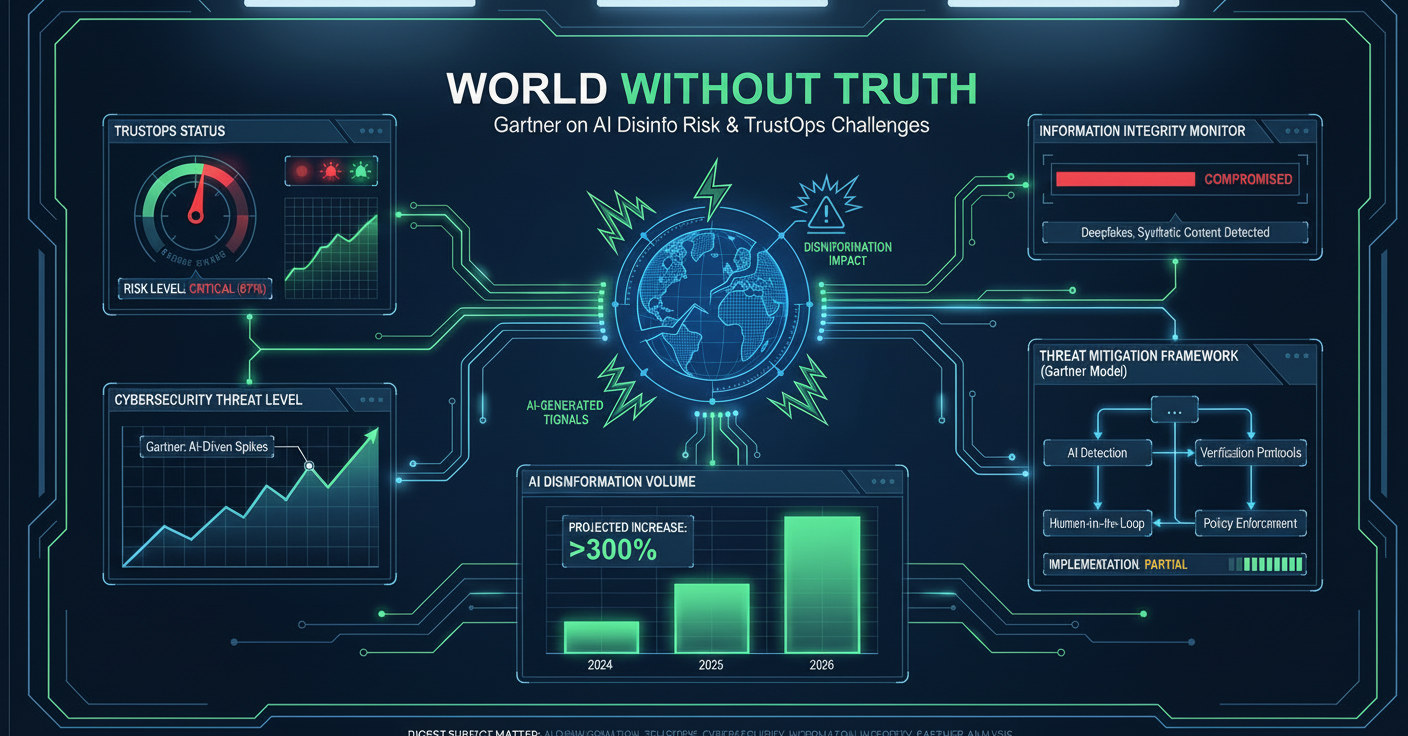
We’ve moved past casual misinformation and into an era of industrial-scale disinformation, weaponized by AI, that poses a trillion-dollar risk to global GDP. This isn't just about bad actors; it’s about sophisticated, funded operations designed to pollute mental models and undermine trust at the fundamental level of “what is true.” As enterprises increasingly grapple with AI-generated content, the risk of internal and external information integrity failures skyrockets, impacting everything from market perception to operational decision-making. Dave Aron, Distinguished VP Analyst at Gartner, highlights this shift, emphasizing that traditional cybersecurity is no longer sufficient against what he calls a “meta-issue.”
"When you can't be sure what's true, you can't make progress on any other issue. So this disinformation, it affects every type of decision making. So it makes it a very high order strategic risk. We think it's about a $1 trillion global problem, which is about 1% of global GDP."
— Dave Aron, Distinguished VP Analyst and Gartner Fellow at Gartner
The core problem isn’t just false facts but rather the mass customization of narratives, where AI enables disinformation campaigns to target individuals with slightly different messages for maximum impact. This means the battle for trust is no longer a PR or legal issue, but a core operational challenge requiring a new discipline: TrustOps. Aron advocates for establishing cross-functional “Trust Councils” and deploying “trustnets” using technologies like C2PA (Coalition for Content Provenance and Authenticity) to secure critical content. Without these, businesses risk making decisions based on compromised information, a vulnerability that will only deepen as AI becomes more pervasive across workflows. How granular are you getting with content provenance at every layer of your internal and external communication stack?
The Rundown
① Legal Education Adapts to AI, Prioritizing Judgment Over Rote Automation. Law schools are integrating AI into their curriculum while focusing on critical thinking, ethical AI use, and the development of professional judgment through simulations. (Benjamin Barros on Clarity)
→ The Operator Take: The legal sector's proactive approach to “automation complacency” and emphasis on higher-order skills provides a blueprint for other industries facing AI transformation; your training programs should follow suit.
② Boards Demand Honesty and Clear Action Plans from CEOs, Especially in Crisis. Effective CEO-board relationships are built on consistent, transparent communication, humility, and the CEO’s ability to deliver difficult news directly and concisely. (Wayne Peacock on BoardVision)
→ The Operator Take: In an uncertain environment, boards are doubling down on trust; ensure your C-suite communications are clear, actionable, and anticipate their needs, including asking for feedback. As Dona Young states, “The biggest assumption is that a CEO doesn't need affirmation and feedback, constructive or otherwise. It's so lonely in the job, and unless you've been a CEO, you have no idea of what lonely really feels like.”
③ North American CEOs Prioritize Uncertainty and Public Policy Over Environmental Concerns. While global CEOs rank AI as their top investment priority, North American leaders are more focused on navigating geopolitical uncertainty, policy shifts, and talent acquisition. (Dana M. Peterson on C-Suite Perspectives)
→ The Operator Take: This divergence signals a regional focus on immediate operational stability and market access; tailor your strategic narratives to reflect these localized priorities for North American stakeholders.
④ Nudge Theory Evolves for Global Challenges, Tackling “Sludge” and Climate. Behavioral economics, or "nudge theory," is increasingly applied to complex problems like climate change and economic inefficiencies caused by bureaucratic "sludge," like mortgage applications. (Richard Thaler on Freakonomics Radio)
→ The Operator Take: Apply "choice architecture" principles to internal processes to eliminate unnecessary friction (sludge) and guide employee behavior towards desired outcomes, improving efficiency and compliance. Thaler explains: "If you want to encourage some behavior, figure out why people aren’t doing it already, and eliminate the barriers that are standing in their way."
The Stack
🚀 HEATING UP
• TrustOps: A new enterprise function for grounding truthful information and combating industrial disinformation. (Dave Aron on Gartner ThinkCast)
• Nudge (book): Its principles are now being applied beyond personal finance to global issues like climate change and “sludge” removal from economic processes. (Richard Thaler on Freakonomics Radio)
• AI in law schools: Integrated into curricula with an emphasis on ethics, critical thinking, and judgment. (Benjamin Barros on Clarity)
👀 ON WATCH
• C2PA (Coalition for Content Provenance and Authenticity): Technology for securing critical content and providing content provenance in the fight against disinformation. (Dave Aron on Gartner ThinkCast)
• Option whales: Large traders making significant bets in the derivatives market, often using algorithmic strategies for income rather than pure speculation. (Ricky Mulvey on The Indicator from Planet Money)
• US Consumer Confidence Index increase in February 2026: Driven by less pessimistic expectations despite worsening present conditions, signals a fragile optimism. (Malala Lin on C-Suite Perspectives)
🧊 COOLING OFF
• AI washing: Companies claiming AI integration to appease investors and cut headcount, often without genuine implementation or impact. (Peter Cappelli on This Week in Business)
• International Emergency Economic Powers Act (IEEPA): Supreme Court ruled that a president cannot use this act to levy tariffs, limiting executive power in trade. (Ted Murphy on The Indicator from Planet Money)
• Environmental & Sustainability Issues: Not a priority for North American CEOs, contrasting with global and European executive focus. (Dana M. Peterson on C-Suite Perspectives)
The Bottom Line
The AI era demands a new operational playbook where trust is engineered, not assumed, and competitive advantage rests on resilient information and refined human judgment.
Your Move
- Implement TrustOps: Task your Head of Security and Head of Communications with developing a joint "TrustOps" strategy, starting with a cross-functional "Trust Council" to secure critical content against AI-driven disinformation.
- Audit AI Data Pipelines: Conduct an audit of all AI pilot programs to verify genuine AI implementation versus “AI washing” and assess training data integrity, especially where it impacts headcount or critical workflows.
- Optimize Internal Choice Architecture: Identify and eliminate “sludge” in internal processes by applying behavioral economics principles to reduce friction and guide employees towards efficient, compliant decision-making.
Appendix
BoardVision: "What Boards Really Want from the CEO" · 23 min · Featuring Wayne Peacock ▶ Listen
Clarity: "How are law schools using AI and how will AI shape the future of legal practice?" · 30 min · Featuring Benjamin Barros ▶ Listen
Clarity: "How can governments protect citizen data in the age of AI?" · 27 min · Featuring Zach Warren ▶ Listen
C-Suite Perspectives: "The State of the Economy for February 2026" · 27 min · Featuring Dana M. Peterson ▶ Listen
C-Suite Perspectives: "Ukraine War: Are We Headed for a Frozen Conflict—or a Bigger War?" · 32 min · Featuring Dr. Lori Esposito Murray ▶ Listen
Exchanges: "Why Japanese Stocks Could Keep Rallying" · 18 min · Featuring Bruce Kirk ▶ Listen
Freakonomics Radio: "All You Need Is Nudge (Update)" · 57 min · Featuring Richard Thaler ▶ Listen
Gartner ThinkCast: "A World Without Truth: Building TrustOps for the AI Era" · 23 min · Featuring Dave Aron ▶ Listen
The Indicator from Planet Money: "Can I get my tariff money back now?" · 9 min · Featuring Darian Woods ▶ Listen
The Indicator from Planet Money: "Do traders who place big bets make big money?" · 10 min · Featuring Ricky Mulvey ▶ Listen
This Week in Business: "Why Hiring Has Slowed Without Mass Layoffs" · 12 min · Featuring Peter Cappelli ▶ Listen
📖 Want the full episode breakdowns, guest details, and listen links?