
The strategic mandate for leaders is shifting from resource management to human development, with culture and curiosity becoming competitive battlegrounds.
📊 11 episodes across 7 podcasts
⏱ 505 minutes of intelligence analyzed
🎙 Featuring: Chris Duffy, Dave Stachowiak, Scott Galloway, Heather Cox Richardson, Simon Sinek, Adam Grant, Joth Ricci, Mike Schroepfer, Sara Fischer, Arvind Krishna, Ed Elson
|

THE BIG SHIFT
Leaders globally are grappling with a fundamental repositioning: the most valuable asset isn't capital or technology, but the capacity for human development within an organization. This extends beyond skills training to fostering environments where vulnerability, humor, and a learning mindset drive performance. The traditional focus on individual high performers is giving way to an emphasis on team health and collective potential, driven by a recognition that true high performance is a relational outcome, not a solitary one.
"What makes high performing organizations is high performing teams."
— Simon Sinek, Ethnographer, Author, Podcaster on Dare to Lead with Brené Brown
This shift implies that the "soft skills" of leadership—like empathy, communication, and the ability to teach—are now hard dependencies for strategic execution. Leaders are realizing that even in a climate of rapid technological advancement, human connection and the ability to navigate complex social dynamics are the ultimate differentiators. Joth Ricci (CEO, LYBL) underscored this by noting the critical need for "people skills" among young professionals, observing that while technically proficient, many lack essential interpersonal abilities. Similarly, Chris Duffy highlighted how humor, often dismissed as frivolous, is a powerful tool for connection and vulnerability, echoing the surprising insight that job candidates who acknowledge imperfections are often rated higher and liked more than "perfect" ones.
"I don't solve problems for people. I teach them how to work through problems. That shows you what people are made of. The people who can figure it out, they're going to do okay. The people who can't—they don't pass the test."
— Joth Ricci, CEO of LYBL on The Leadership Podcast
The implication is clear: those who view leadership solely through a command-and-control lens or prioritize individual heroics over team-based growth will find their organizations increasingly misaligned with the demands of a talent-driven economy. This also extends to how companies approach managing complex systems and failures. Mike Schroepfer (Founder, Gigascale Capital) described Facebook's evolution from a "move fast and break things" ethos to a "learning culture" that prioritized rapid iteration and root cause analysis over blame, demonstrating how a culture of psychological safety directly contributes to operational resilience.
→ Why it matters: Boards and CEOs must scrutinize their leadership development pipelines and cultural norms. Is your organization rewarding individual performance at the expense of team cohesion? Are you building leaders who are teachers, or just problem solvers? The next competitive advantage will flow from those who prioritize the development of adaptable, resilient human systems capable of learning and connecting at speed.
→ Board Question: How are we measuring the efficacy of our cultural investments, and are those metrics tied to long-term talent retention and strategic agility?
IDEAS IN BRIEF
① AI's Dual Impact: Productivity Gains vs. Job Displacement.
While AI is hailed as an incredible productivity tool, there's growing concern that leaders are using AI as a pretext for layoffs after overhiring, without transparency. (Adam Grant on Dare to Lead with Brené Brown)
→ Strategic Imperative: Leaders must distinguish between genuine AI-driven efficiency and using technology as cover for headcount reductions, as this deception erodes trust and generates negative sentiment around AI adoption.
② Leadership Requires Managing Your Own Nervous System.
Simon Sinek emphasized that if a leader cannot manage their own nervous system, they cannot effectively manage strategy or people, particularly in high-stakes environments. (Simon Sinek on Dare to Lead with Brené Brown)
→ The Takeaway: Prioritizing mental and emotional regulation is no longer a personal preference but a foundational capability for effective leadership, impacting decision-making and organizational stability.
③ Humor: An Undervalued Leadership Tool for Connection.
Chris Duffy argued that humor, traditionally overlooked in leadership, is a powerful tool for building connection, fostering vulnerability, and transforming tedious tasks into engaging experiences. (Chris Duffy on Coaching for Leaders)
→ The Implication: Leaders can enhance team cohesion and psychological safety by embracing humor as a means of acknowledging imperfection and creating a more relatable, human-centric workplace culture.
④ The Non-Linear Nature of Success and Career Paths.
Claire Hughes Johnson, former COO of Stripe, highlighted that perceived success is rarely linear, often involving messy, challenging periods that, in retrospect, were crucial for building resilience and learning. (Claire Hughes Johnson on Worklife with Adam Grant)
→ The Reframing: Organizations should normalize the realities of struggle and setbacks as inherent components of growth, fostering a culture that supports persistence through difficult periods rather than fearing perceived failures.
⑤ Communication is Best Demonstrated by Action.
Oliver Aust noted that leaders often communicate vision more effectively through their actions than through mere words, particularly in crucial areas like transparency and intent. (Oliver Aust on SPEAK LIKE A CEO)
→ The Mandate: Strategic communication requires active demonstration of values and vision, where leadership behavior aligns directly with stated goals to build trust and ensure clear understanding across the organization.
SIGNAL BOARD
🔥 HEATING UP
• quantum computing 🆕: IBM’s CEO Arvind Krishna noted rapid advancement from simulating simple molecules to tackling complex proteins, signaling significant progress in a critical emerging technology. (Arvind Krishna on Masters of Scale)
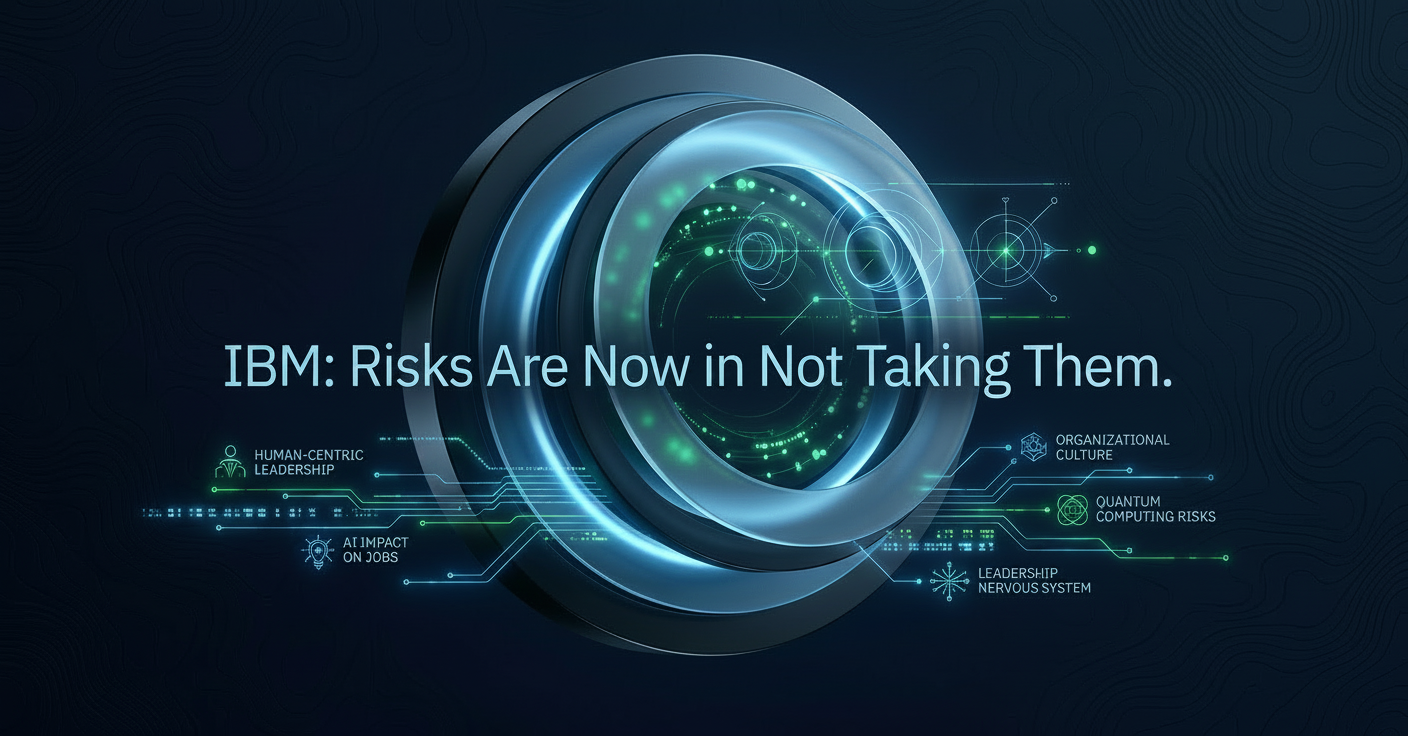
• Risk-taking in Business 🆕: IBM also highlights that the biggest risk for businesses now is not taking any risks, fostering a culture of innovation even with inevitable failures. (Arvind Krishna on Masters of Scale)
• The Creative Class and AI Economic Insulation 🆕: Technology, particularly with AI, is seen to potentially shift income distribution towards individual creators, insulating local 'buy local' economies. (Joth Ricci on The Leadership Podcast)
👀 ON WATCH
• Transparency for building internal and external trust: Emphasized as the "biggest unlock" for communication, reducing barriers to trust. (Tyler Denk on SPEAK LIKE A CEO)
• Impact of political figures (e.g., Trump) on podcast adoption and swing voter reach: Political figures increasingly use podcasts as direct channels to reach specific demographics and swing voters. (Sara Fischer on The Prof G Pod with Scott Galloway)
• US companies using cheaper Chinese open-source AI models 🆕: A signal of market-driven preference potentially overriding geopolitical concerns in AI open source adoption. (Alice Han on The Prof G Pod with Scott Galloway)
❄️ COOLING OFF
• Foundation models commoditization: IBM's CEO predicts foundation models will become commodities within 1-3 years, challenging the current high-valuation paradigm. (Arvind Krishna on Masters of Scale)
• Mass rebellion against short-term capitalism: Simon Sinek observed a global "mass rebellion" against the Milton Friedman/Jack Welch form of capitalism that prioritizes short-term gains over employee and customer well-being. (Simon Sinek on Dare to Lead with Brené Brown)
• Promoting High Performers to Leadership is Mistake 🆕: Joth Ricci argued that a key mistake in leadership is promoting good performers who lack leadership potential. (Joth Ricci on The Leadership Podcast)
THE TENSION
There was no significant divergence of opinion detected across this week's episodes to warrant a dedicated "Tension" section. The conversations generally aligned around synergistic themes, with various speakers offering complementary perspectives rather than direct disagreements.
THE BOTTOM LINE
Navigating the next wave of disruption requires leaders to invest relentlessly in human potential, fostering cultures of learning, humility, and connection that are as vital as any technological advantage.
📖 Want the full episode breakdowns, guest details, and listen links?
APPENDIX
Coaching for Leaders: "787: Better Leadership Through Humor, with Chris Duffy" · 39 min · Featuring Chris Duffy ▶ Listen · Apple Podcasts
Strategic Relevance: Essential for leaders seeking unconventional yet effective methods to foster psychological safety, connect with teams, and build a more resilient, human-centered workplace culture.
Dare to Lead with Brené Brown: "The Highest Performance Strategy is Caring About People ft. Simon Sinek" · 81 min · Featuring Simon Sinek ▶ Listen
Strategic Relevance: Critical listening for executives wrestling with organizational culture, incentive structures, and the long-term impact of prioritizing human connection over short-term financial metrics.
Masters of Scale: "IBM’s $10 billion bet on what comes after AI" · 41 min · Featuring Arvind Krishna ▶ Listen · Apple Podcasts
Strategic Relevance: Indispensable for CEOs and strategists assessing the long-term future of AI, quantum computing, and the imperative for bold risk-taking in enterprise technology strategy.
SPEAK LIKE A CEO: "20 World-Class Communications Experts Share Their #1 Advice" · 23 min · Featuring Nancy Duarte ▶ Listen · Apple Podcasts
Strategic Relevance: Actionable intelligence for leaders looking to refine their communication strategies, emphasizing audience-centricity, transparency, and the power of actions over words to build trust.
The Leadership Podcast: "TLP516: The Leader as Teacher: Building Leaders, Scaling Companies, and Multiplying Impact with Joth Ricci" · 40 min · Featuring Joth Ricci ▶ Listen · Apple Podcasts
Strategic Relevance: Crucial for leaders focused on talent development, scaling organizations, and addressing the growing gap in essential "people skills" among the next generation of professionals.
The Prof G Pod with Scott Galloway: "America at 250 — with Heather Cox Richardson" · 64 min · Featuring Heather Cox Richardson ▶ Listen · Apple Podcasts
Strategic Relevance: Provides a critical historical and political overlay for understanding current macro-economic shifts, wealth concentration, and the implications for corporate responsibility and strategic positioning.
The Prof G Pod with Scott Galloway: "China Decode: Hong Kong's AI Crackdown, Lululemon’s Marketing Backlash, and World Cup Fever" · 40 min · Featuring David Li ▶ Listen · Apple Podcasts
Strategic Relevance: Essential for leaders navigating global market complexities, particularly insights into the geopolitical chess game around AI, tech, and the challenges of cultural sensitivity in international branding.
The Prof G Pod with Scott Galloway: "The Business of Media: 60 Minutes, Billionaire Owners, and the Podcast Economy — with Sara Fischer" · 34 min · Featuring Sara Fischer ▶ Listen · Apple Podcasts
Strategic Relevance: Valuably informs strategies for content creation, marketing, and talent acquisition by dissecting the economics of the creator economy and the shift in media consumption towards spoken word audio.
The Prof G Pod with Scott Galloway: "China Decode: Why China Got Locked Out of SpaceX and America’s Biggest IPOs (ft. Ed Elson)" · 72 min · Featuring Ed Elson ▶ Listen · Apple Podcasts
Strategic Relevance: Crucial for understanding the escalating financial decoupling between the US and China, its implications for global capital markets, and the AI arms race's impact on tech investments.
Worklife with Adam Grant: "What is your company culture (and why does it matter)? with Mike Schroepfer" · 38 min · Featuring Mike Schroepfer ▶ Listen · Apple Podcasts
Strategic Relevance: Fundamental for leaders seeking to actively shape and scale organizational culture, emphasizing the critical role of psychological safety and a learning mindset over blame.
Worklife with Adam Grant: "Why success is never linear with Claire Hughes Johnson" · 33 min · Featuring Claire Hughes Johnson ▶ Listen · Apple Podcasts
Strategic Relevance: Offers a vital perspective for developing resilient leadership and talent by reframing career challenges and organizational struggles as integral to long-term impact and learning.
