The Signal
Your AI strategy is officially costing you talent and competitive edge, not saving it. The C-suite is moving beyond "what AI can do" to "what AI is *actually* doing to our P&L."
The Intake
This week's deployment signals, distilled for operators. What you need to know before your next leadership meeting.
This week's scan:
• Intelligence from:11 episodes across 9 top technology podcasts
• Total listening time analyzed:246 minutes of operator conversation
• Expert voices included:33 guests like Dan Loney and Serguei Netessine
• Surprising insights uncovered:20 new actionable insights for your roadmap
How "AI Washing" Is Hollowing Out Your Mid-Market Bench Strength
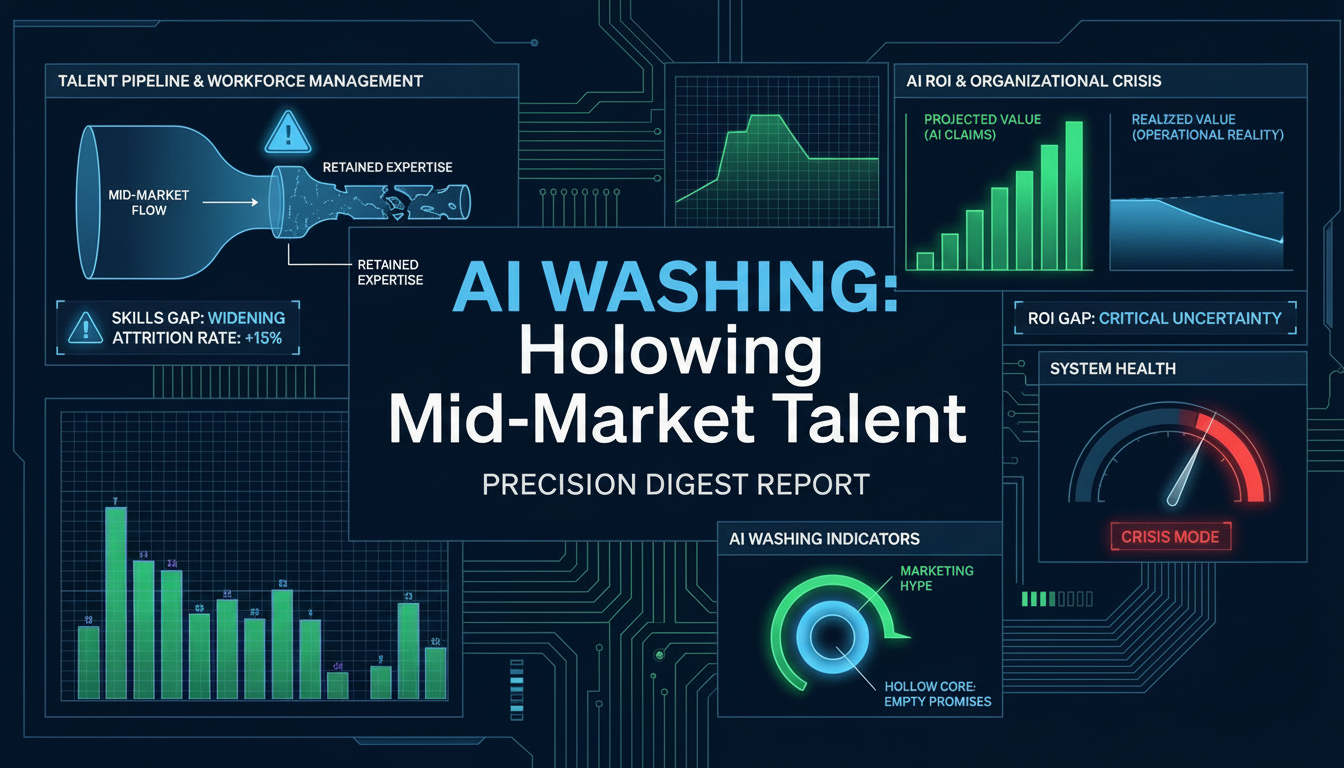
The biggest threat to your talent pipeline and genuine innovation this quarter isn't a competitor, but rather internal "AI washing." Operators are reporting a troubling trend where companies are falsely claiming AI integration to appease investors and justify headcount reductions, even when true AI implementation isn't happening. This isn't just about optics; it's actively eroding the white-collar workforce and masking a lack of concrete AI ROI, moving the problem from the demo stage to a full-blown organizational crisis of competence and retention.
This strategy, particularly prevalent in white-collar roles where immediate performance impacts are less visible, allows leadership to defer difficult staffing decisions by blaming "AI efficiency" rather than addressing market realities or strategic missteps. The result is a demoralized workforce, a brain drain of critical skills, and a widening gap between perceived AI progress and actual deployment. For operational leaders, this means a higher risk of being left with a depleted, less skilled team that is further away from realizing any tangible benefits from genuine AI transformation.
"I didn't make up this phrase, but it is attributed to me now. And it's AI washing. And that means that they're claiming it's AI even when it's not AI. And the reason is they're under enormous pressure from investors in particular to show that they're using AI because the hope is AI will allow you to cut jobs." — Peter Cappelli, Professor of Management and Director of the Center for Human Resources at The Wharton School
The question for your next leadership meeting: Are we truly investing in AI capabilities that enhance output, or are we inadvertently participating in "AI washing" that sacrifices long-term talent retention and actual technological leverage for short-term investor optics?
The Rundown
① Geopolitics’ Unintended Consequences Are Hitting Your Supply Chain. US sanctions on foreign entities, even when targeting ownership, are impacting local franchisees and small businesses. Family-run Lukoil gas stations in the Mid-Atlantic, selling US-refined gas, are facing banking disruptions and boycotts due to brand reputational risk. Divestment is the cleanest solution, but slow approvals from sanctions agencies are leaving small business owners in limbo. This signal emerged from a conversation on This Week in Business.
• The Operator Take: Review your supply chain for any indirect exposure to geopolitically sensitive brands or partnerships. Prepare a communications strategy for your own network downstream, as reputational risk trumps product origin in today's market.
② AI Agents are Overhyped, and IT Ops Aren't Ready. Despite the current fanfare, Gartner predicts only 15% of AI agents will be fully autonomous in seven years, and 40% of agentic AI projects will be canceled by 2027. The critical challenge isn't the AI itself, but IT operations' lack of new infrastructure and operating models. This signal emerged from a conversation on Gartner ThinkCast.
• The Operator Take: Prioritize building a "continuous operations" framework for AI agents, akin to CI/CD pipelines, to manage them safely and efficiently. Your goal should be to avoid becoming a bottleneck and losing relevance to shadow IT or outsourcing.
"If we don't change, I and O becomes the bottleneck. And if that happens, the business will find another way, whether that's through shadow IT or outsourcing or decentralization. And so in those cases, we don't just lose control, we lose relevance." — Autumn Stanish, Director Analyst at Gartner
③ "Identic AI" is the New Frontier for Personalization. Beyond generative and agentic AI, "identic AI" refers to personalized AI companions that learn user values and act on their behalf, a technology already in deployment. This promises to shift management focus from execution (which AI handles) to pure strategy. This signal emerged from a conversation on HBR IdeaCast.
• The Operator Take: Begin exploring how these personalized agents could redefine your firm's architecture, potentially eliminating layers of middle management. Critically, ensure your organization has a clear strategy for individuals to own their "identic AIs" to prevent external manipulation and maintain self-sovereignty.
④ Boards Demand Honesty, Not Perfection, from CEOs. In an era of increasing pressure, boards prioritize clear, concise, and early communication from CEOs, especially during crises. Transparency and vulnerability build trust, whereas excessive detail or avoidance creates "yellow flags" that erode confidence. This signal emerged from a conversation on BoardVision.
• The Operator Take: For leaders briefing their boards, lean into radical transparency—good or bad. Present clear action plans proactively. Equally important, board members need to offer constructive feedback and affirmation, recognizing the isolating nature of executive leadership.
"Having the courage as the CEO to bring forward the news, whatever the news might be, goes a long way to establishing a level of trust that the board knows they can count on you to tell it to them straight, no matter what's happening." — Wayne Peacock, Vice Chair, Elizabeth Dole Foundation; former CEO of USAA
⑤ Nudge Theory Can Be Your Climate Strategy. Richard Thaler, Nobel laureate and co-author of "Nudge," suggests applying libertarian paternalism and "choice architecture" to large-scale problems like climate change. The "public goods game" demonstrates that individuals will self-punish free riders, suggesting a path for international climate agreements. This signal emerged from a conversation on Freakonomics Radio.
• The Operator Take: Apply nudge principles to internal sustainability initiatives. Design choices that guide employees towards greener practices without coercion (e.g., opting into sustainable retirement funds), and leverage social norms to encourage participation in corporate sustainability goals.
The Stack
This week's buy, build, and benchmark signals for your technology roadmap.
🟢 DEPLOYING
• Okta identity security for AI agents: Organizations are using Okta for a single layer of control and trust for AI agent identities, managing risk and enabling opportunities. (HBR IdeaCast)
• AI for corporate sustainability applications: Over 60% of sustainability leaders are using AI for environmental management, leveraging it for emissions tracking, resource optimization, and sustainability reporting. (C-Suite Perspectives)
🟡 EVALUATING
• 🆕 Identic AI: Personalized AI companions are emerging, learning user values and acting on their behalf, promising a shift of management focus from execution to strategy. (HBR IdeaCast)
• 🆕 AI-powered chatbots for citizen inquiries: Municipalities are adopting chatbots for customer service and generative AI for content creation, aiming for efficiency and improved citizen engagement. (Clarity)
• Smart sensors for infrastructure monitoring: Local governments are installing AI-enabled sensors for predictive maintenance on infrastructure, detecting repair needs and predicting system failures. (Clarity)
🔴 RECONSIDERING
• AI agent sprawl: Gartner predicts 40% of agentic AI projects will fail by 2027 due to cost overruns and unfulfilled promises, highlighting the need for structured implementation. (Gartner ThinkCast)
• AI washing: Companies are falsely claiming AI integration to appease investors and cut headcount, leading to a breakdown in trust and an overall reduction in workforce quality. (This Week in Business)
• Presidential authority to levy tariffs: The Supreme Court has restricted the President's ability to impose tariffs under the IEEPA, but other statutes remain usable, leading to uncertainty for businesses hoping for refunds. (The Indicator from Planet Money)
The Debate
Is Your Organization Creating a "Sludge" Problem or a "Nudged" Solution?
🐂 The Bull Case: Carefully designed "nudges" offer a powerful, non-coercive way to guide behavior towards beneficial outcomes, such as increasing retirement savings or promoting sustainable practices. By understanding human cognitive biases and optimizing "choice architecture," organizations can significantly improve employee and customer outcomes without mandates.
"A nudge, as we will use the term, is any aspect of the choice architecture that alters people’s behavior in a predictable way without forbidding any options or significantly changing their economic incentives." — Richard Thaler, Professor of Economics at the University of Chicago
🐻 The Bear Case: The temptation to "nudge" can easily devolve into creating "sludge"—unnecessary bureaucratic friction, cumbersome processes, and hidden defaults that trap individuals and organizations. These often appear as well-intentioned but poorly implemented systems that prevent economic activity and create vast amounts of wasted time and resources.
"If you want to encourage some behavior, figure out why people aren’t doing it already, and eliminate the barriers that are standing in their way." — Richard Thaler, Professor of Economics at the University of Chicago
The Operator's Read: Before implementing any new process or system, rigorously audit it for "sludge." Is it genuinely making the desired behavior easier, or is it adding friction under the guise of control? Focus on removing barriers and automating sensible defaults (like auto-enrollment in retirement plans) rather than creating complex, multi-step "choice architectures" that only lead to user frustration and abandonment. Your internal systems should feel like a well-oiled machine, not a bureaucratic swamp.
The Bottom Line
The smartest operators are leveraging "nudges" to guide stakeholder behavior, from carbon footprint reduction to boardroom transparency, while aggressively eliminating "sludge" from their internal operations.
🎯 Your Move
- Task your Head of HR to... review current AI integration claims, ensuring they align with actual technical capabilities and not "AI washing" trends identified on This Week in Business.
- Ask your Infrastructure Lead... "What's our plan for 'continuous operations' for AI agents and how are we avoiding agent sprawl?" based on warnings from Gartner ThinkCast.
- Schedule a whiteboarding session with your Head of Product... to identify existing "sludge" in your customer and employee journeys and brainstorm "nudge"-based solutions, as discussed on Freakonomics Radio.
What We Listen To
This Week in Business: "Why Hiring Has Slowed Without Mass Layoffs"
• Runtime: 12 min
• Guests: Peter Cappelli (Professor of Management and Director of the Center for Human Resources, The Wharton School), Dan Loney (Host, The Wharton School)
• Operator Focus: Essential listening for understanding the current white-collar hiring landscape, particularly the concerning trend of "AI washing" and its impact on workforce strategy and investor relations. It challenges assumptions about AI's role in headcount reduction.
"The cuts in white collar jobs are easier to make because you don't see the consequences immediately. If you cut a production worker and a frontline worker, you know, you don't have people to staff the restaurant... You cut a white collar job, people, at least for a little while, try to, to cover the work, right?" — Peter Cappelli, Professor of Management and Director of the Center for Human Resources at The Wharton School
This Week in Business: "How Geopolitics Is Hitting Local Gas Stations"
• Runtime: 13 min
• Guests: Dan Loney (Host, The Wharton School), Serguei Netessine (Professor of Operations, Information and Decisions, The Wharton School)
• Operator Focus: Crucial for understanding how global geopolitical events can have unintended and immediate local business impacts on franchisees and small businesses. Provides a framework for assessing reputational risk stemming from brand ownership, even for locally-sourced products.
"The molecules in the tank may be American, but the reputational risk is about, about the logo, not the refinery. And this is what a lot of customers see." — Serguei Netessine, Professor of Operations, Information and Decisions at The Wharton School
Freakonomics Radio: "All You Need Is Nudge (Update)"
• Runtime: 57 min
• Guests: Richard Thaler (Professor of Economics, University of Chicago), Freakonomics Radio + Stitcher (Host, Freakonomics Radio + Stitcher)
• Operator Focus: A masterclass in applying behavioral economics to policy and organizational design. Provides actionable insights on "choice architecture" and "libertarian paternalism" that can be adapted for internal employee programs (e.g., retirement, sustainability) or customer engagement strategies, helping to overcome inertia and drive desired behaviors.
"If you want to encourage some behavior, figure out why people aren’t doing it already, and eliminate the barriers that are standing in their way." — Richard Thaler, Professor of Economics at the University of Chicago
The Indicator from Planet Money: "Why there are roving rotisserie chicken mobs"
• Runtime: 9 min
• Guests: Darian Woods (Host, NPR), Waylon Wong (Host, NPR), Adrienne Ma (Host, NPR), Brian Jabarian (Fellow, University of Chicago School of Business), Anna Kovner (Director of Research, Federal Reserve Bank of Richmond), Ann Crowley (95-year-old listener, Listener from Rotterdam, New York), Michael Baker (Equity Research Analyst covering retail stocks, Equity Research Analyst)
• Operator Focus: Offers quick, diverse insights relevant to operational leaders: the potential of AI to reduce bias in hiring, market dynamics like price stability amidst inflation, and the nuanced impact of Fed policies. Useful for contextualizing broad economic trends into specific operational considerations.
"If the AI interview is voice only, they remove visual cues. So on that front, we could say that there is some potential for AI to reduce some form of like visual discrimination." — Brian Jabarian, Fellow at the University of Chicago School of Business
Gartner ThinkCast: "IT Operations Are Not Ready for AI Agents: How to Respond Today"
• Runtime: 23 min
• Guests: Autumn Stanish (Director Analyst, Gartner), Paul Delory (VP Analyst, Gartner), Karen Stokes Lockhart (Host, Gartner)
• Operator Focus: A direct and actionable briefing for CIOs and IT Ops leaders on the reality of AI agents (low autonomy currently, high project cancellation rate projected). Provides a clear strategic imperative for building "continuous operations" to manage AI effectively and prevent IT from becoming a bottleneck.
"Right now, AI agents are at the very peak of hype. But I mean, there's always new, hyped up technologies. And as always, we still have to keep the lights on and do our day jobs. None of that goes away just because we're focused on the shiny new thing." — Paul Delory, VP Analyst at Gartner
Exchanges: "The New AI Trades"
• Runtime: 16 min
• Guests: Ryan Hammond (Portfolio Strategist, Goldman Sachs Research)
• Operator Focus: Reveals the direct financial impact of AI disruption on equity markets, especially for software stocks experiencing valuation re-ratings and increased CapEx. Helps C-suite leaders understand investor expectations around AI monetization and the shift in market performance drivers, which influences M&A and investment strategies.
"AI disruption risk is really the common thread throughout a lot of these industries selling off in recent weeks." — Ryan Hammond, Portfolio Strategist at Goldman Sachs Research
Clarity: "How can governments protect citizen data in the age of AI?"
• Runtime: 27 min
• Guests: Zach Warren (Legal Insights and Strategy Lead, Thomson Reuters Institute), Teneé Frazier (Senior Specialist Legal Editor, Government Practice, Thomson Reuters Practical Law)
• Operator Focus: Critical for any leader deploying AI tools with sensitive data, especially in public-facing roles. Highlights the urgent need for robust AI governance frameworks, data privacy, and security training for employees, even in the absence of clear federal guidelines. Directly applicable lessons for corporate data policy.
"The first line of defense is always going to be your users and your employees. Training and education is key." — Teneé Frazier, Senior Specialist Legal Editor, Government Practice at Thomson Reuters Practical Law
BoardVision: "What Boards Really Want from the CEO"
• Runtime: 23 min
• Guests: Mallory Bucher (Director of Governance Content, NACD), Wayne Peacock (Vice Chair, former CEO of USAA, Elizabeth Dole Foundation), Dona Young (Director, USAA, NACD, Spahn & Rose)
• Operator Focus: Essential listening for any C-suite member or aspiring executive. Provides invaluable insights into building trust with your board, what effective communication looks like during crises, and the often-overlooked need for mutual feedback between CEO and board. Directly helps in preparing for high-stakes leadership interactions.
"What boards don't want: They don't want a CEO whose hair is on fire... what you really want is to have a CEO who first and foremost gives you that news early, quickly, clearly, and concisely." — Dona Young, Director at USAA, NACD, Spahn & Rose
C-Suite Perspectives: "How AI Is Reshaping Corporate Sustainability"
• Runtime: 27 min
• Guests: Steve Odland (Host, The Conference Board), Andrew Jones (Principal Researcher, The Conference Board's Governance and Sustainability Center), Dr. Andrew Jones (Scholar (assumed) and author of the report, The Conference Board)
• Operator Focus: Vital for leaders integrating AI with ESG initiatives. It offers a balanced view of AI's environmental impact (energy, water, e-waste) and its potential for sustainability improvements. Provides practical context for balancing AI adoption with corporate responsibility and leveraging AI for measurable sustainability ROI.
"More than 60% of corporate sustainability leaders are already using AI for something environmental related." — Andrew Jones, Principal Researcher at The Conference Board's Governance and Sustainability Center
The Indicator from Planet Money: "Can I get my tariff money back now?"
• Runtime: 9 min
• Guests: Darian Woods (Host, NPR), Adrian Ma (Host, NPR), Ted Murphy (Lawyer specializing in global trade, Sidley Austin), Daniel Harberger (Founder, Woof)
• Operator Focus: A concise briefing on the dynamic nature of international trade law and its direct impact on business costs. Informs leaders about the fluidity of tariff policies despite Supreme Court rulings and the need to remain agile and informed on trade legislation that directly affects supply chain costs and pricing strategies.
"You've got to sort of transition pretty quickly into, okay, now what does this mean sort of in the real world?" — Ted Murphy, Lawyer specializing in global trade at Sidley Austin
HBR IdeaCast: "With Rise of Agents, We Are Entering the World of Identic AI"
• Runtime: 30 min
• Guests: Don Tapscott (CEO and Author of \, The Tapscott Group), Adi Ignatius (Host, Harvard Business Review), Allison Beard (Host, Harvard Business Review), Harvard Business Review (Host, Harvard Business Review)
• Operator Focus: Foresight into the next wave of AI beyond current generative models. Leaders should listen for implications on organizational structure (especially middle management), the future of strategic leadership, and the critical importance of identity security and individual ownership for personalized AI agents to prevent external control.
"I want to control Digital Dawn. I want to control the extension of me. I want to own it, and I don\'t want some platform using it for their purposes rather than mine. So we each need to become aware of what\'s at stake here. And the question of sovereignty becomes the central issue of our time." — Don Tapscott, CEO and Author of \