
The Opener
This week, the real AI story isn't about new capabilities, it's about the financial and operational friction of deployment.
The Intake
This week's deployment signals, distilled for operators. What you need to know before your next leadership meeting.
This week's scan:
• Intelligence from:11 episodes across 10 podcasts
• Total listening time analyzed:252 minutes
Expert voices included:28 guests
The Lead
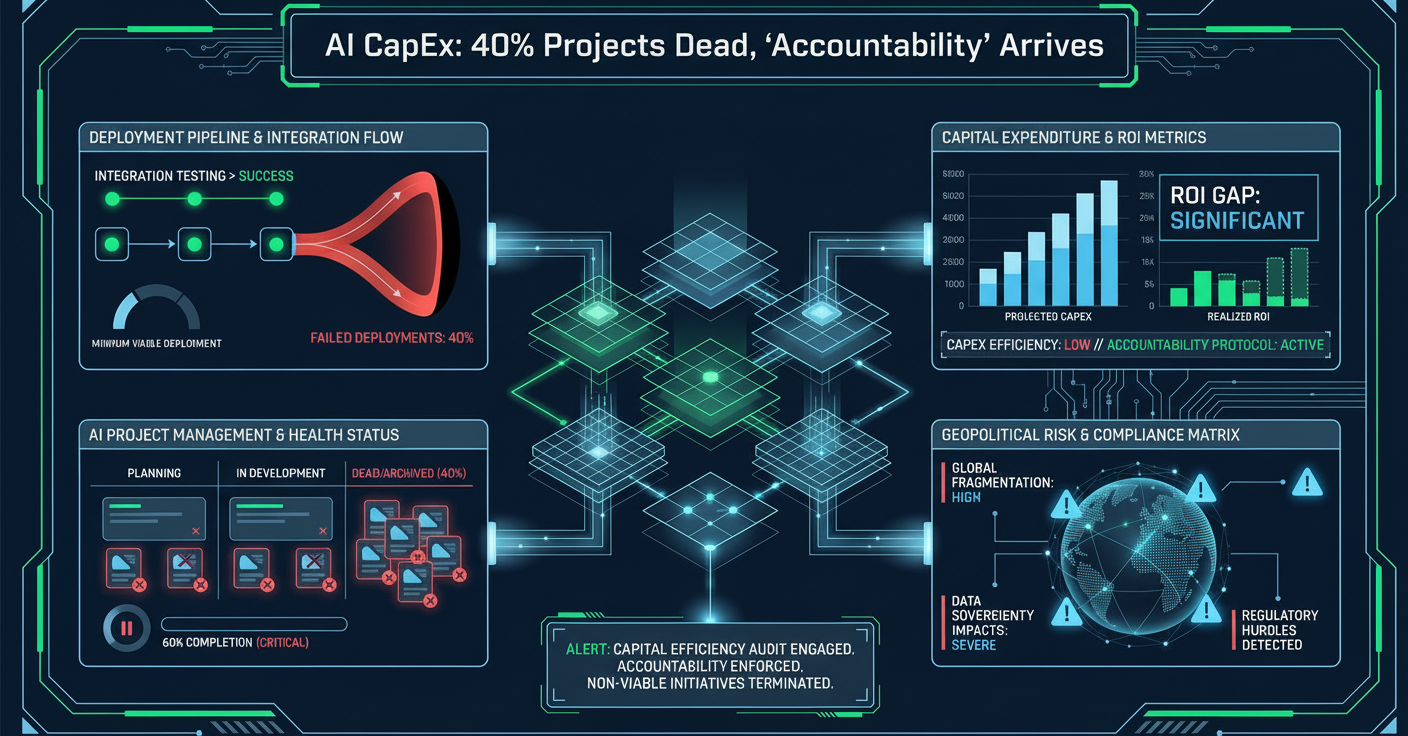
AI's Hidden CapEx Trap for Hyperscalers is Spreading
The Signal: The market is now clearly differentiating between announced AI CapEx and actual revenue/earnings conversion. While the S&P 500 appears stable, beneath the surface, AI is driving significant sector rotations for software stocks, even causing some hyperscalers' valuations to re-rate negatively. What was once seen as a pure growth play is now a highly scrutinized investment. This is extending beyond direct AI plays and is impacting adjacent tech sectors.
The Deployment Reality: CIOs and CTOs are under increasing pressure to justify AI investments with clear, near-term ROI. The market's patience for "build it and they will come" AI infrastructure spending is waning. This means any internal AI initiative, especially those requiring significant capital expenditure on compute or data centers, must have a clear path to monetization or cost-saving that can be tracked and reported. Otherwise, your internal AI projects could become a balance sheet liability, not an asset.
"No longer is it going to be one big group of stocks powering the index higher. You will see periods where some stocks are doing better or worse than others. And again, for us, it's really, how is CapEx translating into revenues and earnings for these companies?" — Ryan Hammond, Portfolio Strategist at Goldman Sachs Research
The Strategic Question: Are we rigorously stress-testing our AI CapEx against realistic revenue and earnings forecasts, or are we falling for the "AI buildout" narrative that the market is now punishing?
The Rundown
① IT Operations Needs a "Continuous Operations" Mindset for AI Agents. Early AI agent deployments are creating sprawl and significant management overhead without proper guardrails. Operators need a "continuous operations" framework to manage agents safely and efficiently, drawing parallels to continuous integration and delivery. (Gartner ThinkCast) • The Operator Take: Proactively building this operational pipeline is critical. Failing to do so makes IT a bottleneck, inviting shadow IT and losing departmental relevance. Don't wait for "fully autonomous" agents to arrive before sorting out governance here.
"If we don't change, I and O becomes the bottleneck. And if that happens, the business will find another way, whether that's through shadow IT or outsourcing or decentralization. And so in those cases, we don't just lose control, we lose relevance." — Autumn Stanish, Director Analyst at Gartner
② "AI Washing" is a Pressure Release Valve for Investor-Driven Headcount Cuts. Some companies are falsely claiming AI integration to justify headcount reductions and appease investors, even when the AI isn't genuinely effective in eliminating jobs. This is particularly noted in white-collar sectors. (This Week in Business) • The Operator Take: Be wary of internal or external pressures to attribute headcount reductions purely to AI. Assess your actual AI capabilities and ROI. Inflating AI's impact can lead to unrealistic expectations and undermine future genuine AI deployments. The cuts may be easier to make, but the work still needs covering.
③ US Sanctions are Inadvertently Crippling Local Businesses, Not Just Foreign Entities. US sanctions against Lukoil are harming American family-run gas stations operating under the brand, causing banking disruptions and customer boycotts. (This Week in Business) • The Operator Take: When assessing global supply chain or partnership risks, consider the "brand adjacent" geopolitical ripple effects. Small businesses with large brand associations are exposed to risks far beyond their direct operational control, creating potential customer and payment processing issues.
④ Boards Expect CEOs to be Radically Transparent, Especially During Crisis. Boards value CEOs who are honest and proactive in communicating difficult news, rather than sugarcoating or delaying. Trust is built through a "steady hand on the tiller" and managing all stakeholders effectively, not just providing good news. (BoardVision) • The Operator Take: Radical transparency builds trust. As a leader, your board wants the full picture, good or bad, early and often. Delaying bad news only removes confidence and partnership.
The Stack
This week's buy, build, and benchmark signals for your technology roadmap.
🟢 DEPLOYING • AI for Corporate Sustainability Reporting: Now used by over 60% of sustainability leaders for efficiency and measurable ROI. (C-Suite Perspectives) • AI-powered chatbots for citizen inquiries: Municipalities are implementing for automated responses and frequently asked questions for efficiency. (Clarity)
🟡 EVALUATING • Identic AI: Personalized AI companions that learn user values and act on their behalf, promising a shift of management focus from execution to strategy. (HBR IdeaCast) • Continuous Operations Framework for AI Agents: Critical for managing AI agents safely and efficiently to avoid sprawl and bottlenecks. (Gartner ThinkCast)
🔴 RECONSIDERING • Agentic AI Projects: Gartner predicts 40% of these projects will be canceled by 2027 due to cost overruns and unfulfilled promises. (Gartner ThinkCast) • Tariff money from IEEPA: Despite the Supreme Court striking down tariffs under, the former President can still reimpose them under other statutes. (The Indicator from Planet Money)
The Debate
Are Autonomous AI Agents Worth the Hype or Set for Disappointment?
🐂 The Bull Case: AI agents are evolving into "identic AI" — personalized companions that learn user values and act autonomously. This new phase promises to offload routine tasks, redefine organizational structures, and empower individuals with "godlike" capabilities, shifting management focus purely to strategy.
"The breakthrough is AI opportunity is still slightly ahead of us or slightly ahead of most of us, and that is the widespread introduction of AI companions that we'll have at our disposal at work and home that are trained by us, that know everything we know and that can take action on our behalf across a range of activities." — Allison Beard, Host at Harvard Business Review
🐻 The Bear Case: The hype around AI agents significantly outpaces reality. Only 15% are predicted to be fully autonomous in the next seven years. A staggering 40% of current agentic AI projects are expected to be cancelled by 2027 due to cost overruns and failure to deliver on promises, putting tremendous pressure on IT operations.
"Gartner predicts that only 15% of agents will be fully autonomous within the next seven years. And just like there's a spectrum of agent autonomy, there's also a spectrum of agent capability." — Autumn Stanish, Director Analyst at Gartner
The Operator's Read: While the long-term vision of truly autonomous and personalized AI agents is compelling, the immediate reality for most operators is one of constrained capability, significant operational overhead, and high project failure rates. Prioritize building robust "continuous operations" frameworks and focus on specific, measurable automation tasks over chasing the dream of entirely autonomous agents for the next 2-3 years.
The Bottom Line
The market has moved past "AI enthusiasm" to "AI accountability"—if your AI isn't delivering, it's a cost, not a capability.
🎯 Your Move
- Task your AI/ML team to... present a realistic 3-year ROI and CapEx plan for all current and proposed AI initiatives, specifically addressing how CapEx translates into actionable revenue or cost savings.
- Ask your Head of IT Operations... to draft a "Continuous Operations" plan for current and future AI agent deployments, focusing on governance, monitoring, and risk mitigation.
- Schedule a working session with your legal and compliance teams to... review how geopolitical risks, beyond direct sanctions, could impact your brand and local operations, as seen with the Lukoil franchisee situation.
What We Listened To
This Week in Business: "Why Hiring Has Slowed Without Mass Layoffs"
• Runtime: 12 min • Guests: Peter Cappelli (Professor of Management and Director of the Center for Human Resources, The Wharton School), Dan Loney (Host, The Wharton School) • For Operators: Essential listening for leaders navigating the current white-collar labor market. Understand the subtle forces, including "AI washing," that are slowing hiring without traditional mass layoffs.
"The cuts in white collar jobs are easier to make because you don't see the consequences immediately. If you cut a production worker and a frontline worker, you know, you don't have people to staff the restaurant... You cut a white collar job, people, at least for a little while, try to, to cover the work, right?" — Peter Cappelli, Professor of Management and Director of the Center for Human Resources at The Wharton School
This Week in Business: "How Geopolitics Is Hitting Local Gas Stations"
• Runtime: 13 min • Guests: Dan Loney (Host, The Wharton School), Serguei Netessine (Professor of Operations, Information and Decisions, The Wharton School) • For Operators: A crucial case study on how global geopolitics can have unexpected, detrimental impacts on local, franchised businesses, creating banking and reputational challenges.
"Today you have local operators running community businesses under a brand whose ownership is a geopolitical flashpoint." — Serguei Netessine, Professor of Operations, Information and Decisions at The Wharton School
The Better Boards Podcast Series: "The Spirit of the Code: Making Comply or Explain Work in Practice | Kelvin Ernest, Senior Policy Associate, Financial Reporting Council"
• Runtime: 15 min • Guests: Dr Sabine Dembkowski (Host, The Better Boards Podcast Series), Kelvin Ernest (Senior Policy Associate, Financial Reporting Council) • For Operators: Valuable insights into how governance principles, like "Comply or Explain," can foster strategic decision-making and accountability, moving beyond mere procedural compliance.
"The biggest takeaway for boards is that it encourages them to think carefully about how each provision fits into their own individual contexts." — Kelvin Ernest, Senior Policy Associate at Financial Reporting Council
Freakonomics Radio: "All You Need Is Nudge (Update)"
• Runtime: 57 min • Guests: Richard Thaler (Professor of Economics, University of Chicago), Freakonomics Radio + Stitcher (Host, Freakonomics Radio + Stitcher) • For Operators: An excellent masterclass on behavioral economics, providing frameworks (like "choice architecture" and combating "sludge") to improve decision-making and drive desired outcomes across an organization.
"If you want to encourage some behavior, figure out why people aren’t doing it already, and eliminate the barriers that are standing in their way." — Richard Thaler, Professor of Economics at the University of Chicago
Gartner ThinkCast: "IT Operations Are Not Ready for AI Agents: How to Respond Today"
• Runtime: 23 min • Guests: Autumn Stanish (Director Analyst, Gartner), Paul Delory (VP Analyst, Gartner), Karen Stokes Lockhart (Host, Gartner) • For Operators: Critical guidance for CIOs and IT leaders on managing the hype vs. reality of AI agents, emphasizing the need for "continuous operations" to prevent IT from becoming an AI bottleneck.
"Right now, AI agents are at the very peak of hype. But I mean, there's always new, hyped up technologies. And as always, we still have to keep the lights on and do our day jobs. None of that goes away just because we're focused on the shiny new thing." — Paul Delory, VP Analyst at Gartner
Exchanges: "The New AI Trades"
• Runtime: 16 min • Guests: Ryan Hammond (Portfolio Strategist, Goldman Sachs Research) • For Operators: Provides a strategic perspective on how AI is disrupting equity markets and driving sector rotations. CTOs and CEOs should listen to understand how the market is scrutinizing AI investments based on CapEx to earnings conversion.
"AI disruption risk is really the common thread throughout a lot of these industries selling off in recent weeks." — Ryan Hammond, Portfolio Strategist at Goldman Sachs Research
Clarity: "How can governments protect citizen data in the age of AI?"
• Runtime: 27 min • Guests: Zach Warren (Legal Insights and Strategy Lead, Thomson Reuters Institute), Teneé Frazier (Senior Specialist Legal Editor, Government Practice, Thomson Reuters Practical Law) • For Operators: Highlights best practices and challenges in AI governance, data privacy, and security in the public sector. Relevant for any enterprise deploying AI tools for customer service or internal efficiencies.
"The first line of defense is always going to be your users and your employees. Training and education is key." — Teneé Frazier, Senior Specialist Legal Editor, Government Practice at Thomson Reuters Practical Law
BoardVision: "What Boards Really Want from the CEO"
• Runtime: 23 min • Guests: Mallory Bucher (Director of Governance Content, NACD), Wayne Peacock (Vice Chair, former CEO of USAA, Elizabeth Dole Foundation), Dona Young (Director, USAA, NACD, Spahn & Rose) • For Operators: Essential listening for executives on how to build and maintain trust with their board through transparency, humility, and clear communication, especially during crises.
"Having the courage as the CEO to bring forward the news, whatever the news might be, goes a long way to establishing a level of trust that the board knows they can count on you to tell it to them straight, no matter what's happening." — Wayne Peacock, Vice Chair, Elizabeth Dole Foundation; former CEO of USAA
C-Suite Perspectives: "How AI Is Reshaping Corporate Sustainability"
• Runtime: 27 min • Guests: Steve Odland (Host, The Conference Board), Andrew Jones (Principal Researcher, The Conference Board's Governance and Sustainability Center), Dr. Andrew Jones (Scholar (assumed) and author of the report, The Conference Board) • For Operators: A dual-perspective on AI's environmental impact—both its footprint and its potential for positive change. Helps operators link AI investments to measurable sustainability ROI.
"The environmental issues have often been much lower in those discussions [AI oversight and governance] than perhaps some other big risk areas of AI. Right. Like bias and transparency and privacy and security and safety." — Dr. Andrew Jones, Scholar from The Conference Board
The Indicator from Planet Money: "Can I get my tariff money back now?"
• Runtime: 9 min • Guests: Darian Woods (Host, NPR), Adrian Ma (Host, NPR), Ted Murphy (Lawyer specializing in global trade, Sidley Austin), Daniel Harberger (Founder, Woof) • For Operators: A concise update on the Supreme Court's ruling on tariffs and its implications. Important for any business with international supply chains or exposure to trade policies.
"You've got to sort of transition pretty quickly into, okay, now what does this mean sort of in the real world?" — Ted Murphy, Lawyer specializing in global trade at Sidley Austin
HBR IdeaCast: "With Rise of Agents, We Are Entering the World of Identic AI"
• Runtime: 30 min • Guests: Don Tapscott (CEO and Author of , The Tapscott Group), Adi Ignatius (Host, Harvard Business Review), Allison Beard (Host, Harvard Business Review), Harvard Business Review (Host, Harvard Business Review) • For Operators: Explores the concept of "identic AI" and the future of personalized AI companions. Provides a strategic outlook on how AI might reshape management focus and necessitates individual sovereignty over AI agents.
"I want to control Digital Dawn. I want to control the extension of me. I want to own it, and I don't want some platform using it for their purposes rather than mine. So we each need to become aware of what's at stake here. And the question of sovereignty becomes the central issue of our time." — Don Tapscott, CEO and Author of \